Select to expand quotePhoenixStar said..
Bolt on keels are fine if you are prepared to draw the bolts every 5 or 6 years. There is not enough oxygen getting to the stainless steel to form the thin surface skin needed to stop pit corrosion. The expensive but permanent fix is to fit monel keel bolts with bronze nuts.
To elaborate a little more, the oxygen free environment is fine until it becomes a wet, stagnant, corrosive, oxygen free environment. Smiley keel joints and wet bilges are the start of keel bolt problems
Select to expand quotesirgallivant said..
Dear Sam. It's ok.
I think you aversion to bolt on keels are developed by bad press and misunderstanding of the facts.
I am not here to defend the concept of bolt on keels, l am simply trying to help you not to dismiss perfectly well built yachts on the bases of personal aversion to something perfectly good, proven and serviceable.
I own an Adams 28 with a bolt on keel of some 1600kg.
 I had two mishaps, one in Canaipa Passage and the second one when l tried to relocate Spectacle Island. Nothing happened, a scratch in the leading edge, that's all.
The cruisers, designed by a reputable designer are strong enough to suffer a lot of abuse while the modern designs with nothing in mind but performance or profit are the culprits of the bad press.
Most of the yachts hauled out and or stored, are standing on their keels and lots of them are bolt on keels. Most of them, in fact.
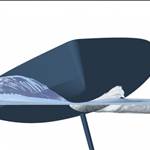
There is the shoal draught with daggerboard like this one, which is not a bolt on design,

The traditional 'English keel'
i know tybo quite well as im the one who has to fix the centerboard every time he does this
That Mason is nice, but what a sharp witted person is the broker putting in multiple pictures of the V berth, settee table, galley, nav station and none of the hull, rigging, deck, cockpit or God forbid the accommodation area, tender etc.
What a brilliant broker! 

I think I raised the issue of the keel attachment first. I wasn't intending to damn all boats with keel bolts, just ensure the quality and fitness for purpose.
A Bavaria 42 match I sailed on said clearly in the owners documentation that after any touching the bottom the boat needed to be hauled out and the keel and bolts inspected. Not good for extended cruising purposes.
Cheers
Bristol
As Bristle pointed out supporting my earlier observation, some modern production line yachts are designed with inherent weaknesses as far as cruising is concerned. Strength is sacrificed on the altar of ease of manufacture, lower production costs, higher profits or just vogue of the day.
Simple, in the past well adhered to principles are discarded trusting the modern, no doubt much stronger space age materials.
Which construction could one trust more just by looks and feel?
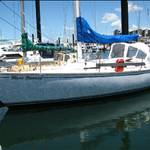
 This is my trusted Adams 28 with proven credentials, staggered keel bolts and a keel-skeg combination which is working well in all situations either dodging flotsam, crab pots or minor groundings as well as being overvhelmed by an occasional beam wave sliding sideways easily because of the construction of the hull.

This Bavaria 42, which must be inspected after the slightest grounding, would not stand up to any of the above mentioned torture tests with it's bottom-heavy narrow keel, most likely non staggered keel bolts, and balanced spade rudder. The odd conctruction of this type of keel would act as an anchor in any grounding however minor.
 This is the most likely occurrence in a minor grounding.
The bottom is sandy, the keel is shaped as it is, would survive with no apparent ill effect as long as the bottom is not rock or corall. Even then, it most probably would survive the ordeal.
 The survivability of a knock down is in many instances depends on the capability of the hull sliding sideways and so, releasing the huge lifting forces of the waves which are trying to lift the keel and tip the hull over the point of no return usually 135-140 degrees resulting in a roll over. A short stubby or full keel would make the hull slide sideways while a long bulbed one would act like an anchor and most likely tip the hull over.
The situation is similar in the case of a major grounding like hitting a reef. The shorter, stubbier keel is more likely to survive.

A keel like above (dehler 34) would not survive any mishap in case of a grounding bar a very minor one in soft grounds like mud and a knock down would develop forces at the keel bolts unheard of around the design table. Those modern keels would act as anchors in many situations mentioned above especially the forward pointed bulb keel which would catch and hang on to anything in it's way, soft or solid wrenching the keel out of it's socket.
The modern design might be fast efficient and cheap to manufacture but when the crap hits the fan they would most likely scatter in all directions.
My last boat was a 1974 S&S 35, ruder behind a full keel, 2.5cm solid glass construction. Sloop rigged, drew 1.6m and weighed 8.5ton.
My new boat is a 2004 Sayer37, fin keel with bulb, spade rudder, western red cedar, glassed both sides with kevlar in all slamming areas. Fractional rig, draws 2.1m and weighs 4.7ton.
They are about as far apart in design and construction as could be. I sailed about 5000nm in my old boat, the new one I have yet to sail. Time will tell.
One thing I don't get though is peoples aversion to using wood in the construction. If its totally glassed in on both sides surely its better than using foam core which has almost no structural strength at all. John Sayer the designer said the wood added about 300kgs to the hull but made a huge difference to the strength, stiffness and vibration absorption.
Here is the build of a very similar boat to mine, 40ft instead of 37ft.
sayerdesign.com/photo-gallery/
Whatever construction you look at has good and bad points, but a boat that won,t sail well will disappoint you every time you go out. I like multis and for them foam or cedar composite , but there is still plenty of good well built plywood and epoxy boats which is what I have at the moment. Timber if sealed in epoxy doesn't have a lot of things going wrong with it.
Freeradical, both, the Bavaria and the Dehlers are marketed as 'cruiser-racers' whatever that suppose to mean?
Of course, there is nothing wrong with timber in boat building just the modern world's attitude is different.
Old is out, modern is in.
It has a lot to do with relentless advertising and brainwashing.
What was wrong with hemp until DuPont - the largest artificial material producer in the world - decided, hemp is the bane of humanity and banned it all around the world using false reasons.
Dexport, good on ya, you looking forward to some exciting times!

What do you think about the bullet proof Adams 35 with all the bells and whistles I think Steel 6 ton yacht with all the cruising stuff that required is a good yacht for a single hander any larger you will need a few crew.

Thanks for all the input. I already have a French cruiser racer and for what I do with it the boat is fantastic. Our family of 4 can very happily cruise for 3-4 weeks at a time throughout the Gulf's of SA and Kangaroo island which has been brilliant. However while our current boat is in great condition, the family is getting larger and our plans are getting more ambitious with further afield sailing in mind, hence the need to change boats.
My thoughts are for a construction method that does not risk water ingress into cavities. I have previously owned foam cored race boats and when I bought it I drilled a hole into the foam at the lowest point and drained the water our which took a number of days, then there was a recoring process that I definitely do not want to repeat. Hence my original post about the qualities of wood cored boats eg: fibreglass carvel or glass over kauri stripped. I am not keen on steel but would consider aluminium but they are mostly too expensive (Onvi drool...). Main criteria are skeg hung rudder, after that I am flexible with different keel configurations, although I am not a fan of a full keel due to the lack of manoeuvrability.
Thanks also for people throwing options of boats for sale. We have put that Warwick onto our short list and while I have seen that Mason before while browsing and I think she is beautiful and very well equipped.
I agree that there could be better photos of Inez, the Mason 44 that Boty and dralyagmas have commented on favourably.
I'm very happy to put them in direct touch with the owner for more details and better pictures. He is pretty motivated at present as in a shed somewhere in Tassie, construction of his new yacht progresses apace .

Select to expand quotesirgallivant said..
Perhaps if you read the specs sheet it would answer those questions. There is a plethora of data about HE's on the net.
By the way, there is nothing wrong with bolt on keels as long as they were designed and built properly.
Absolutley.
There is a really nice Constellation Brewer 44 listed on yachthub. Lots of recent updates. Great sea boat for under 130k.
Most likely the price is a factor but has anybody considered a Radford yacht? Graham is continuing the great Joe Adams tradition of designing very sailable yachts.
Great cruisers, aluminium hull or steel or GRP. There are a few of them around.
Tony Bull posted this link on Facebook. Worth a read.
www.yachtingmonthly.com/yacht-reviews/understand-boat-statistics-30154
Select to expand quoteboty said..
dont worry there are plenty of slow fin keelers probably more than fast ones
I think you will have to expand on that boty!! 
I have only owned fin keelers and never been disappointed on pointing ability or speed on or off the wind.
There are many factors involved. When Naut Yachts bought the rights of the Mottle 33 from George, they consulted with Joe who told them the keel was in the wrong place.
Just another BOUI (bit of useless information). I just invented a new text short cut. 
A boui used to be what you scraped out of your nostril with your index finger nail.
Select to expand quotecisco said..boty said..
dont worry there are plenty of slow fin keelers probably more than fast ones
I think you will have to expand on that boty!!
I have only owned fin keelers and never been disappointed on pointing ability or speed on or off the wind.
There are many factors involved. When Naut Yachts bought the rights of the Mottle 33 from George, they consulted with Joe who told them the keel was in the wrong place.
Just another BOUI (bit of useless information). I just invented a new text short cut.
A boui used to be what you scraped out of your nostril with your index finger nail.
as a guy who races a 37 foot 9 ton boat drawing 4 foot 10 inches with a 36 foot mast (a slow boat) i can assure you i have a lot of supposedly fast production fin keelers finish astern of me, i would like to think its because i am a brilliant sailor but i think the reality is that production boats are aimed at internal space not sailing performance
Purely from the serious cruisers point of view the ORC type boats were not built for cruising and were cantankerous beast in need of large crews to keep them tamed.
Designs like Lars Bergstrom's and Lavaranos's amongst others - who were constantly pushing the envelope with their designs amongst them their offshore cruisers - have been taken up by the French and eventually developed into our modern IRC and BOC racing boats.
Lightly built hulls, vertical bows, full warterlines, balanced spade rudders, fancy deep keels, high aspect ratio rigs, laminated or carbon fibre sails are hardly a requirement for a serious cruising yacht in corall infested cruising grounds. Serious cruising, not a hop to the next Marina few miles away, l mean.
Lots of design features of those racers have been taken up by the designers of the 'racer-cruiser' which is an oddity. Like motorbikes, guns or cars for all occasions. Neither fowl nor fish, full of compromises, production line-built for profit and to satisfy the unsuspecting, ignorant and technically uneducated public's dreams of owning a yacht for all occasions!
This doesn't mean they are un-sailable, far from it, they are cruised on and raced frequently at SAGS and WAGS and all other events. They are a bit of everything or they claim, but not excelling in any fields except a few which has been designed and built as racers rather.
Unfortunately, the rest of those yachts though motored a lot, seldom sailed well and spend their miserable life's as gin palaces at popular marinas. They could be pontoons for entertainment as well, or they rot on their moorings forgotten and unloved.
Specialised yachts like Shaggy's are wonderful racing machines while a Mason, Island Packet or Halberg Rassy, Bluewater 420CC or 420RS (which are built at Cardiff NSW presently) are cruisers built for one purpose not to claim other qualities.
Nothing wrong with a performance cruiser in my opinion. Why not be able to enjoy a bit of both worlds by staying in the middle? If you're coastal cruising or hopping fair weather on short passages, do you really need a "Bluewater" cruiser?
If you're not a serious racer, but enjoy a day out racing for the fun of it with family and friends, do you need a complex race boat with an open dunny?
If socialising/chilling in a marina or nearby quiet bay, swimming off the back of the boat with the kids, is your kind of thing, what's wrong with modern production cruisers built to an affordable price? Does it really matter if you motored over to your favourite bay?
Our boat is at the the cruiser end of the racer-cruiser spectrum and gets lots of use, short cruising, regular social racing, a day out with the kids swimming and fishing less than 1/2nm from the marina. It's probably the most used of all the yachts in the marina.
What's ignorant is when racers deign you as inferior for racing that cruiser, or when cruisers pick your boat to bits as not being up to the task of anything and should never leave the harbour.