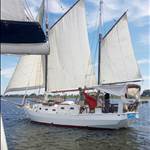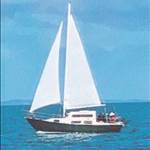
Our boat is sort of a trailerable yacht, an Aquarius 23. Has a shoal draft keel with 400 kg ballast plus a steel plate centreboard. All up weight about 1.8 tonne. Any 22 foot sailboat would have to be easier to drive through the water. But our old girl has a high top cabin, so she's comfortable inside, and is dead stable because of all the ballast.
I'm a bit wary of mentioning brands I've actually used because that IS starting to sound commercial. Let's just say the actual brushless motor is made by an Electric Motor Power manufacturer in Melbourne. Nice people who listened to me when I told them what needed improving. The trolling motor came with a highly objectionable weedless propeller, so I ended up trying about 6 different brands of propellers until I found one (Haswing model 150702801, $50) that was nearly perfect. It needed to be bored out slightly to fit the shaft on the trolling motor and I had to shave the sacrificial anode ring on the motor, to stop the propeller rubbing. Also needed a longer pin for the shaft, but I now have 50 so just ask. But the end result was 30% less amperage at the same boat speed, so well worth doing.
I'd love to buy a big enough 3D printer to print my own 11 1/2 inch propeller, but that'll have to wait. There are some nutcases in NZ (on Youtube) that have a 3D printed a polycarbonate propeller that worked fine on a 25 HP petrol outboard, so making one for an electric outboard seems feasible.
The tiller linkage made the whole package a dream to use in terms of manoeuvrability.
Ok. I mentioned the Delkor batteries because I had one as a house battery, and it wasn't til after I bought the lithium batteries that I found out what I had. That was a real DOH! moment, sigh. Mind you the lithium batteries are a lot lighter and the price has come down enough that I'd be tempted to buy them anyway. Lithium batteries do have one other major benefit, and that is that their useable amp hour output is 10-15% higher than an equivalent lead acid battery.
The solar setup ended up being more, and less complicated than I intended. The original plan was to have 2 separate power systems, 12V for the lights, electronic equipment etc, and 24 V for the outboard. But when the new solar panels arrived, I found I didn't have room for all 3 solar panels.
I ended up with 2 big panels in parallel feeding the 12V system, and I used a smart 12V to 24V charger from the UK (turns on at 13.1V, off at 12.8) that uses the excess power to charge the lithium batteries.
The 160W of panel charge the house battery first, and when it's full they charge the 24V batteries.
That actually kept things reasonably simple, and separate.
I found a high amperage waterproof plug and socket, made a custom mounting plate for it at the back of the cockpit, and put the batteries under the cockpit (lot's of room) with decent sized cables. The 24V batteries take 2-3 days to charge from nearly flat so I's say it's a success.
I'll upload some pictures if you're interested, but a lot of it was ideas I got from other people, it just needed putting together

You could probably get away with the crappy (sorry) weedless prop but if you don't mind doing a bit of extra work, the better prop is absolutely worth the effort.
That's probably more answer than you wanted, but the quick answer is that the costing iis reasonably accurate, though I spent a lot more getting there.