Select to expand quote
Kankama said..
The engineering is done and dusted. The forces involved in cats and tris are pretty easy to cater for if you don't skim the weight too much. Racers may sometimes be a problem but considering that tris and cats can race around the world in 50 or so days and do constant 30 knots for a week proves that a tri is a fine concept, even for a well engineered racer. For a cruiser it should be no problem. I can pin my cat fore and aft on one hull and then jack the stern or bow of the other. I get about 1-2m cm of deflection. I used to do this all the time when building her. Good multis don't break up, even half bad ones don't, just like a nice mono. Tris don't load beams heavily so the stresses stay low enough so that fatigue cycling increases logarithmically. You can always jack the floats and take the stands away from the main hull. It is done all the time to paint the bottom.
Consider the forces on a keel joint or a chainplate. There are huge cycling loads on these parts. Just build them well and there is no problem. Of course it is good that we like our boats, but it does help to sail a nice pedigree boat of a type to get a real feel for the type.
Team Phillips was a problem from the start. She had super long cantilever bows and very few boats have ever had such bows. A cat designer wrote about his misgivings before she sailed as he could make the bows deflect at the dock. She had thin hulls, and no forebeam, which allowed the bows to do their own thing. She was innovative but an evolutionary dead end.
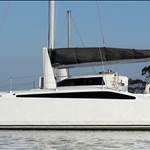
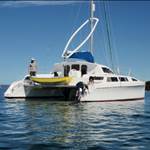
I do have some concerns about the Rapido for family cruising. Cruising a tri can be a pain in a beam sea if the windward float bashes hard on the approaching swell. The way to get around this is to lift the float up high, dihedral, have very veed floats or just push the boat all the time. Racers adopt the latter approach and it is a pain for a cruiser. The Rapido has pretty flat floats and they are not too high. She could bang hard, in a beam sea, and at anchor. Another issue is drying out. A cat is great for drying out, we spent 10 days twice in Percy lagoon and a week in Hill inlet thrice, drying out each low. In the olden days in the tri, we would lean over a lot until I made a crutch, a cat just sits flat. Then there is the kids. A cat has the kids at your eye level when sailing, playing in the cabin. The tri has them with less space, much less floor area and down low. A cat is great for keeping an eye on kids. Our kids had the starboard hull to themselves if they weren't in the cabin. Once, my brother was with us and we were 1000 m off Byron in a westerly, we were doing 12-14 knots and smoking and the boys were making card houses. My brother came up and said "Card houses, at 14 knots?" Flat as a tack and a lovely reach. Cats are great for kids.
Have a sail on a good multi if you haven't had one. Get down the RPAYC and grab a sail if you can. A nice one is awfully fun to sail, as is a nice S and S or Ross or Farr or Alden or metre boat. They are no better or worse, just different, with differences that may suit you or not. Mine suits me to a tee and I love her still after 21 years. And no, no structural issues and she was built by a total amateur.
G'day Kankama,
I agree Team Philips was a stretch too far, you only have to look at the forrard sections of the hulls to know that unless they had re-invented composites that was optimistic to put it nicely.
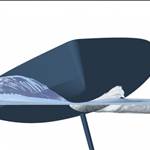
On a sidenote, can you explain the benefits behind the wishbone rig? I kinda get the concept but I've never fully understood it. Its obviously scale-able to maxi size (Team Phillips is a wishbone per mast) so I'm surprised you don't see more of it.
Cheers,
SB