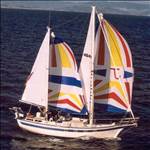
Sorry BOTY, that's not true according to history. The Js did not occur at the inception of the challenge - they came along in 1930, almost 80 years after the Cup was created. The first Cup boats were seaworthy offshore racer/cruisers.
Secondly, the Js were actually conservative in many ways. They were created under the Universal Rule rating system, which was created by Nat Herreshoff to kill off the radical scow-like fin keelers that had developed under the L x SA rules. The Js had to be built heavily following Lloyds rules, and after one challenge they were changed again so they had to carry full accommodation and have heavier masts. So compared to the preceding classes, the Js were very heavily restricted and in some ways old fashioned.
The J class owners and designers noted that they actually followed the smaller boats in development, rather than leading it. For example, Starling Burgess and Vanderbilt took ideas from the smaller M Class and applied them to Js. Uffa Fox and others noted that the smaller boats like 6 Metres led the way in the change from triple headsails to one genoa; Uffa specifically noted that the smaller boats would always lead the way because experiments were less risky and cheaper.
The same thing happens all the time with the AC. Cats were racing in the 1880s, but didn't make it into the Cup for 100 years. There were bermudan rigs in the 1890s, but they only made it to the Cup around 1930. The 12s were heavy boats made of alloy when ocean racing maxis like Condor II were lightweight foam-sandwich structures. Mylar sails were used in Stars, Solos and other boats years before they were used in the AC. Planing hulls were used in small boats a century before they made it to the AC (if they ever really did) and in offshore maxis 20 years before they were used in the AC. Modern spinnakers arrived in the AC years after they were used in small boats. Same with wing masts, assymetrics, bendy spars, wingsails, etc etc etc.
Some people point to Australia II as an advance, but before she was even thought of the French were racing the Atlantic on giant foiling trimarans with wingmasts. They were not only vastly faster than the heavy tin 12 Metres, but vastly more modern. The IOR boats of the same time were light displacement Farrs and the like, much more modern than A2. The AC has almost never led the way.

Edit - here's another example of a boat that was far in advance of the AC - Outlook from around 1900. She was about 50ft long and so light that she had cloth decking in some areas, all kept together with a girder running along the deck. She was far lighter and more radical than the Js of four decades later.

Or finally, compare 1965's radical ocean racer (Infidel/Ragtime) compared to the 1966 America's Cup winner. The fin-keel offshore maxi (top) was much more radical and the same length, but only 1/3 as heavy.