Back in mid eighties I polished the hull of my boat prior to southern eighty ski race.
Used a good car polish.
the boat at full speed only had a flat surface of 9" wide by about 50cm long in contact with water. Outboard leg was only submerged two thirds prop dia depth.
diffence in speed over a marked kilometre with stop watch was 2 knots. 67 up to 69.
two skiers in tow
Some of the stuff I read... says drag reduction of up to 26% using super hydrophobic coatings as the water never actually touches the hull..... or it touches less of the hull / foil 
Hey guys,
The answer to this is Yes and No.
In my sailing days, I used to use a hydrophobic compound on my dinghy hull (think Rain-X). It made a difference when trying to get the hull to break free from the grip of the water and on to the plane. I could get planing a couple of knots boat speed lower than my competitors and therefore exploit the advantage. It does work.
For foiling, I think it would work in the opposite way. Generally, due to the high and low pressure surfaces of the mast and wings, you have a different set of problems if using a hydrophobic copound. We sand the mast and wings to create a rough texture to make the water "stick to the surface". This prevents ventilation.
The race guys will have a cow if you even touch their wings or mast due to the fear of sunscreen on the fingers which will create a hydrophobic barrier on the surface which leads to ventilation. The wings come glossy but usually get sanded. Front third of the wing/mast with 1200 wet and dry and 400 for the back 2/3rds. The rougher texture creates a better bond with the water. Water on water friction is less than water of solid polished surface.
Many off shore race yachts have a textured finish on the hull to create that boundary layer of water to promote the water on water friction.
Don't put hydrophobic coatings on your foils!!
DM 
Maybe the advantages ,if any at the speeds we are at, is at the surface tension interface.
foiling is about getting that board away from the water surface and away from the surface tension layer.
Select to expand quoteActionSportsWA said..
Hey guys,
The answer to this is Yes and No.
In my sailing days, I used to use a hydrophobic compound on my dinghy hull (think Rain-X). It made a difference when trying to get the hull to break free from the grip of the water and on to the plane. I could get planing a couple of knots boat speed lower than my competitors and therefore exploit the advantage. It does work.
For foiling, I think it would work in the opposite way. Generally, due to the high and low pressure surfaces of the mast and wings, you have a different set of problems if using a hydrophobic copound. We sand the mast and wings to create a rough texture to make the water "stick to the surface". This prevents ventilation.
The race guys will have a cow if you even touch their wings or mast due to the fear of sunscreen on the fingers which will create a hydrophobic barrier on the surface which leads to ventilation. The wings come glossy but usually get sanded. Front third of the wing/mast with 1200 wet and dry and 400 for the back 2/3rds. The rougher texture creates a better bond with the water. Water on water friction is less than water of solid polished surface.
Many off shore race yachts have a textured finish on the hull to create that boundary layer of water to promote the water on water friction.
Don't put hydrophobic coatings on your foils!!
DM
Most of the academics don't agree that its beneficial, yet all testing says otherwise.....
You still have a water / water boundary, the drag is just reduced because more air is retained.... like putting rainex on the windshield, water runs freely, vs no rainex = stuck. The coating creates a rough layer
I'll tell you how it goes
Polishing ones skills and fitness workers even better.
Sadly I have some bad habits which I enjoy.
So the polish is yet to arrive, I hit 28.5kts after sanding the front and rear foils with 1500, and cleaning the mast and fuselage...the mast is Ali so not too keen to sand it.
Select to expand quotedachopper said..
So the polish is yet to arrive, I hit 28.5kts after sanding the front and rear foils with 1500, and cleaning the mast and fuselage...the mast is Ali so not too keen to sand it.
I am shaping a front foil wing I'm making out of pine wood. Which leaves me wondering what the best option is after sanding. The wing is strong enough stiffness wise. Would I still need to fiber glass it which is the traditional way to seal the wood (not willing to buy carbon). Or could I get away with sanding the wood up to 1200 and putting some sort of coding on it like laquer to seal up the wood, Has anyone done this before?
I do not know much about hydrophobic copound/paint.
For your foils to achieve the desired "attached flow" you wont get any attachment after @ 600 grit finish depending on the water temp and salinity. Warmer water needs a rougher finish than cooler water. @400 is the best option for achieving max control for foil surfaces.
racers will use different finish for front and back halves of the wings.
Getting above 600 the water cannot grip the wing so you are closer the the hydrophobic scenario.
At minimum removing a gloss finish is advisable.
For a quick easy finish for the wooden wings use sun-cure resin, wont take too long to build up a hard layer than you can sand to the desired finish. Let it sit and become even before exposing then you wont alter your hard earned wing shape.
Back in early 80's Slalom water skis came with a satin texture finish that was supposed to help acceleration as you crossed wake. So helping to get to next Slalom buoy in time.
yet the Masters division guys and those pushing the world records, sanded their skis as smooth as possible to overcome the drag they felt with std finish.
go figure
Select to expand quotebenmj said..
For your foils to achieve the desired "attached flow" you wont get any attachment after @ 600 grit finish depending on the water temp and salinity. Warmer water needs a rougher finish than cooler water. @400 is the best option for achieving max control for foil surfaces.
racers will use different finish for front and back halves of the wings.
Getting above 600 the water cannot grip the wing so you are closer the the hydrophobic scenario.
At minimum removing a gloss finish is advisable.
For a quick easy finish for the wooden wings use sun-cure resin, wont take too long to build up a hard layer than you can sand to the desired finish. Let it sit and become even before exposing then you wont alter your hard earned wing shape.
I'm thinking there must be a difference between the best mast finish and best foil finish, because mast is at the air / water transition, and the foils which are completely submerged. I read an RC race boat article , and they used 200 gritt to help planning hull release the water. Hydrophobic compound tested in that scenario was slower ( dragier )...... but these boats are probably trying to encourage an air boundary layer.
Select to expand quotebenmj said..
For your foils to achieve the desired "attached flow" you wont get any attachment after @ 600 grit finish depending on the water temp and salinity. Warmer water needs a rougher finish than cooler water. @400 is the best option for achieving max control for foil surfaces.
racers will use different finish for front and back halves of the wings.
Getting above 600 the water cannot grip the wing so you are closer the the hydrophobic scenario.
At minimum removing a gloss finish is advisable.
For a quick easy finish for the wooden wings use sun-cure resin, wont take too long to build up a hard layer than you can sand to the desired finish. Let it sit and become even before exposing then you wont alter your hard earned wing shape.
Benmj, where did you buy the sun cure polyester resin. I'm in Canada and can't seem to find any except a large container on Amazon for over $200 cad. I don't need very much resin. I like the fact it can dry in the sun or cloud in a few minutes without having to mix hardener onto it.
Hi mate google the brand Solarez you should find a stock in your area , you can get kits in all sizes
Select to expand quotebenmj said..
Hi mate google the brand Solarez you should find a stock in your area , you can get kits in all sizes
Thanks benmj found that solarez stuff looks good. But wouldn't a marine spar varnish do the same thing? I'm not too worried about cheaping out as I want it to last.
I like the idea of getting a thin layer to seal up the wood. But still haven't decided weather to polish or sand to 600 grit. This may not matter at the end of the day as I already know it will not be the fastest wing (Which wasn't the goal anyway). It will hopefully be stable with its longish chord length and wide span providing early lift.
I finally found some research explaining sort of why sanding is faster
You are creating a superhydrophobic barrier. They found that 240 Gritt sand paper was the most effective, under their slow speed test conditions, and gave maximum drag reductions, but commented that any larger grit paper and the water would be able to fill the cavity rather than sit on the air in it........ hence i guess under higher speed foiling conditions, 320 / 400 gritt would be needed to do the same thing. as pressure is higher.
Maybe someone with some engineering brains can explain why a standard superhydrophobic paint could not achieve the same thing ?
www.ecs.umass.edu/mie/faculty/rothstein/pub_files/ExpFluids2014v55p1783.pdf
Then I found this chart on an RC forum where they are talking about sanding or polishing - no idea where it came from
but sounds like its for displacement hulls.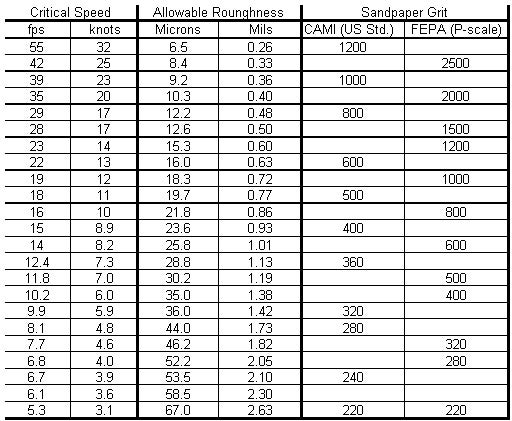
Select to expand quotedachopper said..
I finally found some research explaining sort of why sanding is faster
You are creating a superhydrophobic barrier. They found that 240 Gritt sand paper was the most effective, under their slow speed test conditions, and gave maximum drag reductions, but commented that any larger grit paper and the water would be able to fill the cavity rather than sit on the air in it........ hence i guess under higher speed foiling conditions, 320 / 400 gritt would be needed to do the same thing. as pressure is higher.
Maybe someone with some engineering brains can explain why a standard superhydrophobic paint could not achieve the same thing ?
www.ecs.umass.edu/mie/faculty/rothstein/pub_files/ExpFluids2014v55p1783.pdf
Then I found this chart on an RC forum where they are talking about sanding or polishing - no idea where it came from
but sounds like its for displacement hulls.
Wow , great read and thanks for finding that dachopper!
Sorry I'm not a "engineering brain"...so no idea why superhydrophobic paint is not as good.
The maximum pressure drop was also found when they sanded in the direction of flow.
So I should be using something in between 320 and 400 on my wing. I don't disagree with your sandpaper grit #s but is that considering both the article and rc chart. Looks like the rs chart for 320 to 400 grit the speed is 5.9 to 8.9 knots...is that rather slow. I guess it also depends on wind speed in our case. Could not find the speed they were testing in. The chart in the article was showing mm/s for speed when comparing speed to pressure drop. How slow a speed we they testing( 50 mm/s is less then 1 knot ).
).
Select to expand quoteCAN17 said..dachopper said..
I finally found some research explaining sort of why sanding is faster
You are creating a superhydrophobic barrier. They found that 240 Gritt sand paper was the most effective, under their slow speed test conditions, and gave maximum drag reductions, but commented that any larger grit paper and the water would be able to fill the cavity rather than sit on the air in it........ hence i guess under higher speed foiling conditions, 320 / 400 gritt would be needed to do the same thing. as pressure is higher.
Maybe someone with some engineering brains can explain why a standard superhydrophobic paint could not achieve the same thing ?
www.ecs.umass.edu/mie/faculty/rothstein/pub_files/ExpFluids2014v55p1783.pdf
Then I found this chart on an RC forum where they are talking about sanding or polishing - no idea where it came from
but sounds like its for displacement hulls.
Wow, great read and thanks for finding that dachopper!
Sorry I'm not a "engineering brain"...so no idea why superhydrophobic paint is not as good.
The maximum pressure drop was also found when they sanded in the direction of flow.
So I should be using something in between 320 and 400 on my wing. I don't disagree with your sandpaper grit #s but is that considering both the article and rc chart. Looks like the rs chart for 320 to 400 grit the speed is 5.9 to 8.9 knots...is that rather slow. I guess it also depends on wind speed in our case. Could not find the speed they were testing in. The chart in the article was showing mm/s for speed when comparing speed to pressure drop. How slow a speed we they testing( 50 mm/s is less then 1 knot).
Take the actual matching of the chart numbers ( speed / gritt ) with a grain of salt. The only thing that worth taking out of it - is confirmation that the notion of the faster you plan on going, the smaller the Gritt that should be used...... + as foils are concerned..... On the foil in the area's of highest static pressure at target speed - you should use a higher gritt number, than the areas of lower static pressure ( lower gritt ) and as is pointed out, sand in the direction of the flow.
If you get the gritt number s wrong.... too high or low, simply means that the foil will be more efficient at a lower or higher speed since the gritt is reducing drag based on speed / (pressure really )
Their test chart was stupidly slow - but proves superhydophobicity reduces drag a lot.
The RC boats are fully planing at those speeds - so their hulls are basically just tiny relatively flat wedges in the water........ not really comparable to foil or masts.
Simple way to test - pre - sand 800 rear 1000+ front on your foil, and carry some 400 gritt on you, do some target upwind or max speed runs, then just sand the back 1/3 with 400 and either you will or won't notice any difference :)
I did 28.5kts on an aluminium mast ( best run was 26kts prior ) , after sanding the foils 1500 front / 600 rear...... I've now sanded the mast itself, and changed the foils to 1500 / 400 but havn't tested it out yet.
There is a big difference between trying to achieve low friction or flow. For example boat hull low friction. The wings on your foil need attached flow. So with foiling in most cases the flow is the most desirable, usually at the lower numbers of sanding. Super important when racing as you are pushing hard on the wings upwind, trying to go high and fast. Less so for big wing foiling where it may even be faster to reduce the drag because the wing is bigger than you need.
I have sanded with 60 grit on the belt sander for shaping then did a bit with 120, 240 and 400 at this point, how crucial is sandpaper size spacing between grits. It is a bigger wing , ie more for stability and lighter winds. 80cm tip to tip and a 17.5cm chord length at its widest point, it's boxer looking and doesn't have a lot of body thickness. I think I maybe should have sanded a bit more with the lower #s sandpaper as there is the odd little divit. Im pretty happy with how the front edge turned out and how even it is, I sanded 2/3 the way down on the front edge and 1/3 up on the bottom edge to form the front edge point.
For this size wing then would it be better to keep going up to 1000 grit as dachopper said to.
And benmj said,
"So with foiling in most cases the flow is the most desirable, usually at the lower numbers of sanding. Super important when racing as you are pushing hard on the wings upwind, trying to go high and fast. Less so for big wing foiling where it may even be faster to reduce the drag because the wing is bigger than you need"
This will be used for windfoiling not that it should matter. Looking at my production np wing it is pretty smooth, not so smooth your finger slides right over it easily though.


Select to expand quotebenmj said..
There is a big difference between trying to achieve low friction or flow. For example boat hull low friction. The wings on your foil need attached flow. So with foiling in most cases the flow is the most desirable, usually at the lower numbers of sanding. Super important when racing as you are pushing hard on the wings upwind, trying to go high and fast. Less so for big wing foiling where it may even be faster to reduce the drag because the wing is bigger than you need.
I don't think that there is a difference - they say if you don't have laminar flow ...... you will experience increased drag....
Might the attached flow be a byproduct of less friction ?
Wow lots of work gone into that , good on ya
I would put the solar resin on for sure and fair it out starting with @ 120 down to @ 400 grit
I think the connection looks a little sus, where the wing meets the fuse recon a plate or something and some carbon might be the go.
Hope she goes well
Select to expand quotebenmj said..
Wow lots of work gone into that , good on ya
I would put the solar resin on for sure and fair it out starting with @ 120 down to @ 400 grit
I think the connection looks a little sus, where the wing meets the fuse recon a plate or something and some carbon might be the go.
Hope she goes well
So 400 grit would be ok with the solar resin on top, no sanding after solar resins on?
The joint where the fuse connects angles down at the back where the Back screw mounts. Zoom up on first pic you can kinda see it. It's like that on the pryde wing except for the side walls( which helps line up the fuse in my case). Yah I think something to make that part harder might help since it is aluminum( fuse) on softish wood where I chiseled it out. I also need to figure out how to reases the bolts on the bottom of the wing. Was thinking of using a spade bit but it needs to taper smaller as you go in.
So, is it fair to say the for those of us who are just cruising around, 400 or 600 in the direction of flow is the simplest good enough take-home from all this?
I Recon its the best thing you could do no matter which brand or design you are on