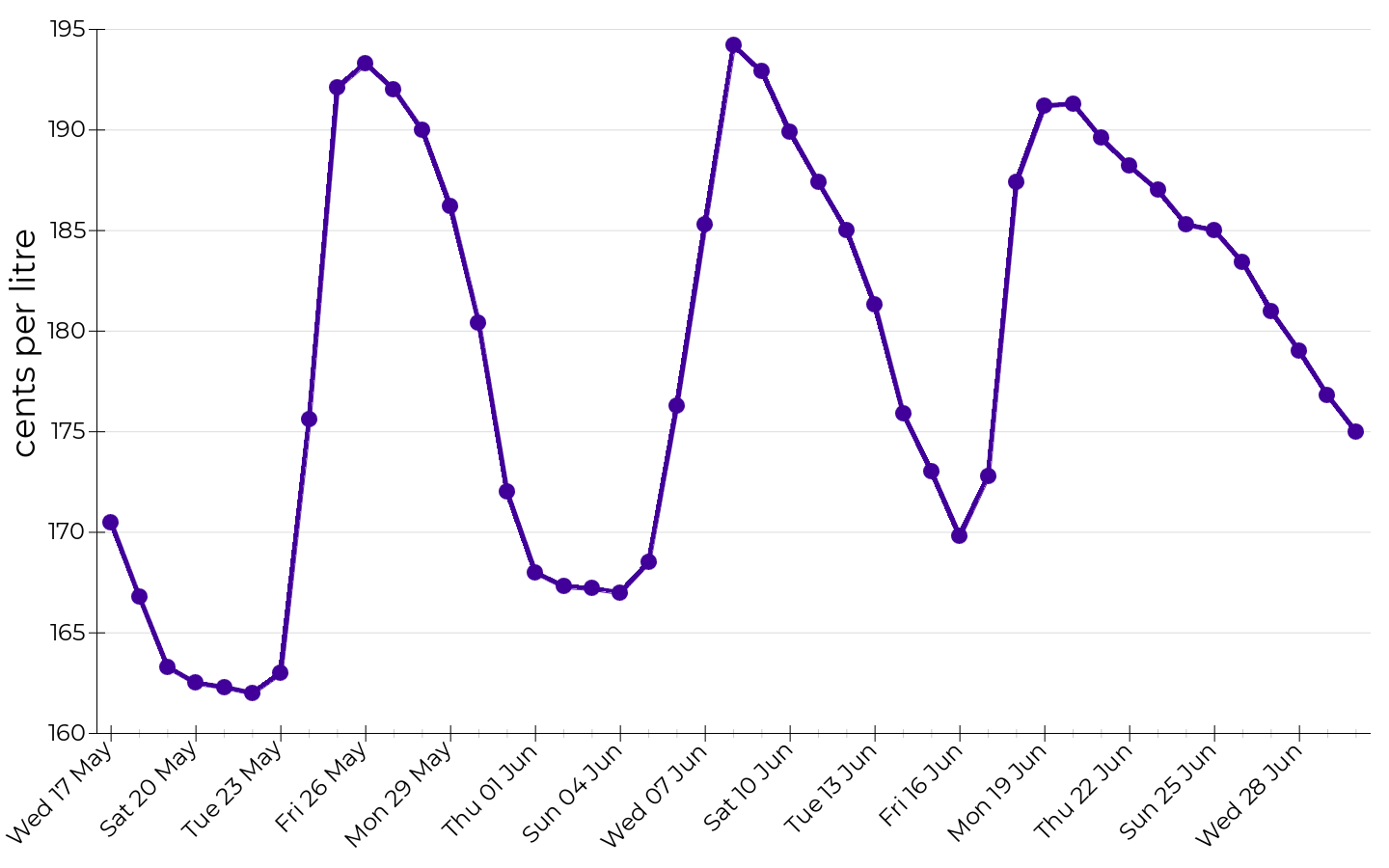
OK; think I have figured it out a priori. The changes that you see in pricing are entirely at the retail level; wholesale prices only change in line with input prices, exchanges rates and so on.
Essentially the retailer attempts to practice price discrimination, that is to sell at as low a price as necessary to price-conscious consumers, as well as making the maximum possible margin on consumers who are not sensitive to price. This is done by varying prices such that at some point in the cycle they are low enough to attract the price-conscious consumers. These customers are patient and/ or knowledgeable enough to buy only at the low point, and by discounting on certain days, the retailer does not lose the opportunity to sell to these customers. Even though prices are high most of the time, most of these customers are not lost.
Customers who are not price-conscious, on the other hand, will buy randomly. At times they will benefit accidentally from the low prices on offer at the base of the cycle, but on average they will pay a higher price than would otherwise be the case if the fluctuating price model were not in use. In this way profits are maximised in a competitive environment. ACCC are OK with this because there is no cartel operating and because all consumers have the opportunity to buy at the bottom of the price cycle if they educate themselves. At the bottom of the cycle consumers benefit from genuine competition. Hence the efforts of governments to promote this via "Fuelwatch" and so on.
If the retailer simply left prices at a steady level, they would neither capture the business of price-conscious consumers, nor maximise profits from customers who are not price-conscious.
I must admit I never look at the price before I buy fuel (but I don't drive that much), so I fall into the second category, or at least I did!