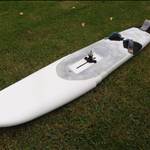
With the first batch of fins on their way across Australia to their new owners and more to follow soon, I thought it would be good to have a FF Community page where our collective experiences and knowledge should be able to benefit all. I would really like this project to be open source. I will provide the 3D CAD files to anyone who is interest on the basis it is personal use only. ( not for commercial exploitation please).
I would love to see; a gallery of finished fins, a Q&A because I am certain there are sailors out there who have far more metal working know-how than I do. Tips and Tricks to get the job done faster, Get out jail tips for when you stuff it up - I have a few of those already ;-) , better ways to seal the hollow and finally finishes: polish, anodised and paint.
I will start it off with FF used for wood splitting. This was a FF20 that I finished and then managed to drop on the concrete garage directly on its tip...Solution, careful bending of the tip back to original shape ( it was looking a bit Free Willy) OR cut it off and make an FF18. Off with the tip and a quick polish and voila the "block splitter" was born

So don't leave me hanging here peeps, as you finish your FF or need some collective wisdom please post :-)
cheers
fangy
heres a tip on a fin repair,
cut out the corners of a milk bottle and cut into the shape of the leading edge and lay some double sided tape on the bottom of the fin
mix some resin and wait for it too soft gel and place on the fin making sure not to wet the tape
place the plastic on the tape an over the resin and work the resin to take the shape of the foil cavity, flip the fin over and you mite need to top up with resin , clean the fin up and put some tape over the repair wait for it to set and doo the other side
if you want to use rovings you will need to use a wheel over the plastic so you can move the rovings underneath and force out excess resin


Nice idea Keef - do you heat the plastic under some hot water make it easier to bend it to shape?
I use the 2lt bottles the corners are molded and quite solid and holds the shape ,its something you have to examine so you can cut it to get the rite shape , I would imagine you can use many sorts of plastic bottles because all you need is a small part of the round so it gives you the foil
also being glued on the resin cant run out
both fins are done with the tip build of 15mm & 20mm , I didn't take a pic of the fins before the repair but you can see the repair when held against the light, the most important tip on rebuilding fins is to never use sand paper to blend in the repair as you will scratch the original part of the fin, instead use a long Stanley blade as the blade is perfectly strait , use the original part of the fin as a guide and you will only scrape the repair and not the original fin
a good fin is between $200 & $300 so it is important to know how to repair it
also a tip for fangy , I would imagine if you can sand alloy you will eventually need to repair it (maybe  )
)

^ thanks Keef  To plagiarise a line from Ronny Chieng, compared to G10, the cast aluminium is 'harder than diamonds on viagra'.
I have yet to get any wear that requires repair, other than some re -sanding and polishing. ( the incident with the plank splitting required no attention at all) The same goes for all the crash test dummies that have been using the demo fins. For small defects in the casting I have used with Knead it (metal version). If anyone gets to the point of needing a tip repair I would be very interested in a good technique. My thought at this time, ( if it is indeed possible to damage the tip to the point it needs repair), I would be to simply cut off the damaged tip reshape and polish the tip and keep the fin as a higher lift, shallower water version. For example I have tested :a 28 cut down to 22, a 24 cut down to 20, and a 20 cut down to 18.
Anyhoo, With the first batch of DIY fins having found new homes across the nation, I thought I would put down a rough order of finishing;
I work on the box fitting first and clamp the foil part of the fin in the vice with cloth protection to stop the vice from marking/scratching.
I go hard with angle grinder and grinding/cut off discs to get rid of the excess and rough it out. Because the fillet takes some of the load, the fit of the base is not quite so critical as in normal fins.
Once the base is fitting in and the fillet is engaging the board surface, I start trimming the underside of the fillet to a flat/smooth finish. There is an excess of aluminium at the front of weed scoop to cope with board rocker. If your board is still has a nice and flat rocker in front of the box, you can grind the underside of the fillet to a flat edge and finish with a handfile. I leave a very very small amount of excess aluminium on the lip of the leading edge of the weed scoop to allow for fine tuning.
Check and check again the fillet is flush. Grind more off the box section if you need to get the fillet to sit flush. The box section is massively over engineered so it can handle a lot of further grinding.
Once I am happy with the fillet fit, I drill a pilot hole for the bolts with the fin in place in my board. I then go through normal drill and tap procedure.
Once that is done, I bolt the fin in tight and see if I can get dental floss under the weed scoop. I adjust the fillet accordingly. It should be tighter than a fish's arsehole. A very thin smear of window/bathroom silastic can be used as a 'washer' if you wish on the fillet fitting surface.
Next I prepare the topside of the fillet with flap sanders in my drill and start thining the outside edge of the fillet down to an edge, so that the junction between board and fillet is a smooth as possible. The aluminium is malleable so small gaps can be closed with by a few taps with a wooden mallet and dowel.
Then on to the foil itself,
Flap disc in the grinder to knock of the excess and then out comes my flat pad sander, and wet n dry sandpaper and then each step from 80 grit up to 1200. The first few grits take 80% of the time.
If I want to make it shiny, I use compound and sisal mop on the bench lathe and then soft cotton mops and polish.
Finally, I jam up the hollow with polystyrene packing foam to just shy of the surface and seal the hollow off with bathroom silastic.
Hopefully that's clear as mud. I will try and remember to take pics next time I am working of the fin to help clarify things further.
Select to expand quotefangman said..
Finally, I jam up the hollow with polystyrene packing foam to just shy of the surface and seal the hollow off with bathroom silastic.
As some tail rockers and boxes differ slightly, prior to applying the silastic to seal the foam filler, would/could it be practical to lay some pvc tap around the fin box of the board you intend to use it with. Once the silastic is applied to the fin, screw the fin into the box therefore creating a seal for the filler and also a pliable "gasket" between board and fin fillet molded specifically for the intended board being used?
Yep - I have done the same using a film of Glad Wrap on the board. I found I just needed to be careful not to over tighten the bolts and squish out all the silastic. Trim edge around the fillet with a sharp knife. Thin adhesive backed rubber tapes also work well.
I've done a fair bit of metal polishing and when my Fin arrives I will record the process so that it may help others doing theirs.
Here ya go Fangyfin 20cm.... This took me about 2 hours work (started after lunch today).
Roughed in to fit PB. Will tap thread, final polish and apply silicone gasket tomorrow.


Select to expand quoteStorm Ahead said..
Here ya go Fangyfin 20cm.... This took me about 2 hours work (started after lunch today).
Roughed in to fit PB. Will tap thread, final polish and apply silicone gasket tomorrow.
2hrs! that's so fast - I must be doing something wrong! What did you use to grind back the box section?
(PS your bench is a disgrace )
You should see the floor.... and my board bag!
Did 6 week metal workshop course when I was 18.
Cut back with angle grinder, then P60 and P180 disks on orbital sander.
Ok you asked for tips in metal working and polishing .
Get some marking blue coat fin each time you sand with different grits you will see when there is no blue you have sanded out the previous grit scratches.
This can save a lot of time as you dont unnecessarily keep sanding when you dont have to &also it stops you changing grits early so you still have a scratch thats there many finner grits later .
That said aluminum is soft &i imagine people over sanding.
You can use a pencil & get the same results but marking blue is better .
Its easier to see on aluminum.
I also recommend doing it by hand with a good file .
A couple of different grade files
Its a lot faster than you would think &it stops you going to deep you have more control .
I have hand filed swords out just as fast as grinding &i haven't had to throw them away as i ground to deep in one spot .
And they get polished buy hand to mirror finish.
Just go to 2000 grit &then metal sol on newspaper you will have a mirror finish.
Not that people want that I suppose.
But its when you go for mirror finish you see the previous scratches that haven't come out .
Some good tips there - I have some bearing blue somewhere in my shed too - God knows where though 
I am currently using and air driven pad sander and water with wet 'n dry paper which keeps the dust down.
Ok so it's becoming obvious that the guys who know what they are doing can knock out a fin way faster than I can! I really like the shaping in the cutout area on your fin Roger - really nice job mate
Yeah, That shaping in the cutout looks really nice. I left the 'meat' on mine and also added a silicone gasket. Not sure if that will effect the performance
M6 Hole tapped and ready to go.....
Select to expand quotedecrepit said..
And I was taught to use water on the file, it stops the alli clogging it.
Whether filing or sanding, the use of water also lubricates and actually lessens the cut made by the file or sanding disc. Same principal as how a skim board works.
Also done the 28 today. Took 1 hr 40 mins drilled and tapped and ready to go. Both are in a usable state but probably require a couple of hours finishing each.
I used a grinder with a sanding disc for 90% of the work and a file and coarse emery for the rest. Make sure you get the fin sitting in the box with no gap under it before taking metal out of the fillet to get the seamless transition from board to fin. On the 28 once I had done this a couple of inches of the edge of the fillet were already to a knife edge.
As using grinders is part of my job I had no problems with this method. If not competent with a grinder do it the long way with a file.
Spray a bit of crc on the file while using it to unclog it, wipe dry and continue, repeat as required. Also use crc when tapping the screw holes, gives a better cut than doing it dry.


Noice Swindy. Good tip about touching the base of the fillet, especially on the 28 with its looong base. Can't wait to see it in action.
Select to expand quotefangman said..
Ok so it's becoming obvious that the guys who know what they are doing can knock out a fin way faster than I can! I really like the shaping in the cutout area on your fin Roger - really nice job mate
Fangy, Maybe you should subcontract the fin finishing?
Select to expand quoteWindxtasy said..fangman said..
Ok so it's becoming obvious that the guys who know what they are doing can knock out a fin way faster than I can! I really like the shaping in the cutout area on your fin Roger - really nice job mate
Fangy, Maybe you should subcontract the fin finishing?
No Sue, its good therapy for him plus he's cheap. Oh, I mean much cheaper.
Select to expand quoteWindxtasy said..fangman said..
Ok so it's becoming obvious that the guys who know what they are doing can knock out a fin way faster than I can! I really like the shaping in the cutout area on your fin Roger - really nice job mate
Fangy, Maybe you should subcontract the fin finishing?
Absolutely Windxtasy! I tried a couple of local commercial premises - usual story: the number of fins was too small, the difficulty of setting up a tuttle and power box for them to use for fitting was too time consuming/expensive, and finalIy I am too fussy on the quality of finish/ maintaining the foil shape - it all meant that for the time being, I am doing the finishing. ( I was quoted between $90 -120 per hour plus GST with 3 hours expected to do the job to Basic Level ) My last exam is next week and after that I can pretty well go full time on the fins and I will pressgang my offspring into doing some the finer grades of finishing for me as well.
Select to expand quoteSwindy said..Windxtasy said..fangman said..
Ok so it's becoming obvious that the guys who know what they are doing can knock out a fin way faster than I can! I really like the shaping in the cutout area on your fin Roger - really nice job mate
Fangy, Maybe you should subcontract the fin finishing?
No Sue, its good therapy for him plus he's cheap. Oh, I mean much cheaper.
It must be said, as a rule I do prefer Hardie's on-water therapy techniques better. However, I think my neighbours are learning to love the sound of an angle grinder, so I will keep at it.
Not to worry fangy, I'm sure you'll get quicker with practice, TOG is the clue (time on grinder). But if you want a check of your technique I'm always available.
 Too right Mike, time is money. Have just put Ross on to a product that goes from 60 grit emery to this in about 10 minutes. I will let him rant about it.

I never get tired of a tool in my right hand, and having just this morning, replenished all my sandpaper stocks, I was pretty nonplussed to see the results Swindy got so easily. I am too much of a tight arse to go and buy them immediately, but they will be on my list when I am a little more solvent.
Found it here: in coarse / meduim / fine grades for both 100 and 125 mm grinders.
www.josco.com.au/product/brumby-100mm-course-poly-flap-disc/
www.josco.com.au/product/josco-125mm-coarse-poly-flap-disc/
Here they are. They take out all but the deepest scratches. I prefer using emery cloth than sandpaper on metal and 60 grit gets rid of most scratches pretty quick. These discs smoothe it down enough to start polishing in no time at all.