Howdy Troops,
In France and Canada there is a resurgence of the division 2 class of sailboards/windsurfers.
www.facebook.com/groups/OpenDiv2/
Where have all the Division two boards gone, If you have one or know of anyone who has one in the rafters or under the house please let ping me. Would be great to save some of this history.
Cheers
Belly
I have a mistral M1 division 2 board. It is carefully stored away ready to use when I have the time. I just have a few other projects on the go at the moment.
Clarence
i live in Canada, butt have NO access to Farcebook
can u give me the 411 on DIV II in Canada here ??
out of Toronto ?? or ??
My Lechner is in the rack, the old TC Win is near Forster in NSW, and as of an hour ago the custom has gone to a new home here in Canberra.
Wonderful boards!
I currently have 3 !! My first being a Mistral M1 from the mid 80's; a second one, a Davidson (Swedish design) that was used in competition until the purchase in 1989 of the Olympic Lechner A-390 board. It last saw use in around 1995 when the Mistral One Design replaced the Lechner as the Olympic sailboard. So 20 years has passed with it gathering dust in the garage & the centreboard gaskets crumbling away to mere dust. I did some googling over the years to find out if indeed new gaskets were obtainable, but without any luck. That is until just recently, when I found the new D2 website which allows one to ask questions.
In no time at all I received a response re my query on Lechner gaskets. Two very helpful people from Canada & France, namely Eric & Aymeric, have now enabled me to fit new original gaskets as of yesterday. I hope to go sailing on it this weekend. For all those saying D2's are too difficult to sail, you should try a Lechner one day. They are for me a much more stable D2 board than the earlier models due to I believe having more V shape in their hull than previous designs.
For interest the following links were supplied to me just the other day by Eric & Aymerichttps://www.facebook.com/groups/OpenDiv2/,
www.opendivision2.org.
Whats the idea behind them? What earlier planing or ..?
Were they harder to ride than usual boards.?
Hey Rob,
Since you have said almost everything about us....I leave entertaining our friends here 
Oh!...one thing guys..very important: 
We recently launched the International Association (ID2CA) with IWA of which we are full Class Member now!
We need Division 2 community to rally and join massively behind it.
Call your friends and take your memberships (see link below)
Among other news:
- We are invited at World RCB Championship in Sopot, PL, in June...1st official international starting lines for Div2s since......? Amazing.
- We will be at the Europeans in Cadiz, Spain, in September
This is just the beginning. ...I'm working at relaunching the Class in North America (Joe, I'm in Montreal) and at reorganizing races.
Next step is YOU guys in Australia or NZ...Or sooner if you get ready...So, start organizaing yourselves, clean your boards, train and sail
You can reach me either on Open Division FB page or through our website.
Cheers all
Good winds
See you soon
Éric
internationalwindsurfing.com/windsurfing_competion_0449v01.htm
Sue,
They have displacement hulls (i.e. round bottom instead of flat), hence they are very fast (faster than a traditional flat bottomed raceboard e.g. Starboard Phantom, Mistral Equipe) in non planning conditions. They obviously plane but are a bit of a handful and slower than a traditional flat bottomed raceboard off the wind.
Select to expand quoteJohn340 said..
Sue,
They have displacement hulls (i.e. round bottom instead of flat), hence they are very fast (faster than a traditional flat bottomed raceboard e.g. Starboard Phantom, Mistral Equipe) in non planning conditions. They obviously plane but are a bit of a handful and slower than a traditional flat bottomed raceboard off the wind.
So what's the theory /how come a displacement hull is quicker in in lightwinds?
Rob, good news regarding gaskets.
I replaced mine using pattern mylar and contact cement;

Select to expand quotesboardcrazy said..
John340 said..
Sue,
They have displacement hulls (i.e. round bottom instead of flat), hence they are very fast (faster than a traditional flat bottomed raceboard e.g. Starboard Phantom, Mistral Equipe) in non planning conditions. They obviously plane but are a bit of a handful and slower than a traditional flat bottomed raceboard off the wind.
So what's the theory /how come a displacement hull is quicker in in lightwinds?
Less wetted surface area for the same waterline length
"The theory behind planing vs. displacement hulls is that a planing hull is slower at low speeds but once it starts to plane at higher speeds, it lifts out of the water and reduces the wetted surface, lowering friction and allowing higher top speeds. In comparison, a displacement hull uses a long waterline and smooth water entry and exit to allow for less drag at low speeds. You can get a displacement hull on a plane but the top speed is limited by water wrapping around the rounded edges versus the flat bottom and hard edges of a planing hull that allow a clean release, more lift, less drag, and higher top speed" This quote came from an article comparing two types of SUP boards, and provides a quite simple rather than a very technical answer to the question posed. In the mid 80's when major open events were run with large prize purses, ie; Peter Jackson events, it was lengthened D2's (often called darts) that won outright. They were perhaps another 0.5m - 0.7m longer so providing a longer waterline length, therefore being faster again, particularly sailing upwind. The sailors may have had a few problems turning them off the straight & narrow but their sheer speed won out in the end. Memory recalls Lachlan G, Bruce W & Ric M sailing them in NSW.
They were actually only after than planing race boards in a very narrow wind range of 'sub planning' strength.
But since the rule with racing was, that whenever a race is scheduled; "there shalt not be any planing wind", they tended to win a lot of races.
They were absolute sh**s of things to ride though unless you were a complete masochist! So unless there was a race to be won, no normal person would want to ride one.
Hence, the design concept all but disappeared......
they disappeared because they were too fast.
they were banned from the Peter Jacksons and future races, the rules said no div ll's, funboards only.
smart guys duct taped twigs to the nose of their boards making them longer than what the regs defined as a div ll, others turned up with darts.
Select to expand quoteJohn340 said..sboardcrazy said..
John340 said..
Sue,
They have displacement hulls (i.e. round bottom instead of flat), hence they are very fast (faster than a traditional flat bottomed raceboard e.g. Starboard Phantom, Mistral Equipe) in non planning conditions. They obviously plane but are a bit of a handful and slower than a traditional flat bottomed raceboard off the wind.
So what's the theory /how come a displacement hull is quicker in in lightwinds?
Less wetted surface area for the same waterline length
I venture an answer based on Newton’s 3rd law. This law says « When one body exerts a force on a second body, the second body simultaneously exerts a force equal in magnitude (and opposite in direction ) on the first body ».
Here the two bodies are the water mass and the board . Under the force of the wind, the board tends to move laterally against the water, but the water in turn exerts a lateral force ( lateral resistance) of the same magnitude in the opposite lateral direction. These two equal but opposite forces combine in the forward motion, since in this direction the resistance of the water is lowest. A curved displacement hull, unlike a flat bottomed hull, is partially sunken in the water : by BITING more, as it were, on the water, it encounters MORE lateral resistance, less wind power is lost in lateral drifting and the total force of the wind is conserved for forward motion. This is why old longboards could move around with much smaller sails !
On a flat bottomed hull, on the other hand, lateral resistance is less because the hull tends to skim over the water and some of the wind power is expended in lateral drifting, imperceptible though it may be. This is why larger sails are needed, as well as longer fins and centerboards are needed to increase lateral resistance, especially for upwind sailing.
In more practical ( and mundane !) terms, when you squeeze a soap with your hand you have two opposite forces : the palm of the hand pushing against one side of the soap bar in one direction and the fingers wrapping the soap across the palm pushing in the opposite direction, with the same force. The result : the soap shoots off your hand and is projected forward. Hope this answers your question Francone
Planing raceboards were faster when they first came out (e.g. F2 Lightnings) because of footstraps, sliding mast tracks, and larger fully battened mylar sails. These things all allowed them to brute-force their way out of the inherent inefficiency of the hull shape relative to the Div 2 shape. Div 2 technology was never really developed in that direction (barring the last-gasp Lechners), so I don't think we know how fast they might have become.
The other thing to remember is that at the time a standard race course (the classic Olympic triangle-sausage-triangle-windward finish) emphasised upwind performance, and Div 2's were magic upwind. Even dinghy courses now are much more focussed on the downwind.
Oh, and Francone - nice try, but raceboard shapes have *way* more lateral resistance than Div 2 hulls. Every successful raceboard ever made goes upwind on a hard chine that runs most of the length of the board, which is how they can get away with relatively poor centreboards (to generalize a little).
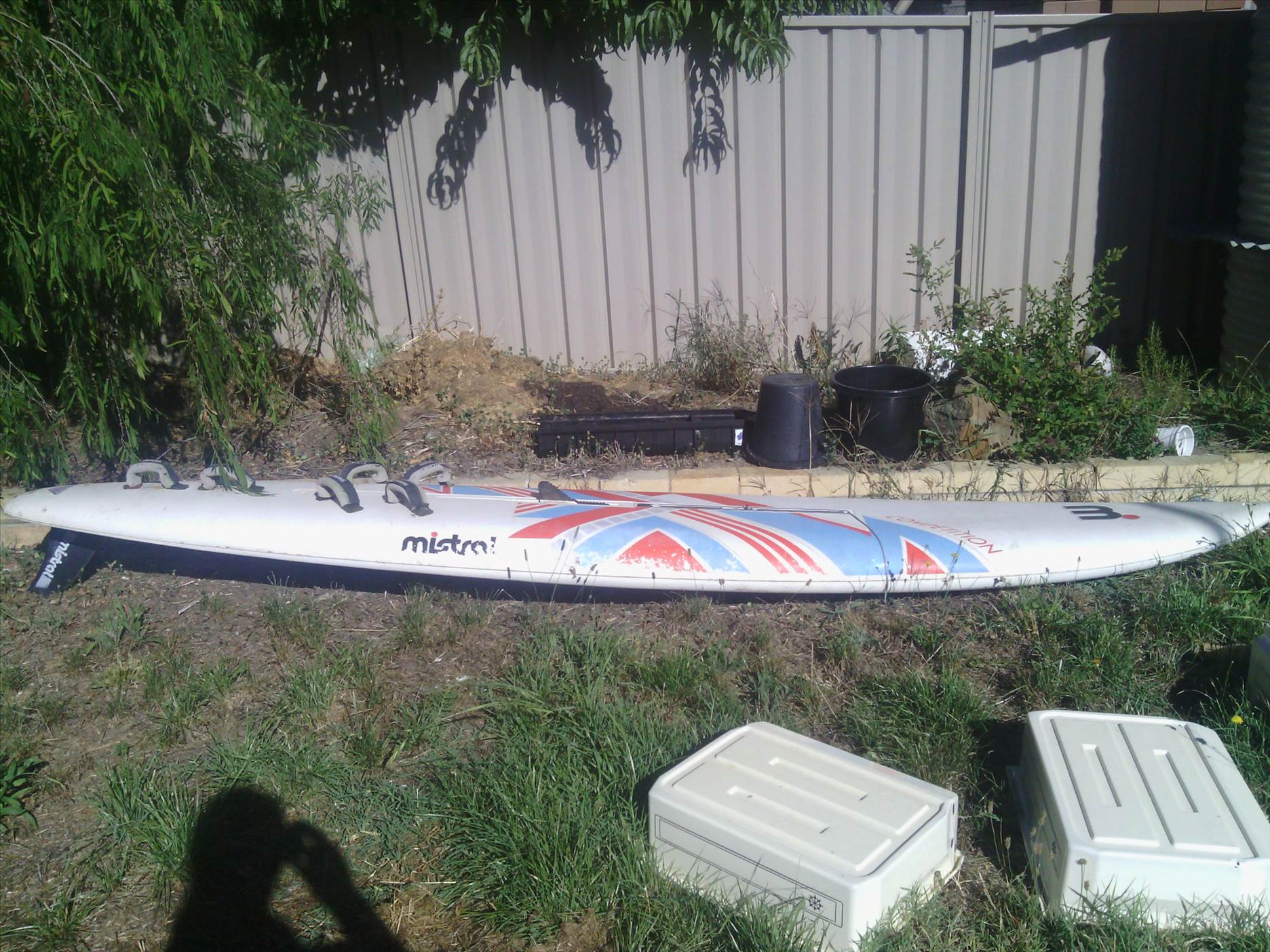
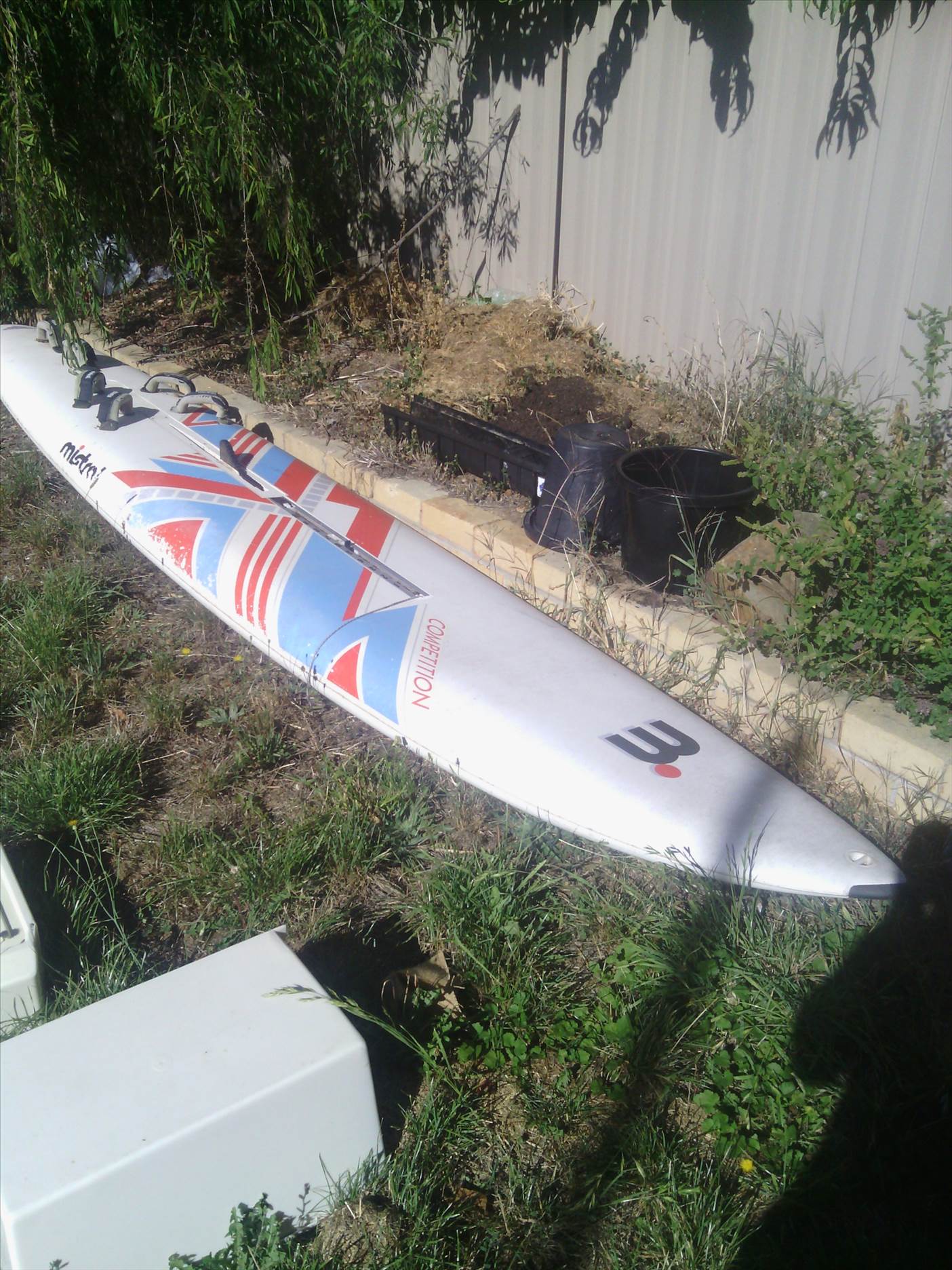
I have this board. I know it's a Mistral xD ...that's all.
Does anyone know anything about it?
It has quite a flat tail so i expect it planes quite well but it is quite long and rounded at the front so sub-planing should be good too.
NOT a DIV II (obviously)
Mistral as marked
Model Competition as marked
i just recently purchased a Mistral COMP SST
and have started collecting data:
joewindsurfer.blogspot.com/2015/03/mistral-competition-sst.html
i have not had mine on the water yet - STILL ice n snow
hopefully enough for me to get out ONE MORE TIME with my ice sailboard
I have two Lechners in the shed (actually at the club), one was used at the Barcelona Olympics and the other one at the Sth Korean(?) Olympics. They are a little bit different - the "Spanish" one has its mast track & centreboard a little bit aft compared to the "Korean" one. I haven't sailed them for a year or so , but I remember them being a joy to sail upwind in less than 12 knots of wind - they certainly point higher and go faster than a raceboard with the same size sail. Downwind they are a bit of a handful - a real test of balance! In windier conditions the fun continues - they are surprisingly fast(ish) and really highlight board handling skill deficiencies! No carve gybing here!
I reckon there is a "purity" to sailing them - where you place your feet , body position etc seems to be much more critical than on a raceboard. It is a case a really feeling what is going on with the sail and board in tandem. Note that I've only raced the Lechner at the local club, never in a "serious" regatta.
Reading this thread has inspired me to do that "bit of maintenance" on the boards and get them out on the water.
Hey Doug, we should get the Lechners out at the next raceboard regatta!
Doug,
What is the board on ground, next to the Mistral? Likely a D2 but can't see.
Obviously the one on top, that is up side down, is a Lechner..isn't it?
hey Eric, i was going to ask you !
we think it is a local board.
the underside is not too different to a M1 but it has a curved deck.
i once had a local copy of a DB2 but this one does not have the chines, i wonder if it is a copy of an earlier DB.
Chris above kindly gave it to me, it needs a few repairs.
Glen; yes re. dragging out the Lechners.
i recently sailed mine with the 9.5RB, the bigger sail was a bit awkward for what seemed like not much gain.
i think i would stick with the original LC7.3.
would be interesting to hear what others have found using big sails.....
Hi Doug,
The underside Board:
Should it be a Jaguar Mach I or II? They have the same bow than a Lechner A390...can someone check closer?
Big sails:
We have a quite good experience now using big sails on D2s...
Conclusion is that:
- It works in light winds, obviously, especially for heavy weights (many in our generation weight above 90kg)
- However, most of these sails are very heavy in comparison to a classical 7.5
- Difficult to pull back from water
- More costly: you need another mast and another wish.
Finally, consensus seems to be heading toward either new 7.5 sails (Aerolite Sails has started to make new ones for DII...Lefebvre is thinkg about it)
or
using 8.5 sail, same gear than a 7.5...no need for another mast or wish generally.
- lighter and better handling than a 9.5
Check the new Class Measurement Rules for DIIs (IWA website):
We allow up to 9.5 for men and 8.5 for Ladies for type C sails, Type A & B remaining the same.
(type C being a "lab"; we gonna continue testing sails and new boards for the next 2 years)
Cheers
Eric
Doug,
If not a Jag MachI/II...A Tiga Race? very hard to say from here
I can see the fin at the rear...remind me the one of A390
(what does "chines" stand for ?)
Cheers
Eric
Select to expand quotesailquik said..
They were actually only after than planing race boards in a very narrow wind range of 'sub planning' strength.
But since the rule with racing was, that whenever a race is scheduled; "there shalt not be any planing wind", they tended to win a lot of races.
They were absolute sh**s of things to ride though unless you were a complete masochist! So unless there was a race to be won, no normal person would want to ride one.
Hence, the design concept all but disappeared......
Woowh, I am surprised how your authority in that matter could effect outcome. Your post is green thumbed and I was covered totally in red , 
when I did say about this same on our local forum.
My post was in the context of bringing more youth to the sport.
Local clubs opt for this all wind sailing coffins and I did suggest new , quick, light sporty equipment as we all use.
BTW based on my own experience when youngsters managed to master short board in no time at all, but it took ages for me.