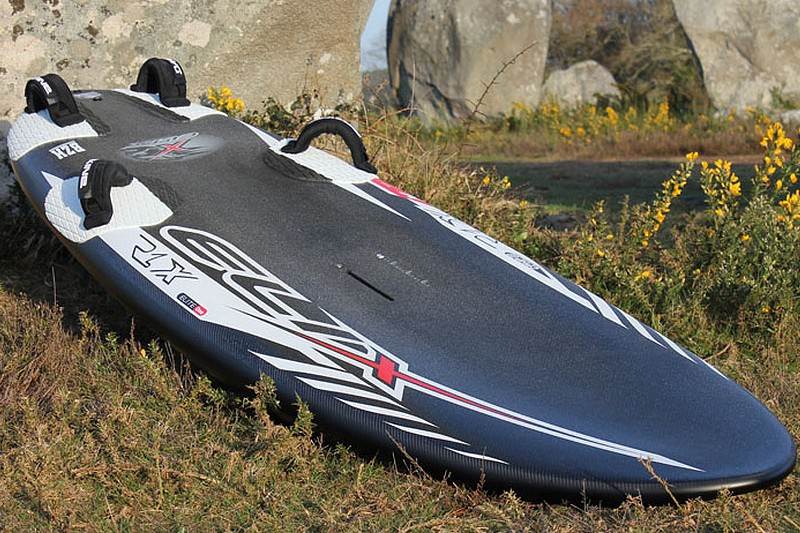
I have a 4 year old Freerace board that has gone soft between the front and back staps.This board is 77 wide and according to the advertising spiel light construction with a sanded finish,is this a problem because of the finish or the fact that a light weight board of this width is more likely to have this problem.I would gladly pay for a board that was a bit heavier built and was going to last a few more years than this[as a soon to be retiree] .The board itself is a dream to ride and for light wind days is fantastic but I am not happy about the durability of this particular board.Maybe I should be looking at a custom built board built here and requesting strengthening in this area.I have recently drilled about six holes in the area and injected resin in and it has done a good job and the board now feels firmer under foot,was a bit disconcerting going into a gybe and feeling my foot sinking into the deck.
Select to expand quotenbr said..
I have a 4 year old Freerace board that has gone soft between the front and back staps.This board is 77 wide and according to the advertising spiel light construction with a sanded finish,is this a problem because of the finish or the fact that a light weight board of this width is more likely to have this problem.I would gladly pay for a board that was a bit heavier built and was going to last a few more years than this[as a soon to be retiree] .The board itself is a dream to ride and for light wind days is fantastic but I am not happy about the durability of this particular board.Maybe I should be looking at a custom built board built here and requesting strengthening in this area.I have recently drilled about six holes in the area and injected resin in and it has done a good job and the board now feels firmer under foot,was a bit disconcerting going into a gybe and feeling my foot sinking into the deck.
Fanatic Ray by any chance?
Select to expand quotenbr said..
I would gladly pay for a board that was a bit heavier built and was going to last a few more years than this
Maybe I should be looking at a custom built board built here and requesting strengthening in this area.
i'm modifying a 2007 naish sp60, I haven't touched the deck but the bottom has a full layer of Kevlar over the core, then another layer of Kevlar and a layer of carbon over the pvc, I haven't ridden the slalom or bigger naish boards but if the bigger boards have the same layup as the sp60 they could be worth a try
nbr I hope you used a super slow hardner? Injecting resin is not a great way to go with delam repairs, can melt your core.
Back on topic - I am also dismayed at the lack of quality in many boards. Whilst repairing a board the other day it dawned on me that I reckon we reached top line construction about 2004 - 2006 ish with double sandwich and decent weight cloth used. You couldn't hurt them. A Starboard of that age, with carbon/kevlar and wood sandwich is HARD to ding with a hammer when you are trying to, and some current boards you can damage with it with your hand. And I'm not talking fragile race boards, I mean things marketed for wave and freestyle use!!!
Now to save 500g the standard of some boards is just a disgrace.
The (deliberate) light-on use of materials is fine if they are upfront about it but then if you add a defect like a little short of resin in an area, they just break too easily.
There is no way I'd ever buy a 'pro' or 'light' or 'team' etc nowadays.
Select to expand quoteMark _australia said..
nbr I hope you used a super slow hardner? Injecting resin is not a great way to go with delam repairs, can melt your core.
Back on topic - I am also dismayed at the lack of quality in many boards. Whilst repairing a board the other day it dawned on me that I reckon we reached top line construction about 2004 - 2006 ish with double sandwich and decent weight cloth used. You couldn't hurt them. A Starboard of that age, with carbon/kevlar and wood sandwich is HARD to ding with a hammer when you are trying to, and some current boards you can damage with it with your hand. And I'm not talking fragile race boards, I mean things marketed for wave and freestyle use!!!
Now to save 500g the standard of some boards is just a disgrace.
The (deliberate) light-on use of materials is fine if they are upfront about it but then if you add a defect like a little short of resin in an area, they just break too easily.
There is no way I'd ever buy a 'pro' or 'light' or 'team' etc nowadays.
Amen.
do you think for small soft spots (like 1-2 inches diam), would be acceptable to inject some sikaflex adhesive-sealer? would save from buying and mixing expensive foam...
In case of soft geck You should inject foam, but no resin.
Here you can find very good example how to fix this :
www.boardlady.com/softopbuckle.htm
www.boardlady.com/petersjp.htm
boardlady.com/softdeck.htm
Hi Mark yes I used slow cure hardner and yes I had a Mistral Naish 80 lt enduro and you would have a job denting it with a hammer but had a 2009 model which all the advertising mentioned carbon,hardened ,reinforced nose blaa blaa blaa and the nose of that opened up like a sharks mouth,the guy that repaired it said the cloth was cigarette paper thin.I think the specs on some of these new boards that the big companies insist Cobra build their boards to are just too fine or light.
Select to expand quotenbr said..
Hi Mark yes I used slow cure hardner and yes I had a Mistral Naish 80 lt enduro and you would have a job denting it with a hammer but had a 2009 model which all the advertising mentioned carbon,hardened ,reinforced nose blaa blaa blaa and the nose of that opened up like a sharks mouth,the guy that repaired it said the cloth was cigarette paper thin.I think the specs on some of these new boards that the big companies insist Cobra build their boards to are just too fine or light.
nbr,
Curious to know what board you were talking about in your original post, is it a secret?
Similar for me, had the last model of the Mistral Flow series, a 2002 V85 Custom Flow which I owned from new for about 10 years and got used/abused including dropping it on rocks, also never took the vent screw out. On the other hand, the 2009 Fanatic Hawk I owned got stored in the same shed as the Flow for a while and suffered a full nose-to-tail bottom delam. Upon further inspection (i.e. cutting a hole in the rail where a split had appeared), the glass cloth either side of the wood was pretty thin and the wood appeared to be around 1.5mm thick (no pvc). Steve Stratfold, one of the best board repairers in Perth, said that it was the lightest construction he had seen of any board from the Cobra factory!
Select to expand quotepowersloshin said..
do you think for small soft spots (like 1-2 inches diam), would be acceptable to inject some sikaflex adhesive-sealer? would save from buying and mixing expensive foam...
Seems a waste of a board (worth a few hundred $$$) when 2L of 2pack polyurethane high density foam is $35
Select to expand quoteMark _australia said..powersloshin said..
do you think for small soft spots (like 1-2 inches diam), would be acceptable to inject some sikaflex adhesive-sealer? would save from buying and mixing expensive foam...
Seems a waste of a board (worth a few hundred $$$) when 2L of 2pack polyurethane high density foam is $35
ok, will take the advise of the expert and look for the smallest pack. Thanks !
My last two boards (different brands) have had issues in this area. I've put it down to my gybing technique. Coming out of a gybe, my old front foot hits the deck hard right in front of the back straps.
Some delam repairs are easier than others -it depends which layers have come apart.
The first board had gone soft in the entire area between the straps. The carbon / divinycell had seperated from the core. There was no way I wanted to tackle this one and professionally repaired by a local guru. He removed the pads and laid two complete layers of carbon. It was a bullet proof repair.
The next board had a couple of small areas of the top layer of carbon separate from the divinycell (maybe 5-10 cm²), which was an easier fix. I drilled three holes through the outer layer, injected some epoxy, clamped it for 36 hours and it was solid. For safety, I laid up a couple of layers of glass in the area right in front of the back straps.
Just make sure you know where the issue lies in the sandwich construction.
Select to expand quotenbr said..
Gazman you got it first,a Fanatic Ray.
Pretty much the same wood sandwich construction as the 2009 Hawk I owned except the Ray had the light finish, i.e. unfinished look (still got the 2009 Fanatic brochure).
Heard of a number of Rays mentioned on Fanatic forum with same issue between straps. Also heard of some 2010 Tabou boards with same prob in same area (all built at Cobra factory). Maybe a quality control or design issue at Cobra factory across brands, possibly insufficient reinforcement specified around/under straps?
Ok, so who builds durable freeride/ freerace/slalom boards that last longer than the norm?
And what boards are not mass produced in the Cobra factory?
Select to expand quoteGazMan said..
And what boards are not mass produced in the Cobra factory?
AHD are made in Tunisia I believe. One of the few (except custom) not produced at the Cobra factory. Not sure though, if they are stronger.
Select to expand quoteGazMan said..
Ok, so who builds durable freeride/ freerace/slalom boards that last longer than the norm?
And what boards are not mass produced in the Cobra factory?
Off the top of my head, Carbon Art made in New Zealand, Thommen made in China I think, Mistral I think made in Vietnam, and some Australian board makers too. So there is a fair bit of choice out there.
I don't know how they compare to Cobra boards. I have two Tabou Rockets. The older one, a 2006 model I think is pretty tough. The newer one, a 2009 model I think is fairly fragile. I bought it cheap as it had a big crack in the deck between the footstraps and the nose was cracked. However the newer one has the lighter build.
Seeing as though this has come around a few times I'd like to hear from some manufacturer's or at least reps/distributors. We know they read here and some other forums they are active on.
Why have you gone backwards in board contruction? Why do you claim carbon / kevclar etc and we find it is a tissue thickness and only in selected areas? Why can't the Cobra boys wet ou the glass in all areas (and when they make a mistake you need to cover it not duck n dive and say the customer abused it)
The other day I cut up a F2 Style, about 2002 - 2005 ish model. Full double sandwich top and bottom, decent weight carbon/kevlar cloth and a bottom v-stringer made of CK. That was a hire board abused for many years and lasted much longer than most new boards now. About the same time, Starboard, Tabou and RRD at least did top notch builds like that.
Interesting the O.P is talking about Fanatic, I recently did a Fanatic T.E and the bottom glass / carbon was about the same as a surfboard. That is manifestly inadequate. Even worse it was a freestyle board (designed to be jumped) so god knows how they make a slalom or race board!
Select to expand quoteMark _australia said..
Seeing as though this has come around a few times I'd like to hear from some manufacturer's or at least reps/distributors. We know they read here and some other forums they are active on.
Why have you gone backwards in board contruction? Why do you claim carbon / kevclar etc and we find it is a tissue thickness and only in selected areas? Why can't the Cobra boys wet ou the glass in all areas (and when they make a mistake you need to cover it not duck n dive and say the customer abused it)
The other day I cut up a F2 Style, about 2002 - 2005 ish model. Full double sandwich top and bottom, decent weight carbon/kevlar cloth and a bottom v-stringer made of CK. That was a hire board abused for many years and lasted much longer than most new boards now. About the same time, Starboard, Tabou and RRD at least did top notch builds like that.
Interesting the O.P is talking about Fanatic, I recently did a Fanatic T.E and the bottom glass / carbon was about the same as a surfboard. That is manifestly inadequate. Even worse it was a freestyle board (designed to be jumped) so god knows how they make a slalom or race board!
Chatted to a guy on this forum (via email) who owns both a JP FSW as well as a Fanatic Freewave to find out more about the differences between the two. Interesting what he said about the boards, particularly re durability. Sure he won't mind me quoting him since no names mentioned:
I don't rate the construction of my 2010 FW though. It's not the weakest board, but it's not strong enough for the "wave" and "freestyle" parts of it's name. I haven't broke my FW board (yet), but I have repaired three mates FW boards who go hard on their boards - all 2010 models. I've repaired a soft deck, two nose jobs, and a cracked rail. The construction of my JP (even though it's a Pro edition) is far superior, and probably the best constructed board I have ever repaired (I repaired a suspected cracked nose 2 years ago. I discovered it didn't need repairing).
To quote the 2009 Fanatic brochure:
Custom Wood Sandwich Technology
'Using a lightweight yet robust wood and glass fibre construction gives a very high strength to weight ratio. In combination with the double pvc/wood sandwich, this is an extremely durable layup, the thick sandwich, wood and glass fibre absorbing high forces after even the hardest landings! Used on the NewWave, AllWave and Freewave.'
So who are they kidding?
Same for me Mark_aust, I would also like to know who is driving the push for lightweight, seemingly fragile boards, considering the relatively high prices that we, the consumers, are paying for supposedly 'high quality' composites. Sure, not every board is a 'lemon' that delams within 2-4 years of moderate use but if they are only designed to last for 'X' number of years then maybe the designers and/or manufacturers have got it wrong and may need to offer a generally stronger standard of construction that will last longer and be more durable (as Mark_aust says, much like the 'old' days around 8-10 years ago when the average board was built much stronger than the average board of today).
Select to expand quoteGazMan said..
I would like to know who is driving the push for lightweight, seemingly fragile boards, considering the relatively high prices that we, the consumers, are paying for supposedly high quality, mass produced composites. Sure, not every board is a 'lemon' that delams within 2-4 years of moderate use but if they are only designed to last for 'X' number of years then maybe the designers or manufacturers have got it wrong and need to offer a generally stronger standard of construction that will last longer and be more durable (much like the 'old' days around 10 years ago).
I think its the fact that people compare lightness of boards that makes the manufacturers try and reduce the weight to levels where they are not very durable. If someone who buys a new board only keeps it for a year or two, they will never realise that the construction is not that great. It's only the next owner, or maybe even the next that will notice.
Of course it doesn't hurt that it keeps people wanting to buy new boards if they don't last that long.
I have rebuilt some boards to make them more durable, and added extra inserts that aren't going to let in water, no matter what you do to them, but they add extra weight. Agreed, I haven't always used the best techniques, but these extra reinforcements add noticeable weight. I am sure a customer in a shop would notice the 1/2 kilo difference and pick the lighter board not realising that the heavier board might be the more durable.
Select to expand quoteMark _australia said..
Seeing as though this has come around a few times I'd like to hear from some manufacturer's or at least reps/distributors. We know they read here and some other forums they are active on.
Why have you gone backwards in board contruction? Why do you claim carbon / kevclar etc and we find it is a tissue thickness and only in selected areas? Why can't the Cobra boys wet ou the glass in all areas (and when they make a mistake you need to cover it not duck n dive and say the customer abused it)
The other day I cut up a F2 Style, about 2002 - 2005 ish model. Full double sandwich top and bottom, decent weight carbon/kevlar cloth and a bottom v-stringer made of CK. That was a hire board abused for many years and lasted much longer than most new boards now. About the same time, Starboard, Tabou and RRD at least did top notch builds like that.
Interesting the O.P is talking about Fanatic, I recently did a Fanatic T.E and the bottom glass / carbon was about the same as a surfboard. That is manifestly inadequate. Even worse it was a freestyle board (designed to be jumped) so god knows how they make a slalom or race board!
When I cut up my Mistral Flow, I noticed that they used double layers of divinycell. It seemed very durable. I think any other board I have modified has only had a single thicker layer of divinycell. I guess this saves a bit of weight, even though I am sure the double layer construction is much stronger.
Carbon by itself is pretty delicate under compression anyway, so probably not the best choice for board construction, at least when I use them.
Select to expand quoteMark _australia said..
Seeing as though this has come around a few times I'd like to hear from some manufacturer's or at least reps/distributors. We know they read here and some other forums they are active on.
Why have you gone backwards in board contruction? Why do you claim carbon / kevclar etc and we find it is a tissue thickness and only in selected areas? Why can't the Cobra boys wet ou the glass in all areas (and when they make a mistake you need to cover it not duck n dive and say the customer abused it)
Mark,
Your sentiments are spot on and (as you know) having experienced a severe structural failure of a brand new board and then having to deal with the manufacturer unsuccessfully and finally to the point where they privately accused me of damaging their brand (even though their own board developer on their international forum agreed that there was a deficiency in the construction lay up of the subject models), I'd be very surprised if you got an honest response that goes someway to explaining why construction techniques have changed to the detriment of durability.
Nothing like stating the obvious but changes in construction technique* would primarily be cost driven.
*From my limited knowledge the wetting out of layers is now done by a process of spray foaming epoxy resin which saves on excess weight and use of resin but can tend to cause insufficient wetting out in areas.
Select to expand quoteMobydisc said..
GazMan said..
Ok, so who builds durable freeride/ freerace/slalom boards that last longer than the norm?
And what boards are not mass produced in the Cobra factory?
Off the top of my head, Carbon Art made in New Zealand, Thommen made in China I think, Mistral I think made in Vietnam, and some Australian board makers too. So there is a fair bit of choice out there.
I don't know how they compare to Cobra boards. I have two Tabou Rockets. The older one, a 2006 model I think is pretty tough. The newer one, a 2009 model I think is fairly fragile. I bought it cheap as it had a big crack in the deck between the footstraps and the nose was cracked. However the newer one has the lighter build.
My 2008 rockets are very durable..Maybe I don't want to upgrade to newer ones..

Select to expand quoteMan0verBoard said..
Show of hands who wants to see a step by step remediation
Sounds good to me! Its always good to see people's repair techniques and learn something.
Select to expand quotesausage said..
Exothermic reaction and foam (skip to the end)
not?rel=0
Also as mentioned in previous posts be careful with what you let come into contact with the EPS core
not?rel=0
Seriously, did anyone other than me bother to watch the first video? The guy drones on and after more than an hour the 'reaction' which he is hoping for supposedly happens, but he 'accidentally' doesn't catch it on video... What a waste of time to watch. I don't even know why he bothered putting it up on Youtube. He could have at least edited it down to a couple of minutes instead of 13 minutes of nothing.
He says the foam melts at 100 degrees (I think). Hmmm... I wonder if he has ever tried adding boiling water to a styrofoam cup? Not many of those 'melt'.
You would think he would at least try the experiment first before trying to film it. In summer you can get epoxy to thermal in maybe 5 minutes, yet he wastes an hour to get there because its not that warm when he does it.
I even think he thought it was going to react like polyester resin...
Bahhh.... I give it 1 out of 10 
Bit off topic Formula, but worthless nonetheless,
smp.uq.edu.au/pitch-drop-experiment
Select to expand quoteFormulaNova said..sausage said..
Exothermic reaction and foam (skip to the end)
not?rel=0
Also as mentioned in previous posts be careful with what you let come into contact with the EPS core
not?rel=0
Seriously, did anyone other than me bother to watch the first video? The guy drones on and after more than an hour the 'reaction' which he is hoping for supposedly happens, but he 'accidentally' doesn't catch it on video... What a waste of time to watch. I don't even know why he bothered putting it up on Youtube. He could have at least edited it down to a couple of minutes instead of 13 minutes of nothing.
He says the foam melts at 100 degrees (I think). Hmmm... I wonder if he has ever tried adding boiling water to a styrofoam cup? Not many of those 'melt'.
You would think he would at least try the experiment first before trying to film it. In summer you can get epoxy to thermal in maybe 5 minutes, yet he wastes an hour to get there because its not that warm when he does it.
I even think he thought it was going to react like polyester resin...
Bahhh.... I give it 1 out of 10
UPS foam core will effectively melt, or more accurately described, soften and return to it its beaded form between 70C and 80C = hollows in boards.