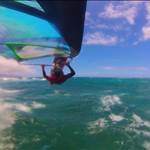
Interested in people's thoughts as to the wisdom of this. Sailed out of Fingal bay around into shoal bay (port Stephens). Cheated by ducking across the Fingal spit, but 16km all up. Wind varied up to approx 20kt. Mixed southerly swell with NE chop. Hard to control at points (keeping board in water), but I rigged conservatively (plenty of downhaul and outhaul) and just backed off a fair bit upwind. Very lonely - didn't see another boat. it was a bit spooky off zenith and the cliffs of the heads. Kept my legs on the rig when taking photos :). Didn't see any of my Noah mates though :) Safety: I had someone expecting me, and carried my phone in waterproof pouch. Knew I'd be in range. Was wearing vest of course. So, it felt a bit spooky, overly risky?, but it was a great sail. I loved the feeling of being out there. Blasting down the swells through the heads was fantastic!Foolish? Would you do it? Anything else I should have done? Anyone else interested in this sort of thing?


Great adventure sail ! Dont see many doing this kind of sailing these days. Most are happy to just go back n forth on sheltered waters.80s n 90s saw many more people sailing adventurous treks.
Select to expand quoteolskool said..
Great adventure sail ! Dont see many doing this kind of sailing these days. Most are happy to just go back n forth on sheltered waters.80s n 90s saw many more people sailing adventurous treks.
Yeah I vaguely remember some ocean crossings? Some guy sailing Alaska to Russia?
It'd be cool to do some island hopping somewhere. LT might not be best choice for it though? I'm open to the notion that I might be misjudging it though, and that someone will come in say it's a bit silly...
When I raced hobie 16s I always wanted to sail down the coast with the NE for a few days, beach camping. Never did it. Anyone ever do it on a board?
ive always thought about circumnavigating bribie island. never done it.
dont sail offshore much these days. there are a few in qld that people used to do in the 90's
mooloolaba to old woman island
cleveland to straddie
caloundra to moreton.
good on you for doing the journey delmar!
Good on you Delmar. I suggest carry a small PLB and/or flares for that sort of thing. Particularly if offshore wind, or could swing offshore
Well done, certainly a different feeling being alone on the ocean by yourself on a windsurfer!! Yeah prob the small individual epirb registered would give me peace of mind, flares not always effective!!
About 25 years ago I windsurfer from the Pittwater side of Palm Beach, out into Broken Bay and then around to the beach at Palmy. Wind was northeasterly. As I arrived into the surf at palm beach my old mast broke due to fatigue/old age. A worry to think what would happen if my mast had broken in Broken Bay. Anyone else sailed around Palm Beach lighthouse?
Gestalt, the ocean side of Bribie would be do able. But up the inside all the twists n turns, windshadows from mangrove trees, n shallow spots sure would make it pretty challenging. Even in a powerboat it takes some navigating.
Select to expand quoteZachery said..
Well done, certainly a different feeling being alone on the ocean by yourself on a windsurfer!! Yeah prob the small individual epirb registered would give me peace of mind, flares not always effective!!
Yeah PLB is a good suggestion. Pretty obvious, I should have thought of it. A great sail would be out to Broughton island (off port Stephens)... hmm...
My memory served for once: www.telegraph.co.uk/travel/destinations/europe/russia/articles/The-Baron-blows-in-on-the-Russians/
Ended sadly: www.outsideonline.com/1930996/swept-away-windsurfer-disappears-sea
I think some fresh drinking water might be a very good idea. Especially if something were to go wrong and you got stranded or something broke and you ended up drifting offshore for a while. Even if nothing goes wrong you tend to dehydrate more than you realise on hot days in salt water.
Select to expand quoteqldnacra said..
I think some fresh drinking water might be a very good idea. Especially if something were to go wrong and you got stranded or something broke and you ended up drifting offshore for a while. Even if nothing goes wrong you tend to dehydrate more than you realise on hot days in salt water.
Yeah good call. have a camel back that could be deployed.
Select to expand quoteSparky said..
About 25 years ago I windsurfer from the Pittwater side of Palm Beach, out into Broken Bay and then around to the beach at Palmy. Wind was northeasterly. As I arrived into the surf at palm beach my old mast broke due to fatigue/old age. A worry to think what would happen if my mast had broken in Broken Bay. Anyone else sailed around Palm Beach lighthouse?
I used to regularly sail from the Pittwater side out into BB and well outside Palmie, but always made sure that it was an onshore breeze. Longboards paddle well, so you can basically always get out of trouble.
I've sailed through and out of Port Stephens heads in strong NE and SEers. It's fine on a longboard on onshore breezes; you can always paddle back in ever if your mast breaks.
Be sure to check the tides if you go through those heads again. It really rips through there.
Select to expand quotejamesf said..
Be sure to check the tides if you go through those heads again. It really rips through there.
Yeah made sure I was sailing in on a rising tide.
Yes going exploring / travelling on your windsurfer ( foiling) is great fun. A change from just reaching in /out. I always make sure i carry and PLB, phone and wear a 50N jacket. Plus a good constant breeze forecast, ideally a bit onshore. Below is a track sailing from Fremantle to Rockingham. (Only 25 km straight up wind, but over 100km of sailing)

Select to expand quoteDarrylG said..
Yes going exploring / travelling on your windsurfer ( foiling) is great fun. A change from just reaching in /out. I always make sure i carry and PLB, phone and wear a 50N jacket. Plus a good constant breeze forecast, ideally a bit onshore. Below is a track sailing from Fremantle to Rockingham. (Only 25 km straight up wind, but over 100km of sailing)
Great stuff! Do you carry water?
I've done quite a bit of offshore cruising over the years- but it doesn't seem to attract a lot of interest generally.
I agree with most of comments above about safety gear, onshore winds, PLB, phone etc.
I carry all the "legally required" gear- so in the event of something going wrong, it cannot be said you are not prepared.
This includes a radio (VHF I think), flares, EPIRB, compass.
Definitely a particular skillset and mental approach are required to do it over any great distance.
I have done sails of 50km or so along the coast- always keen to do more.
I also strongly advocate use of a leg rope.
Clarence
If you have a 4WD you can do a short hop out to broughton island. I've wanted to do it for years but as usual never get around to it. If I ever do make the trip I will be taking a waterproof radio and a smoke flare and of course a life jacket.

Select to expand quoteclarence said..
I've done quite a bit of offshore cruising over the years- but it doesn't seem to attract a lot of interest generally.
I agree with most of comments above about safety gear, onshore winds, PLB, phone etc.
I carry all the "legally required" gear- so in the event of something going wrong, it cannot be said you are not prepared.
This includes a radio (VHF I think), flares, EPIRB, compass.
Definitely a particular skillset and mental approach are required to do it over any great distance.
I have done sails of 50km or so along the coast- always keen to do more.
I also strongly advocate use of a leg rope.
Clarence
The leg rope might just have saved Arnaud de Rosnay's life if the following hypothesis is the reason for his demise: "For 11 days, Chinese and American pilots searched from the air while ships patrolled the sea. The Taiwanese combed fishing villages, thinking maybe he'd made landfall after all. But no one found a board, a sail, or a body. Satellite images later showed no storms had been in the area when de Rosnay disappeared. The wind was strong, gusting up to 37 miles per hour, but those conditions were within the baron's capabilities. "Of course, we can't discard the hypothesis that he fell from his board and couldn't catch it again," his older brother, scientist and writer Joel de Rosnay, told a French TV network."
Select to expand quoteCluffy said..
If you have a 4WD you can do a short hop out to broughton island. I've wanted to do it for years but as usual never get around to it. If I ever do make the trip I will be taking a waterproof radio and a smoke flare and of course a life jacket.
I do and noted, cheers.
Select to expand quoteclarence said..
I've done quite a bit of offshore cruising over the years- but it doesn't seem to attract a lot of interest generally.
I agree with most of comments above about safety gear, onshore winds, PLB, phone etc.
I carry all the "legally required" gear- so in the event of something going wrong, it cannot be said you are not prepared.
This includes a radio (VHF I think), flares, EPIRB, compass.
Definitely a particular skillset and mental approach are required to do it over any great distance.
I have done sails of 50km or so along the coast- always keen to do more.
I also strongly advocate use of a leg rope.
Clarence
Where do you sail Clarence? And what on?
Select to expand quotedelmar71 said..DarrylG said..
Yes going exploring / travelling on your windsurfer ( foiling) is great fun. A change from just reaching in /out. I always make sure i carry and PLB, phone and wear a 50N jacket. Plus a good constant breeze forecast, ideally a bit onshore. Below is a track sailing from Fremantle to Rockingham. (Only 25 km straight up wind, but over 100km of sailing)
Great stuff! Do you carry water?
I would only carry water if I thought it would be over 3 hours.
Normally just fill the back of the PFD with ice and throw a few cans in for emergencies ??

Hi guys. Great stories. Keep them coming :)
I'm looking into long distance sailing safety gear ATM. Primary concern is comms. Where I'm sailing there is access to nearby islands, though the waters are known to be quite shark infested which poses its own problems.
A design concept I have is a mast tip mounted UHF (thin stainless type) that connects to a 5W handheld waterproof UHF. A challenge may be to maintain waterproofing with the external antenna. 5W handheld are good for 17km (from what I've read). If anyone has experience with ocean UHF comms, please chime in as to realistic distances and the expected range benefit of a mast tip mounted antenna.
Another challenge is how to take weight off my person (backpack etc) and onto the rig somewhere with a low CG to maintain responsiveness. I'm only carrying about 3kg of water/food/PLB/flares/gin initially, potentially more if camping is involved. The nose of the board would be ideal, however I just think it's too prone to mast strike and puling things off any mounts. Now looking at an elastic mesh similar to uphaul but connected to clew to form a triangle and storage component for storing a stowage bag.
If anyone has explored this and tried some solutions, please let me know.
What do people do to ensure foil screws dont wind themselves out? Is Loctite effective or is there a better product for Al/Ti in salt water?
Finally, any PLB brand/model recommendations? I am not looking for anything fancy.
One of our group of windsurfing friends carries a handheld marine VHF (without an external antenna) just in case he ends up out in the bay with an equipment failure. Volunteer Coast Guard, VMR and most boats will monitor VHF. If you are really getting away from everyone, maybe an orange smoke flare could help them find you.
I love heading way out from Illawarra beaches on Summer NE ie. cross on, so safe enough - a key reason I got the Windtech Silver Bullets 64 & 72 which are perfect for the job, with extra length and flex tail for control in the roughest conditions - Neil's latest baby the Cruise Missile is specifically designed for long coastal runs
Sometimes see sharks, so far no collisions

If you SUP , I would be stashing a paddle along the centreline (if your taking a longboard windsurfer) - blade up on the nose ,.. What could go wrong that u possibly couldn't get out of ? .. (even if something big and murky shows up at least you have a weapon !) .....If ANYTHING breaks on the rig ,, you de-rig on the deck , and paddle in ... simples ..... if tippy paddling standing up , paddle on yr knees .... A sup paddle imo would be the best piece of backup kit ... if you have an adjustable - even better .... hardly any length stashed in yr standing room - (ie on an LT could along nose centreline)
Would it be preferable to opt for a Personal Locator Beacon (PLB) or a VHF radio?
I was impressed how small and light PLB's are; they'd easily fit into the little front pocket of a flotation vest.
The VHF handheld radios with GPS have a feature (called DSC) which can transmit a distress signal with your info and your exact location. I guess you can also get weather etc over the radio, and talk to other vessels, if desired. I gather a license is required, though, to take full advantage of the VHF radio features.
Thoughts?
Cheers,
sf
Former (90s) professional windsurfer here, now kitefoiling exclusively.
I was perhaps a foolhardy young chap, and maybe lucky, but I did long-distance ocean solo missions all the time. A couple of times it was well after dark when I made it home, and a few times I had to self-rescue with broken gear, but I never needed rescuing. Again, maybe lucky, but I'm sure there was a very different sense of self reliance back then. From the depths of winter and Melbourne Covid lockdown I'll offer some glory-days yarns, for what they're worth:
My adolescence in the 80s had consisted of windsurfing solo on the Manning River pretty much every day after school, and dealing with whatever happened. This was a good grounding in self reliance. Once, several km upwind of home in a black nor-easter, I snapped a boom extension. I sailed carefully to the nearest shore with hands spread wide on the good side of the boom, pulled up on the mangroves, and began searching. I found a length of inch and a half ag-pipe (cattle country), managed to cut off a few feet using the rough edge of a concrete trough, and used this to sleeve the boom extension, wedged in place with some sticks, and, as I recall, sailed full speed back home in the back straps with no issue. (I would have been 15, on a Cobra 380 race, Gaastra 7.0 racefoil pro, and a crappy old alloy boom)
I used to pore over Sailwind Quarterly, Freesail, and whatever US mags I could get, and there were lots of good self-rescue articles in them that helped me with general principles and specific solutions.
Most challenging self-rescue was off Cervantes at the slalom comp in 93. Sailing back upwind around the slalom course, my mast broke below the boom as I leaned into my outside gybe. There was a rescue boat for the comp, but they didn't see me. Wind 25-30 knots, cross offshore, I'm losing ground quickly. I'm on a 5.6 race sail on a small slalom board, maybe 55litres. If I recall correctly, this is what got me back in. Backed the downhaul off, released the clamp on the boom but left the rope fastened so it could slide up the mast. Worked the bottom of the luff sleeve up over the break in the mast. Sitting astride the board, fully released the downhaul, pulled the mast off the extension and threw the bottom bit (maybe 70-80cm) away (sorry planet) whilst holding the rest of the rig. Pulled the extension off the uni, and somehow managed to jam the extension up the broken bit of mast. Downhauled very loosely, with plenty of slack. Worked my way to the mast tip and pulled a couple of feet of luff sleeve over the top of the mast. On the way back down the mast, I tightened the boom head to a raised position. I then put a touch more downhaul on, and put the extension back on the uni. Very gingerly waterstarted with the sail somehow not ripping, and grovelled in on a broad reach. Probably was 15-20 minutes to jury rig and another 20 to get back in, and the maybe an hour's walk back up the beach.
Once, at sunset, off Sprecklesville, I had a mast break maybe 1.5 km offshore. There was no jury rig option this time. Just derigged, rolled everything up as tight as possible and tied it up with downhaul and outhaul and, balancing awkwardly with the crap along the middle of the board, paddled back in downwind to Kanaha (straight downwind, and where I'd started from). Well dark by the time the paddling began. Kicked the fin at one point (very sharp trailing edge) and thought I might have drawn blood, just to add some excitement a few days after a tiger shark had given a local surfer's leg a thorough makeover. This was on 270x54 cm slalom board in 20ish knots.
I've self rescued and jury rigged kitesurfing maybe a dozen times in as many years of the sport. It is a perennial theme among kiting commentariat how few kiters can do basic self rescues in even the most commonly encountered issues (wind drops/ broken line/burst leading edge) ... but I digress ...
I'd emphasize the rule of never ride anywhere from where you wouldn't be confident of being able to swim in. Other questions - How calm can you remain when things go wrong? How fit are you? How good an open-water swimmer? Do you have basic plans for common breakages? I'm not against radios and epirbs, but you'll still need to keep your head and survive for a while before help arrives (assuming it does), so there's no substitute for preparedness on all fronts.
There are few feelings like offshore sailing in gnarly conditions. For some of us it is a calling, and only a fool would refuse it. As T. S. Eliot put it:
Old men ought to be explorers
Here or there does not matter
We must be still and still moving
Into another intensity
For a further union, a deeper communion
Through the dark cold and the empty desolation,
The wave cry, the wind cry, the vast waters
Of the petrel and the porpoise. In my end is my beginning.