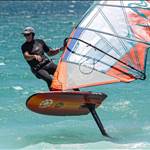
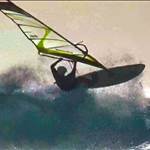
Been watching a few vids lately and it's easy to see the top of sails twisting off appropriately. But it also seems like the entire leech is doing absolutely nothing most of the time, except perhaps causing a bit of drag and adding weight.
Is there any logic to removing floppy leeches for certain types of sails?
Surf sails for example still find the extra grunt up high useful, but perhaps a speed sail does not need a floppy leech at all.
Just wonderin'.
I would've thought a speed sail needs it even more, to account for the apparent wind direction being different up there. 
Dunno what the alternative is
Some of the newer race sails actually run a tighter leech in the mid 1/3 of the sail
On the wave sailing front - loose leech / flat sail does you no favours when its light and onshore - tight leech is good for getting first gear / extra low range planing power out of your sail. Bit of a Scarbs thing because you are up against so many elements trying to sail there
downwind current
3 directions of well / chop /back wash
Kites coming in from all directions
Kite lines in the break
flash in the pan ramps that require instant planing to take advantage of
Philip Koster runs some tight leech full sail set ups - he is the onshore master and i think it really gets him into a position to do all the stunts he does
Go somewhere like margs and the loose leech is your friend again because its windy and the wave pushes into the wind a lot of the time
In some of the stronger fronts this winter i had to give my 5.0m extra downhaul just to hang on and stay safe.
In older sails the leech went floppy as in a noisy,shaking leech.The newer sails the leech still opens but is much tighter. A huge improvement.
To what degree do you suppose flex top masts contribute to the top of the leech twisting off perhaps too much?
Would a stiffer mast as in a taller same brand mast that would fit the same sail decrease the twisting off and help power up a sail in lower winds?
I've been struggling to understand this too.
I apply down-haul to increase twist and free the top leach, but it seems then that the top of the sail is not providing lift and possibly causing drag.
Any sail designers out there care to comment what the floppy leaches are really doing and what difference would be apparent if the leach was cut back?
I hope your brain can take it Azymuth! Great comments following the article too!
http://www.windsomnia.com/2010/03/10/how-to-calculate-sail-twist/


"The answer is you design the sail with a lot of twist. The reason is because apparent wind decreases when you head off the wind and increases when you head up wind. So, by designing the sail with sail twist to match apparent wind twist at deep tacking angles, this ensures that when sailing at deep tacking angles, when apparent wind is low, and you need the most power from the sail, the entire the sail is optimally sheeted to produce the most power. Headed upwind, there is less wind twist, therefore the sail will be under sheeted at the top of the leach. This essentially depowers the top of the sail when headed up wind. Depowering the sail upwind is ideal because the apparent wind is so much stronger and you actually want less power from the sail. So therefore designing the sail with twist helps to provide more constant sail drive over a large tacking range."
Yep, Antoine looks like he is going really fast. Understood.
That's the great thing about this forum. You realise that some people know a lot more about some things than you do. I was aware that there was twist and it made it feel fast.
I had assumed that the Naish chopper was an effort to design a wavesail that minimized the need for twist, though it seems to me that it would work best in quite even wind conditions when you can rig a bit smaller.
I thought this stuff on birds wings was pretty good too.
I am sure the change in wind speed relative to height above water is a contributing factor, but I don't think its the whole story.
I noticed the author of the http://www.windsomnia.com/2010/03/10/how-to-calculate-sail-twist/ has extrapolated data for a racing yacht, not saying he is wrong, just that it is an extrapolation.
There is quite a bit more to it, this is a good discussion if your interested:
en.wikipedia.org/wiki/Forces_on_sails#Influence_of_Aspect_ratio_and_Sail_Planform_on_Induced_Drag
The following paragraph from that link is a pretty good summary:

I believe there's also a pumping effect from the floppy leech, especially upwind. Something similar to FB's notion of the self-adjusting flexi-top skiff rig, the idea being that the rig not only flexes and dumps power in a gust or as you hit a wave and slow down, thus reducing drag, but then also adds drive as it bounces back so you can regain speed again. Frank had some nice graphs of how frequently an 18 going upwind encounters minor wind variations proving that it's not humanly possible for the sheethand to react quickly enough, and therefore the rig had to do it automatically.
I don't know if windsurfer sails were really designed with this in mind, but it does seem to me that you get this effect with large formula sails at least.
As I understand it wind gradient over the height of a windsurfing sail is bugger all. I think that colourful vector analysis above is probably not a true representation of the way things are but just an explanation of a theory with angles extrapolated from the photo not from factual wind data.
Yep, yep. Got all the pretty pictures. Apparent wind is different at the top and bottom of the sail, and at different tacking angles (and speeds).
___________________________________________________________________
For anyone that doesn't get it:
A) Wind travels at different speeds the higher off the ground you go. This is the important bit. It goes faster as you go up. Lie on the ground one time; no wind. Fly a kite; heaps of wind up there.
B) If the wind is coming from the North at 15 knots, and I am traveling East at 15 knots, the apparent wind, where the wind is apparently coming from on my boat, is 15 knots from the North-East.
C) Because of both A) and B) the apparent wind will be at different angles at the top and bottom of the sail. Oh no! What is a sail designer to do?
Therefore: Sails have "twist" to provide the best trim angle for that part of the sail.
___________________________________________________________________
I am also led to believe the twist lowers the power in the sail moves most of the power to the lower half or so of the sail, making it easier to sail. Basic leverage.
I'm not denying this works, It does. Definitely!
But it appears that, for the top panel at least, there is often so much twist that the angle is matching the apparent wind; that is not producing any power at all. I certainly can't feel anything from the top panel, perhaps even the next down too, and looking up at it it just flops around there. Are the very top panels actually doing anything?
Just like the winglets that are now common place on jet wing tips, as well as the theory outlined in Lao Shi's post I thought that the twist off of a sail releases the air cleaner creating much less drag. Less drag = faster (and also means less large womens shoe sizes being sold)
I am struggling to keep track of the details but I thought that Gaastra had their sail mounted horizontally on a truck when they developed their sail twist. Still I think Dunky was faster and I dont think he had a truck to develop his Pryde sails.
don't know... got rid of my floppy drive around 1999. Replaced them with CDrs and external hard drives.