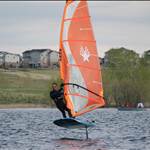
I have a SB Super Cruiser 1700 - which I have already come to appreciate in the few weeks that I have been using it. At about 12 knots(est) it pops up on the foil with little effort. The technique for pumping is different than for windsurfing without foil - I am looking for any light wind specialist advice and tips that might help lower the foiling wind range for me.
Stats:
100K (dropping this would be useful :)
SB Isonic 90 wide 2019
Sailworks NX 8.5 2019
Solid windsurfer since the mid-80s 9(gybe, water start, fast tack etc)
I can pump in conventional windsurfing but not well with foil yet.
For pumping the foil you want the sail to have backhand power because that translates to power on your backfoot and into the foil. Let go alot of outhaul (vario-kit), and pump in a rowing kind of motion! Make sure you pump your sail front to back and not side to side, and the most important part, lift your weight off the board when extending the rig forward, in order to "lift it up the plane" so to speak. You only want to really push hard through the backleg at the switching point between pulling the rig back and bringing it forward, right before you lift your weight off the board (like an ollie on a skateboard?). The rest of the time my weight is mostly hanging from the mastfoot / on my front foot.
This is me pumping onto the plane in minimal winds, you can see the board popping up higher out of the water as I bring the rig forward due to lifting my weight off the board, jumping of the backleg so to speak:
www.instagram.com/p/B1yGKGhAL-B/?igshid=pw5teqoxn69
Select to expand quoteWhiteofHeart said..
For pumping the foil you want the sail to have backhand power because that translates to power on your backfoot and into the foil. Let go alot of outhaul (vario-kit), and pump in a rowing kind of motion! Make sure you pump your sail front to back and not side to side, and the most important part, lift your weight of the board when extending the rig forward, in order to "lift it up the plane" so to speak. You only want to really push hard through the backleg at the switching point between pulling the rig back and bringing it forward, right before you lift your weight of the board (like an ollie on a skateboard?). The rest of the time my weight is mostly hanging from the mastfoot / on my front foot.
This is me pumping onto the plane in minimal winds, you can see the board popping up higher out of the water as I bring the rig forward due to lifting my weight of the board, jumping of the backleg so to speak:
www.instagram.com/p/B1yGKGhAL-B/?igshid=pw5teqoxn69
Wow...pretty impressive!
^^^ what white of heart said.
I find that pumping up onto the foil is about getting the pressure onto your back foot. I usually hook in both feet and start pumping. Once im moving along, i put all the pressure as im pumping through the back foot, and then youll feel/see the board lift off. I usually give it a couple more after lift off to help get the speed up a bit more before stopping and settling in.
Wow, that is truly inspiring pumping there - I have a lot of work to do. Thanks for sharing that clip - the power you are generating is clearly seen there.
That clip was awesome!
I have a tendency to turn a little more downwind (broad reach) before I start pumping in light wind. Since you're a little new to foiling, just getting out and sailing/foiling more will help. My pumping technique sucked the first year, so I ended up stepping up to a larger sail. Now that I'm at the end of this season, I can grab much smaller sails and pump quickly to get up.
Gear: Big sail, big wings help a ton. The rest is technique.
WhiteofHeart's description is good. I have a tendency to 'slide' or shove the board forward when I pull in the sail during the pump. This gives the board a little more speed to build on. Let's break it down to the elements using his video: www.instagram.com/p/B1yGKGhAL-B/?igshid=pw5teqoxn69
I watched WhiteofHeart's video a few times to kind of breakdown the physics/technique.
1-6 starter pumps: Initial pumps will be larger pulls, grabbing as much wind as possible (using WoH's pointers). I also sort of lift myself off the board and try to hang on the boom a little more (like WhiteofHeart mentions). The key is to get speed. Don't push the rear foot down too early for flight at this stage (or you'll stall/stop/slowdown). You'll need to learn the feel of your rig/wing to figure out when to move into the transition pumps.
2-3 transition pumps: The transition is where you can start to lift the front of the board out of the water, but still can't sustain flight. The board will fly, but will come back down...this may repeat a few times as your speed increased for sustained flight. After the starter pumps to get speed, start pushing down on the rear foot more to lift the board. Sail pump: You will use shorter sail pumps here. Quicker and shorter throw. There is a board pumping element here too. Board pump (Advanced): Your first lift off may not result in flight in light winds. If you keep the first lift off with a high angle of attack (AOA), you'll end up stalling the board out and losing speed. It will come back down, so don't fight it; instead guide it. You've seen pumping technique on foil surf boards, think of that. So, in one motion, pull the sail back and pitch the board up (by adding more back foot pressure). When you push the sail out for the next pump, guide the board down (or push it for more speed due to gravity), and then repeat. There shouldn't be many pumps in this sequence, but you'll start to rapidly increase speed.
1-2 flight & stabilization adjustments: Now that you're up with the transition pumps, your speed has changed. Be mindful of the new relative wind direction and speed. You'll be gaining speed here. You can point down or up into the wind as needed to keep speed. In light winds you might be doing a bit of both (down wind for a little more speed, and then point up quickly to change the relative wind speed). Your Angle of Attack (AOA) still might be abnormally high. At this point, you need to focus on reducing that angle and straightening out for reduced drag.
-Sail position here is critical as the aerodynamics and power has changed. Most sailors think that the more you sheet in the sail, the faster you'll go. Not always the case in light wind. Sheeting in/out to find that right spot is important. When in flight, you might throw in a medium pump or two to increase your speed.
-Board: At this point, the key is to get front wing parallel to the water surface (low AOA). As your speed increases with the correct sail position, try to focus on this aspect. Advanced board pumping at this point can help. Using most/some of the height to pump the board for speed too can help dramatically (but don't touch down).
Hope this helps!
Select to expand quoteIndecentExposur said..
Gear: Big sail, big wings help a ton. The rest is technique.
Generally, yes, but there tends to be a limit usually depending on your body size and strength. I can pump my 7.7 fine but I tried my 9.5 on a lark and found I just didn't have either/or the body weight or strength to move it enough. Plus, the long boom length meant have my efforts were just wagging the sail back and forth instead of pulling air. Once up, the 9.5 had slightly better bottom end but I found the 7.7 got off the water just as fast because I could move it quicker and more forcefully.
I, too, usually do better in very marginal conditions by bearing off on a broad reach.
Sorry if I missed someone else saying it, most really short boards need to be pumped up from at least in the front strap - maybe your first one or two pumps are in front to generate some momentum. Otherwise, you are pumping against the rocker line and just driving the board into the water instead of out. It feels weird and that you are dragging the tail but it helps give the wing a positive AOA and the board back on the flat part of the rocker line.
Select to expand quotePaducah said..IndecentExposur said..
Gear: Big sail, big wings help a ton. The rest is technique.
Generally, yes, but there tends to be a limit usually depending on your body size and strength. I can pump my 7.7 fine but I tried my 9.5 on a lark and found I just didn't have either/or the body weight or strength to move it enough. Plus, the long boom length meant have my efforts were just wagging the sail back and forth instead of pulling air. Once up, the 9.5 had slightly better bottom end but I found the 7.7 got off the water just as fast because I could move it quicker and more forcefully.
I, too, usually do better in very marginal conditions by bearing off on a broad reach.
Sorry if I missed someone else saying it, most really short boards need to be pumped up from at least in the front strap - maybe your first one or two pumps are in front to generate some momentum. Otherwise, you are pumping against the rocker line and just driving the board into the water instead of out. It feels weird and that you are dragging the tail but it helps give the wing a positive AOA and the board back on the flat part of the rocker line.
That's a great point! I too, have found you want to keep your board as flat as possible when pumping in light wind. I just started pumping strapless initially, and then getting into the straps at the transition-takeoff phase. in WoH's video, he does just that.
On my short foil board (202cm) and a 6.5m Hotsails i put my front foot in first then 3 pumps, back foot in another few pumps.
kind of pumping cirkels with the sail.
You can see the first few seconds of my foiling video filmed with a drone.
Recently tried a very similar setup (Supercruiser / SB Foil 144 / Simmer 2XC 8.5), and to be honest, for your weight I think for early flight you would be better off with the starboard race millenium than with the supercruiser. The big sail is too heavy for the foil and you can clearly feel it, it throws your board off balance during turns and since you can't really lean far out and hang your weight into the sail you really diminish the capabilities of foiling using an 8.5.
With a small <5m wavesail it might be a different story, but I haven't had the chance to try, and it won't get you anywhere in the 10-15 knot windrange...
My feelings:
1 a big wing doesnt provide more early flight, it just masks a bad pumping technique, but is also less sensitive to a good one.
2 If you want to use bigger (cambered) sails, use a more racey foil, because your sail will overpower a more freeridey one (like putting an 8.5 2 cam on a 105L waveboard, get yourself a freeracer and you'll be way better off.)
Pumping a formula board with foil is totally different from pumping a formula board with a fin.
A formula board has a ton of nose rocker. With a fin you have to pump it up over its own bow wave. Since a foil will begin to lift even at sub-flight speeds, it will help lift the board up off the nose rocker. This makes pre-flight pumping a LOT easier.