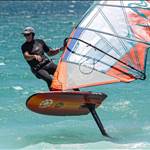
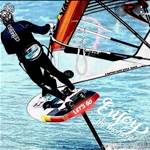
Heaps of posts about foil gybing.
Simon's the best I've seen anywhere - a vid to inspire us all 
Slomo is a bit jaggedy at times but I thought it helps to see the movements clearly.
Drone footage - Thomas Hofmann
All of these gybes are sail flip first then foot change (carve gybe), which is certainly much easier than foot switch pre sail flip (step gybe) for me.
Do the dudes in the video ever do the step gybe on the foil? if so how do they find it. And what is their preferred gybe on the WS step or carve?
Obviously there are two ways to jibe.
All the jibes in the first video, of me, are carve jibes. All are on the SS Wizard with either the infinity 76, Timecode 68 or infinity 65(freeride gear) When I used to windsurf it was on wave gear and all my jibes were carve jibes.
Nico is riding race gear and step jibes, very smoothly
I find Sam Ross does a pretty job explaining it... The only thing I would say is maybe shift the sail a bit earlier then explained in those videos.
Sam like Nico is on race gear and both do step through jibes. Interestingly Sam emphasise's back foot all the way across the board while Nico emphasise's not to.
For me, if you watch someone learning to foil jibe they tend to get half way around then round back up. Back foot on the opposite rail prevents this from happening
My biggest mistake was not going boom to boom!!I was flipping, grabbing the the mast...since the sail was not " inflate " or "pop" in the proper sidd, ..that was bringing me with the apparent wind upwind...the time I was talking to pop the sail I was crashing. As soon I a realized that(about 2 weeks ago) my success rate went to the roof.
I guess when you passe tons of jibe and become more used to the jibe...you can grab whatever you want you have plenty of time to jibe. I never tried a duck jibe, but I imagine you do a little subtile double touch at the clue @azymuth and not throwing the sail as a normal duck..I guess if you throw the sail that will lift you up big time?
Select to expand quote2keen said..
Sam like Nico is on race gear and both do step through jibes. Interestingly Sam emphasise's back foot all the way across the board while Nico emphasise's not to.
For me, if you watch someone learning to foil jibe they tend to get half way around then round back up. Back foot on the opposite rail prevents this from happening
That's definitely what's happens to me. Or it gets away from me and I come off the back.
Select to expand quoteNordRoi said.. I never tried a duck jibe, but I imagine you do a little subtile double touch at the clue @azymuth and not throwing the sail as a normal duck..I guess if you throw the sail that will lift you up big time?
Those are some smooth duck gybes in Simon's video.
Seems like there are some variations of the same old duck gybe. I move my back hand way down the boom. The margin for error is still big for doing duck gybes on foil. If you duck too early the sail gets thrown too far inside of the turn causing you to get stuck upwind/backwinded.
If you duck too late you don't carve into the turn and kinda keep going down wind and it's harder to sheet in. Usually when the sail feels light is a good time to duck the sail. Try it with smaller sails first like <4.5.
Duck gybes feel unreal in strong wind on a 3.5m super quick and silky, well worth the many crashes learning in the beginning.
Select to expand quoteNordRoi said..
My biggest mistake was not going boom to boom!!I was flipping, grabbing the the mast...since the sail was not " inflate " or "pop" in the proper sidd, ..that was bringing me with the apparent wind upwind...the time I was talking to pop the sail I was crashing. As soon I a realized that(about 2 weeks ago) my success rate went to the roof.
I guess when you passe tons of jibe and become more used to the jibe...you can grab whatever you want you have plenty of time to jibe. I never tried a duck jibe, but I imagine you do a little subtile double touch at the clue @azymuth and not throwing the sail as a normal duck..I guess if you throw the sail that will lift you up big time?
So much this. It's so important to trust the hands and let your eyes spot the exit so you can fly level and not round up too much. It's not so much that it's hard but to let go of the mental crutch of thinking you need something to hold on to. Because we are using smaller sails and there is so little sail pressure downwind, it's easier than we are accustomed to coming from planing jibes where there is more power in the sail.
Select to expand quote2keen said..
Obviously there are two ways to jibe.
All the jibes in the first video, of me, are carve jibes. All are on the SS Wizard with either the infinity 76, Timecode 68 or infinity 65(freeride gear) When I used to windsurf it was on wave gear and all my jibes were carve jibes.
Nico is riding race gear and step jibes, very smoothly
So carve gybe is your preference, makes sense. I guess I am wondering if the success rates of the carve and step gybes are different.
My success rate for full foiling gybe is probably 90% in carve gybes and <5% doing step gybes. I also had a preference for the carve gybe with WS but cannot say I was ever that much better at carve versus step gybes on the WS that I am not sure it factors in much. Even on my big gear I prefer the carve gybe. Never tried race gear though.
Kind of wondering if those freeride foilers that prefer the step gybe in WS and are struggling to foil through their gybes, should switch over to the carve gybe?
I think with bigger sails 6.0> I prefer the step gybe. I learned foil gybes that way but prefer the carve gybe now with smaller sails <5.2.
On small sails the only time I'll do the step gybe is if I'm in a lull and have to turn I find I can pivot better by flipping the rig after foot change. But when powered nicely on small sails the carve gybe seems faster and smoother. Anyone else find this?
Took me a bit to learn the crave jibe and make them feel like they were clean enter-exit,never even thought about the step jibe yet.If you look at the videos from the french guy that post here sorry can't think of his name all he does is step jibe. I think whatever way you learn is what you go with.
The videos and discussion here are really helpful
I'm a slapper, but like foiling to extend my TOW for the light days.
because of this I'd say my progress has been slowish as I haven't devoted a lot of my time to foiling over the past 12mths. I've been trying to foil gybe, haven't done one yet but have done a few "touch and go". I focussed on my footwork today (step gybing) and feel like my technique there has improved thanks to the guidance provided here. No foiling gybes today, but I feel a little closer. With my footwork improved, I now need to get my rig transition technique better and quicker. what seemed to happen today:
1 rear foot out and in position just in front of opposite rear strap
2 carve turn - foot switch at at about dead downwind was working fairly efficiently and quickly. I was able to hold my arc more consistently
3 flip rig - I probably held the rig clewfirst for a second before initiating this. Trouble is I could feel the board dropping even before I started the flip - I then couldn't flip the rig quick enough to get power back in the sail before I touched down.
Light wind today, although I tried to gybe in the gusts, I simply didn't seem to have enough momentum to carry through
Great video, thanks for posting. They show a few things really well:
1. Minimal body movement during the jibe.
2. The mast stays perpendicular over the board for the flip. Since the board is tilted into the turn, the mast also leans into the turn.
3. No rush in moving the feet after the sail flip. In waves or chop, sail a bit further until you have a smooth stretch of water.
I have verified multiple times on the water that deviating from any of these rules is an excellent way to induce crashes  . On the slapper, you can move a lot, but on the foil, any body movement causes direction changes and/or instability. On the slapper, you move the mast to the outside, especially with big slalom sails; on the foil, that stops the carve. When carve jibing on the slapper, I usually want to switch feet quickly after the sail flip; on the foil, I may not have carved far enough, or may be going up or down a big piece of chop.
Regarding carve jibe versus step jibe on the foil, the decision depends a lot on your speed relative to wind speed. On freeride foils, we're usually a bit slower than the wind, so the carve jibe (more descriptively called "sail first jibe") works well. On race foils, the speed is often significantly above the wind speed. Since you loose very little speed carving downwind on the foil, that means you have apparent wind coming at you when downwind - you can't flip the sail by opening up and letting go with the back hand. If you try to push it around, you get backwinded. So you slice the sail forward, and then do a helicopter-tack like sail flip, as Nico shows in his video. That's why the racers all step jibe on the foil.
The step jibe is also doable when foiling slower than the wind on freeride gear. But you move your feet at the same time as the sail, and with the higher sensitivity of the foil compared to the slapper, small mistakes can throw you off quickly. The higher speeds on race foils stabilize things a bit here, and the wider boards probably also help. But the carve jibe on (slower) foil gear is easier, since you can concentrate on one thing at the time. The movie demonstrates that very nicely, especially the first jibe.
Interesting comments about carve vs step gybes on slower gear Peter. I've been a step gyber for many, many year so flip first will do my head in, but I'll give it a crack
Select to expand quoteStretchy said..
Interesting comments about carve vs step gybes on slower gear Peter. I've been a step gyber for many, many year so flip first will do my head in, but I'll give it a crack
Same here, Stretch. That probably makes it harder for me to carve jibe on the foil - I've even had a bit more success with step jibes early on. I've done a few sessions practicing carve jibes on a slapper, but when windsurfing, it's perfectly fine to move the mast to the outside of the turn for the sail flip. Doing that on the foil invites disaster .. the windward rail may come up at you, and you're falling towards the foil with just one hand on the boom (some pics at boardsurfr.blogspot.com/2020/08/no-more-rail-rides.html). One of the scarier foil crashes!