What fins are you using in your surf SUPs at the moment. Pics would be good 
I'm using GL quads in my Lopez 8.10
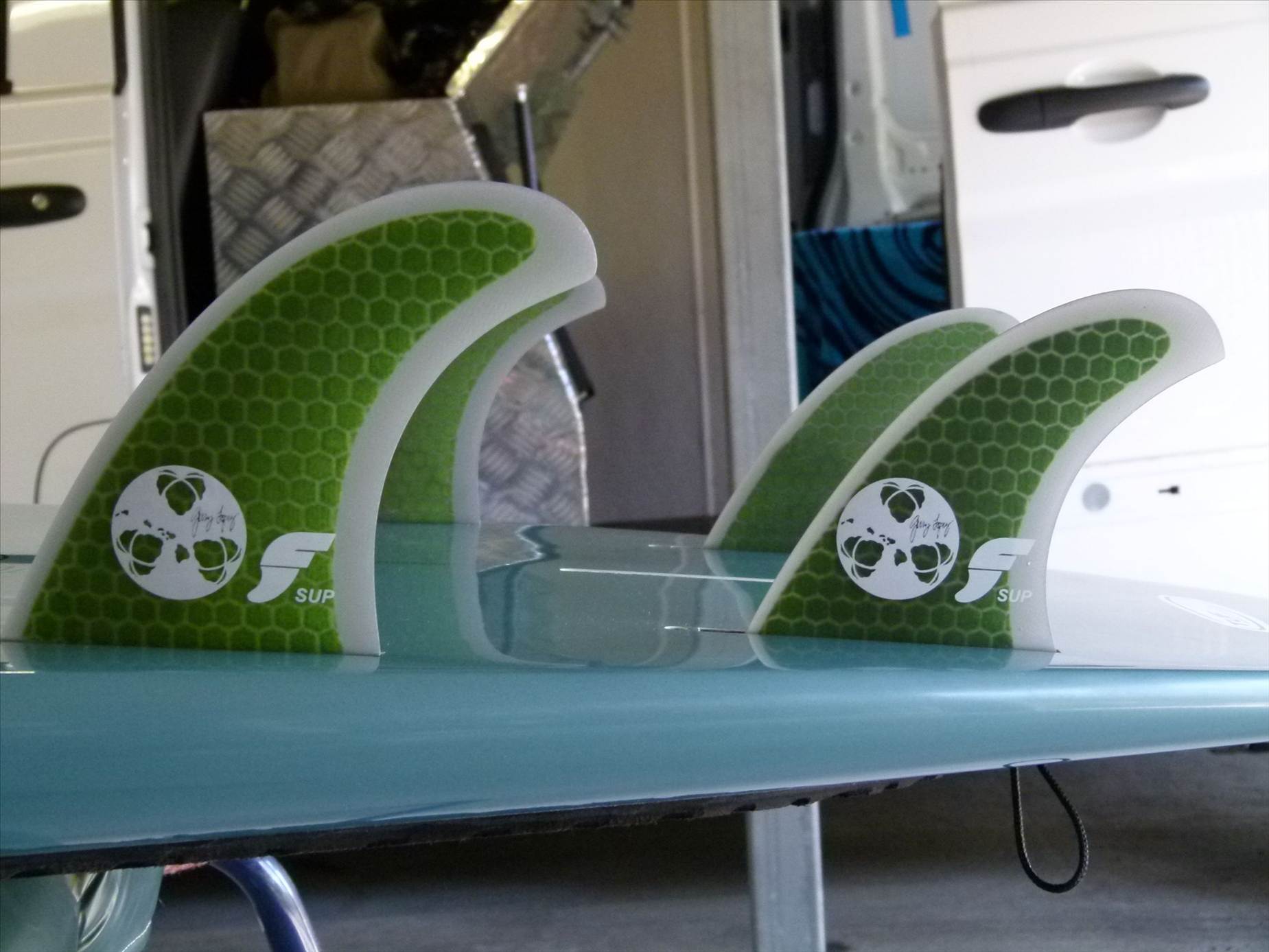
The standard Naish fin in my 10.6 Nalu (I think its 9 inches) with a set od glass m5s in the sides.
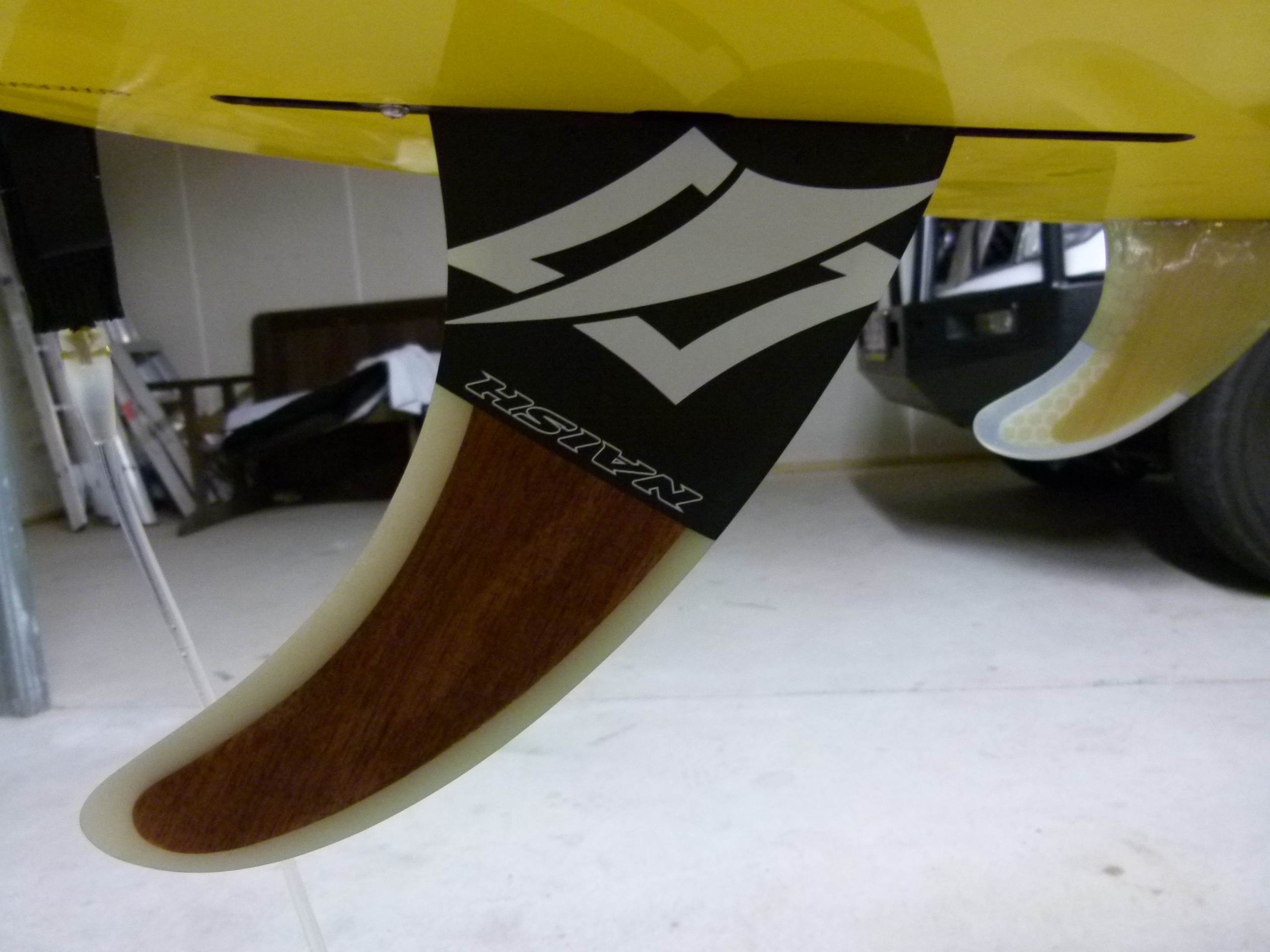
And these Sunova fins in the Skate. A quick measure puts them at 5.25 inches base and 5.25 inches depth.

Kinetic Racing Luke Egan thruster set in Starby 9'8" Pro & Shapers SMFL thruster set in Starby 9'0" pro.
I have come to 2 sets of fins as my favorite:
- C-Drives for boards I pump to speed and "throw around". Typically sub-7' boards. Extreme positive grip (wide base) and stellar reliability at speed in extreme situations (small tip does not "foil" in powerful sections). Australian made but ship wordwide , plenty of sizes, owner is super cool (you can buy any replacement one easily).
- FCS Nexus H3 for boards that I drive through the rails. Typically thin railed ~ 8' boards. These are the best fins I ever found to glide and accelerate during rail turns, less drag (and weight) than the C-Drives, but less grip at slow speeds. Quite overpriced however.
I use them as thruster, quads, or quad+nubster, or twin+trailer.
Basically, I like fins with some inside foil, and small surface tip. I have read good things on the Alan Byrne ones, but could not find them (and they may be too small for my 100kg). My ideal fin would be C-Drives with the Nexus foil profile.
For single fin boards, I like the greenough A4 (I hate the 2+1, so I go either single of multi)
I had GL (on a Lopez 8'10" too), but hated them, I think they are too big (especially in the tip) and slow and "kill" the board too much, but that's my personal taste.
Note that you already have some info on this thread: www.seabreeze.com.au/forums/Stand-Up-Paddle/Review/Good-performance-fins/ and www.standupzone.com/forum/index.php?topic=15007.0
Thomo, just out of interest, what performance gains did you see running the glass m5s on the sides of your Nalu?
+1 for cdrives. They are everything colas said. Turn your jalopy into a formula one. Speed and drive with top turns that release properly with acceleration. I can't make any of my boards spin out with them.
Colas would you be so good as to explain how 100kg floats on a sub-7ft board?
Cheers
Select to expand quoteJoffaDan said..
Thomo, just out of interest, what performance gains did you see running the glass m5s on the sides of your Nalu?
Hey JoffaDan, I'm not sure if it improves performance because I didn't try the M7s it came with. From past experience, I prefer 2+1 setups with a larger centre fin and smaller side fins. So when I bought the Nalu I thought the centre fin looked good but the sides looked too big. I had a set of M5s spare and threw them in. I've been very happy with the Nalu and that setup. It works pretty well in anything up to 2x overhead. (I haven't tried it in anything bigger than that)


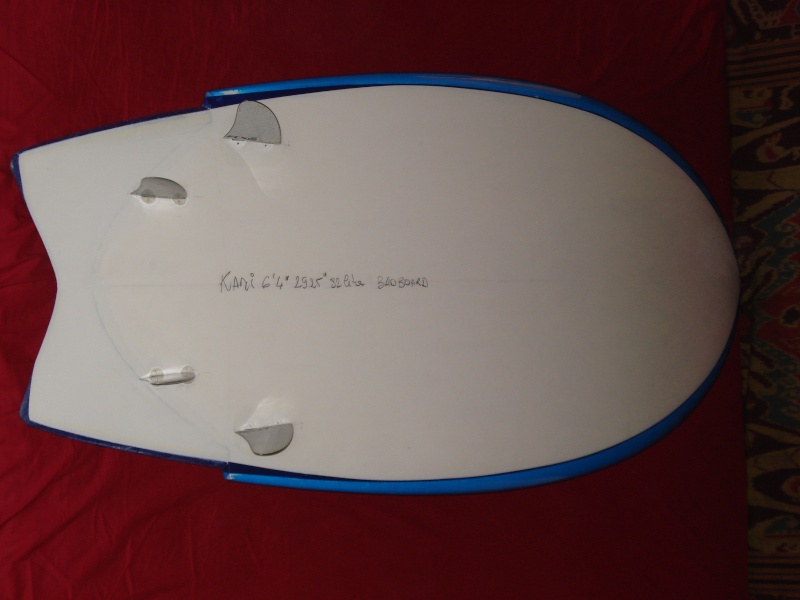



" Kami, what is "repartition"? Those Soar fins look great, too. The only problem I find with the KNubster as a one-plug fin is that if it's in the forward slot the fin can tip back, and if it's aft the fin can tip forward....though you'd probably have to run someone over to get it to move... this is just staring to get interesting."
In " repartition" i mean the minimum volume you need to your own weight, it has to be under yours feet stepped at the board maximum width .
In first point, this volume is optimum for taking off when it is a bit backward the maximum width; Then paddling aptitude come in second priority with front board area is more important than buoyancy of this front part.
For the tab position, IMO : fins don't make the all thing, have to choose the right fin for the right plugs locations. For example: On my new board 6'4"i fixed the locations plugs thinking about H2. So, cause of H2 special cant fins i put plugs a bit more inside rail as usual...
When you want to buy a board, always install fins and look the whole thing, board and fins, if something wrong, leave it, if it's get you" frothing" , GO!
D'ont worry Tang, finding the right fins for a board is far away more difficult to find the perfect woman ... this is why i'm more looking after surf shop shelves rather than dating site requests 
"And cyberhusky, what's that tail stabiliser/knubster thing you;ve got? I threw a knubster in the tail fin slot on my fish and it's stiffened it up a whole lot, but also given it a stack more drive, even with quad c-drives in it."
It's a Shapers Darc Drive, smaller than a Knubster by about half I reckon and a completely different shape. It does exactly what I wanted it to, which is allow the board to trim in a straight line like a thruster does, without stiffening the board up too much. I was lucky enough to get some small barrels with this setup a few weeks back and interestingly, when the board was in the barrel I could feel it suddenly start to hum/vibrate. Never had that happen before, weird. I've only tried it in the pictured position so far, I have 2 other options with the plug setup.
Has anybody tried these or does anybody have the scientific/engineering background to know if the theories he puts forward make sense?
wavegrinder.com/
Select to expand quoteTh0m0 said..
Has anybody tried these or does anybody have the scientific/engineering background to know if the theories he puts forward make sense?
wavegrinder.com/
These fins are made for longboard because they deep and narrow base . For SUP which are wide board, they need wide base and small tip, like C drive are. Wavegrinder fins is on opposite of Cdrive fins.
I like H2, they got some tip extra area looking tall square shape too as Wavegrinder ones but H2 got extra toe and cant.
About the little winglet at the tip of wavegrinder fins , it's working for sure .
Ciberhusky fins got a good combo with H1 quatro fins
Select to expand quoteTh0m0 said..
Has anybody tried these or does anybody have the scientific/engineering background to know if the theories he puts forward make sense?
wavegrinder.com/
Not tried, but they should work to get more efficiency (less drag) in a straight line. Guess good for race & downwind.
The technical explanations on their pages are very sound. They definitely know what they are talking about.
For turning on a wave, they will most probably give a special feeling, a bit "twitchy" due to the low rake angle (a bit like the "spitfire" fins): fins with a more curved outline will feel smoother during the turn by dampening the fin responses to various angle of attack. But they explicitely say they choose a NACA foil that counteract this effect, so, yes, they seem like worth trying.
Thanks for the replies Kami & colas, I'm not sure I'm ready to hand over the cash for a set of these yet though.
Select to expand quoteTh0m0 said..
Has anybody tried these or does anybody have the scientific/engineering background to know if the theories he puts forward make sense?
wavegrinder.com/
One point from the Wavegrinder website... They talk about winglets on airplanes being more efficient.... So winglets on surfboard fins are more efficient.
I am no expert but I work with many smart naval architects and aeronautical engineers.
My understanding is that a longer wing would be more efficient but that would make the wings too long to fit on a jetway, or for on ground manoeuvring. So the winglets are the next best alternative. Endplates are good but only when you are trying to get more from a limited size wing.
So winglets on a surfboard fin adds to the drag of the fin and the lift characteristic is not as efficient and a longer fin. The connection of a winglet to the fin is a draggy area.
Select to expand quoteLordRumpunc said..Th0m0 said..
Has anybody tried these or does anybody have the scientific/engineering background to know if the theories he puts forward make sense?
wavegrinder.com/
One point from the Wavegrinder website... They talk about winglets on airplanes being more efficient.... So winglets on surfboard fins are more efficient.
I am no expert but I work with many smart naval architects and aeronautical engineers.
My understanding is that a longer wing would be more efficient but that would make the wings too long to fit on a jetway, or for on ground manoeuvring. So the winglets are the next best alternative. Endplates are good but only when you are trying to get more from a limited size wing.
So winglets on a surfboard fin adds to the drag of the fin and the lift characteristic is not as efficient and a longer fin. The connection of a winglet to the fin is a draggy area.
Shane Horan 's fins are the closest of what you reckon as shown on this hand laminated Star Fin.


Want to make a SUPboard to fit this wonderful fin
Lovely work, gentlemen. Thanks for all responses. I'm going to undertake a short degree in applied physics and get back to you with more questions....

Hi

A
ll. My two cents worth.
I have had my JP Surf wide body 8 8 for about a year now.
It came as a quad and I have a 5th fin box inserted.
Surfed it as a Quad, loose and great in small and mush. Thruster , good grip and great drive in bigger surf. Over 4 foot swell.
But my preferred set up is as a 5 fin with the knubster. It is loose but has good drive. Grips a wave and can run a rail, yet is fast enough and easy to manoeuvre. I prefer this as the go to set up.

On a Starboard 8-10 Widepoint, custom fins made for Wardog at SUPsports.com in Santa Barbara, California.
Bamboo core with slight flex, I like them. Center fin is only 7 1/2" but it looks huge in the pic.
Select to expand quoteMastbender said..
Center fin is only 7 1/2" but it looks huge in the pic.
Ha you can say that again. It looks like it'd take your leg off if you got to close to it!
Wardog makes some nice fins. I've thought about buying from him before but I find his website a bit difficult to navigate. I see he's launching a new site soon, so I might have to have another look.
The best thing to do is email him, his site is not set up as a purchasing site, more info only. But just tell him what you're interested in and he'll give you a complete rundown on what the haps is, prices included.
Here's the best link, surfingsports.com/
Select to expand quotemomasfolly said..
But my preferred set up is as a 5 fin with the knubster. It is loose but has good drive. Grips a wave and can run a rail, yet is fast enough and easy to manoeuvre. I prefer this as the go to set up.
Good to know. I found with the cdrive fins and the knubster that it made the board quite stiff. Though the rear position for the knubster had a lot of drive. What's that knubster you;ve got? Doesn't look like FCS...?
I should say that it make the 7'10"x31.5: Starby Airborne quite stiff. Compared to quad setup.
I just pulled the Sunova fins out of the board and measured them properly. The centre fin is actually a bit smaller than the sides. Still it's a pretty big fin set. Here's how it compares to the Shapers S9 fins.
S9 thruster fins all same size: Base: 4.72 in/120 mm Depth: 5.25 in/133 mm (from the Shapers web site)
Sunova 105 Sides: Base: 5.2 in/132 mm Depth: 5.2 in/132 mm
Sunova 105 Centre: Base: 5.04 in/128 mm Depth: 5.04 in/128 mm