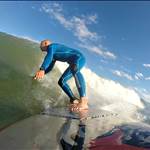
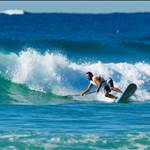
Here's a very short vid showing catching a downwinder runner.. and here's a few tips for those DW newbies.
Don't paddle, paddle, paddle.. It's not a race..
Don't look down at the nose of your board..
Don't look at the water just in front of the nose of your board..
Don't look back to try and see runners (waves) coming.. They're not behind you..
Paddle casually saving your energy for when you need it (to catch a runner)
Look up.. way up.. Approximately 30-50 feet away.. Sometimes further..
If land is on your left they will usually head (move) left.. Not so much head directly towards the shore.
If land is on you right they will usually head that way regardless of the wind direction.
Look for waves that stand out because you can see the backs of them..
Wind waves (runners) are usually in set of two or three.. and sometimes four..
It's best to get in behind the last one.. It's usually the biggest.. You are trying to surf into the hole left behind the wave in front of the wave that you're surfing on.. If you catch the first one and you quickly run ahead and into nothing.. If when you see these waves ahead and you just stop paddling they continue to move forward and away from you.. It just takes a steady pace to catch up to them.. They are more like a standing wave on a river than a normal surfing wave.
In my case with land on my left I'm looking for waves that are not only ahead but ahead and to my right (because they move across towards the land)... If they're straight in front of me by the time I catch up to them they will have moved too far off to my left to chase them down without heading too much off my finishing point direction.. Holding your line towards your finishing point is very important..
Anyone else with with tips please feel free to add to my list.. I'm sure there's more.. 
or if anyone disagrees please also feel free to coment..
Also.. In my vid I could have surfed the runner more to the right to milk it more.. but I chose to use it to surf left.. to hold my line towards the finishing point.. Towards the end of that runner you can see another set of waves ahead and over to my right.. I might have been able to link the two together but I was more concerned with holding my line and going left.. 
Thanks for the tips and the video DJ- very helpfull 
I saw the video before before I read the text and was dying for you to go right- but now I know why.
One tip that really has helped me is : not to go straight. I ofte see people taking of on a bup and then plowing straight in to the wave in front of them, you stay on the run a lot longer if you go a little diagonal. Downwinding is not straigh-lining you often stray a100 meters( or more) to the left or right before going back on line.
Keep the vids coming :-)
Select to expand quoteDavidJohn said..
Here's a very short vid showing catching a downwinder runner.. and here's a few tips for those DW newbies.
Don't paddle, paddle, paddle.. It's not a race..
Don't look down at the nose of your board..
Don't look at the water just in front of the nose of your board..
Don't look back to try and see runners (waves) coming.. They're not behind you..
Paddle casually saving your energy for when you need it (to catch a runner)
Look up.. way up.. Approximately 30-50 feet away.. Sometimes further..
If land is on your left they will usually head (move) left.. Not so much head directly towards the shore.
If land is on you right they will usually head that way regardless of the wind direction.
Look for waves that stand out because you can see the backs of them..
Wind waves (runners) are usually in set of two or three.. and sometimes four..
It's best to get in behind the last one.. It's usually the biggest.. You are trying to surf into the hole left behind the wave in front of the wave that you're surfing on.. If you catch the first one and you quickly run ahead and into nothing.. If when you see these waves ahead and you just stop paddling they continue to move forward and away from you.. It just takes a steady pace to catch up to them.. They are more like a standing wave on a river than a normal surfing wave.
In my case with land on my left I'm looking for waves that are not only ahead but ahead and to my right (because they move across towards the land)... If they're straight in front of me by the time I catch up to them they will have moved too far off to my left to chase them down without heading too much off my finishing point direction.. Holding your line towards your finishing point is very important..
Anyone else with with tips please feel free to add to my list.. I'm sure there's more..
or if anyone disagrees please also feel free to coment..
Also.. In my vid I could have surfed the runner more to the right to milk it more.. but I chose to use it to surf left.. to hold my line towards the finishing point.. Towards the end of that runner you can see another set of waves ahead and over to my right.. I might have been able to link the two together but I was more concerned with holding my line and going left..
Thanks DJ for taking the time that information is golden having not come from a surfing background the biggest challenge for myself is reading the ocean.
Cheers.
Great info, spot on, exept for the left and right thing.
where I live conditions change a lot, the south west part of the Island, is completely different from the north Side.
on both sides, you can go left hand shore OR right hand shore, depending on the wind direction.
you have to adapt to these conditions for sure, but I don,t recognice what DJ says in this
Select to expand quoteflowmaster said...
Great info, spot on, exept for the left and right thing.
where I live conditions change a lot, the south west part of the Island, is completely different from the north Side.
on both sides, you can go left hand shore OR right hand shore, depending on the wind direction.
you have to adapt to these conditions for sure, but I don,t recognice what DJ says in this
I'll try and explain that left and right thing better..
Maybe I shouldn't have complicated it by adding that..
Excellent work Dj
Very hard to explain and teach. It is an art form. Some of our best paddlers were once beginners at this and I know from experience they didn't learn it overnight.
I do like to look at the water in front of the board.
I don't normally look to far out in front. Basically studying the water in front and to either side of the board.
There is a diferent technique to catching a bump/runner than your normal stroke.
Your quite right about NOT looking behind. This is a common mistake with a lot of people.
cheers
Pete Dorries
Select to expand quotepetedorries said..
Excellent work Dj
Very hard to explain and teach. It is an art form. Some of our best paddlers were once beginners at this and I know from experience they didn't learn it overnight.
I do like to look at the water in front of the board.
I don't normally look to far out in front. Basically studying the water in front and to either side of the board.
There is a diferent technique to catching a bump/runner than your normal stroke.
Your quite right about NOT looking behind. This is a common mistake with a lot of people.
cheers
Pete Dorries
I remember a paddle with Pete in a 6 man canoe downwind for about 12-13ks with bumps galore. As the steerer he directed traffic in the boat... 'Ok, in the hole just sit up and relax' next thing he's telling you to get ready and "Now... GO!" he jams it left or right and we railroad 50,60 or 70m of bumps together with the OC6 moving around like a go-cart left and right.
At one point I'm looking up straight at the beach, the next directly out to sea. I'm thinking.... WTF is he doing? we're meant to be heading up the beach??. By memory we came around the half way buoy and turned downwind in about 25th out of 50 or so boats, we finished top 10.... Far from the fittest or strongest crew in a National Titles race. The upwind bit hurt, the downwind bit we had a guy that knew the bumps taking us for a ride. Yelling, cheering and having a great time...
Moral of the story I think I learnt more in that paddle than ever before about relaxing on the bump and work out however you can to get onto the next one and not just let the one you're on fade away crusing for ever. Go whichever way you need to stay on the bump. If you're good you'll probably have put yourself in the right place to get over to the next bump and hardly paddle at all while going twice as fast as everyone.
I also recall Beau Obrien passing me one day while I was trying to paddle fast, he flew past and dissapeared out of sight taking about 6 strokes to do it. I was amazed and demoralised in one foul swoop/
Hi there seabreeze's I am new so hope this is the correct spot to ask for advise,
I have picked up a 2nd hand 14' fly race (red rocket) and been playing in North Qld short choppy waters.
My request is for tips on paddling out to get a suitable downwind angle you have great tips on the downwind component of this additive sport but I have some seriously uneven bumps to get through when I head out. I dont seem to be getting any better at this part of my paddling seem to get knocked off a lot, end up on my knees etc I do not have anyone to copy tequnique so it's over to you guys for any tips.
Thanks
DJ you are an excellent teacher , I have been lucky enough to benefit from your patience and advice first hand.
Many a time I have seen you intentionally lag behind on a good run to assist newbies on their first downwind experience.
Thanks from all of us!
Select to expand quoteMOSCA said..
Hi there seabreeze's I am new so hope this is the correct spot to ask for advise,
I have picked up a 2nd hand 14' fly race (red rocket) and been playing in North Qld short choppy waters.
My request is for tips on paddling out to get a suitable downwind angle you have great tips on the downwind component of this additive sport but I have some seriously uneven bumps to get through when I head out. I dont seem to be getting any better at this part of my paddling seem to get knocked off a lot, end up on my knees etc I do not have anyone to copy tequnique so it's over to you guys for any tips.
Thanks
this is probably one of the best descriptions of how to downwind paddle that there is, along with DJ's videos being some of the best downwind footage
most people don't just hop on straight away it will take time and practice, and a lot of little tips, but if you keep at it you will get better, if you are getting knocked off a bit, maybe try altering your stance a little bit
Jarryd
Thanks for the input everyone but i think my question may be misunderstood.
Downwind all good having a ball even getting some runners joined together.
Getting offshore far enough at a 45 degrees angle to the swell is my problem.
If I stand back near the centreline handle the nose is continually blown downwind and if I am up on the front of the deck pad the waves coming over the nose don't allow me to get enough speed to make headway.
Is it just a stubborn resolve needed to get out.
Or do you all just start from land that is directly upwind of your expected arrival point in downwinders.
Select to expand quotepetedorries said..
Excellent work Dj
Very hard to explain and teach. It is an art form. Some of our best paddlers were once beginners at this and I know from experience they didn't learn it overnight.
I do like to look at the water in front of the board.
I don't normally look to far out in front. Basically studying the water in front and to either side of the board.
There is a diferent technique to catching a bump/runner than your normal stroke.
Your quite right about NOT looking behind. This is a common mistake with a lot of people.
cheers
Pete Dorries
same as.
its usual for some one to say don't look at the water in front of the board and look way ahead.
but hey jd did you do get the bumps and I swear, by your vids, you are looking at the water just in front the way you paddle
cheers
Select to expand quoteMOSCA said...
Thanks for the input everyone but i think my question may be misunderstood.
Downwind all good having a ball even getting some runners joined together.
Getting offshore far enough at a 45 degrees angle to the swell is my problem.
If I stand back near the centreline handle the nose is continually blown downwind and if I am up on the front of the deck pad the waves coming over the nose don't allow me to get enough speed to make headway.
Is it just a stubborn resolve needed to get out.
Or do you all just start from land that is directly upwind of your expected arrival point in downwinders.
Up wind paddling sucks but I do it for training runs if alone out into the bay and back. I have a big boof nose board so any side wind spins it. I find paddling hard dead straight into the wind and swell is best. From any angle and it's going to throw you around a bit.
It's just finding the right angle and then hitting it hard short sharp strokes help in head wind paddling and I also stand left foot forward just a little bit in surf stance but maybe that's just me.
If you find yourself going to ur knees then I think it's just practise and practise getting the balance worked out on the board in those conditions.
A hard slog upwind is always worth it when you turn and get a few kilometres of runners back.
Select to expand quoteAndyR said..MOSCA said...
Thanks for the input everyone but i think my question may be misunderstood.
Downwind all good having a ball even getting some runners joined together.
Getting offshore far enough at a 45 degrees angle to the swell is my problem.
If I stand back near the centreline handle the nose is continually blown downwind and if I am up on the front of the deck pad the waves coming over the nose don't allow me to get enough speed to make headway.
Is it just a stubborn resolve needed to get out.
Or do you all just start from land that is directly upwind of your expected arrival point in downwinders.
Up wind paddling sucks but I do it for training runs if alone out into the bay and back. I have a big boof nose board so any side wind spins it. I find paddling hard dead straight into the wind and swell is best. From any angle and it's going to throw you around a bit.
It's just finding the right angle and then hitting it hard short sharp strokes help in head wind paddling and I also stand left foot forward just a little bit in surf stance but maybe that's just me.
If you find yourself going to ur knees then I think it's just practise and practise getting the balance worked out on the board in those conditions.
A hard slog upwind is always worth it when you turn and get a few kilometres of runners back.
Or you are on the wrong board.
I have gone from 12'6" Fanatic to 14' DC to 17' Naish. (2011 model, cheap second hand)
In big cross chop, the Naish just blew me away.
The rudder helps, but you can do 45 degrees up or downwind no problem
Since got at 17'4" SIC, which is even better.
Absolutely planted and stable in waves.
The big boards do get difficult around home though - can't turn them without bashing something.
Particularly on the big boards, I also enjoy an upwind slog - no ride, but very satisfying to do.
And I find the wave motion upwind less threatening than downwind
Select to expand quoteMOSCA said...
Hi there seabreeze's I am new so hope this is the correct spot to ask for advise,
I have picked up a 2nd hand 14' fly race (red rocket) and been playing in North Qld short choppy waters.
My request is for tips on paddling out to get a suitable downwind angle you have great tips on the downwind component of this additive sport but I have some seriously uneven bumps to get through when I head out. I dont seem to be getting any better at this part of my paddling seem to get knocked off a lot, end up on my knees etc I do not have anyone to copy tequnique so it's over to you guys for any tips.
Thanks
If you're still using the stock fin in that board then try smaller as it's massive. Large fins will force the nose off the wind as they can't drift meaning you put a lot of force in to redirecting the board which is slow and very tiring.
Smaller fins are far more agile and let you keep the board pointing where you want it to point not where the wind wants it to point
Select to expand quoteMOSCA said..
Thanks for the input everyone but i think my question may be misunderstood.
Downwind all good having a ball even getting some runners joined together.
Getting offshore far enough at a 45 degrees angle to the swell is my problem.
If I stand back near the centreline handle the nose is continually blown downwind and if I am up on the front of the deck pad the waves coming over the nose don't allow me to get enough speed to make headway.
Is it just a stubborn resolve needed to get out.
Or do you all just start from land that is directly upwind of your expected arrival point in downwinders.
Yes best to start from land that is in a good line but not always possible
I have seen the best Downwind paddlers in Australia on their knees paddling out. So don't think nothing of it. If its windy its windy.
if you can try to surf out to your desired line if possible. May seem slower but builds good skill.
Nice work DJ - some great tips there and a nice little video to top it off. Your technique obviously works very well.
However, I also don't get the look 30-50 feet ahead thing - I could understand looking further ahead if you mean for balance? (keep a key on the horizon?) or navigation (nasty looking headland looming), but can't understand what you're looking at in the 30-50ft ahead that actually helps with catching runners.
Regarding paddling out cross wind to get to the downwind run... one of my most common runs requires about 500-750m slog cross-wind to clear a set of headlands. Usually there's a bit of swell as well as the wind chop and wind itself. Everything conspires to turn me leeward and send me to the rocks. I've tried:
- sinking the reverse rail when paddling (really tricky in ocean conditions and doesn't seem to make any difference that I can notice)
- standing near the back and constantly swinging the board back side on to the wind to correct course
- stopping, turning back side on then paddle hard until I need to correct again
- paddling on knees, alternating with paddling prone (you can't paddle on knees for too long otherwise your legs don't work when you need to start going downwind, paddling prone on a 29" wide board isn't the most efficient either)
None of them are much fun, but I deploy them in that order depending on how close the rocks are getting.