Guys,
I am looking for any pointers to improve my downwinding.
I haven't been doing it for long, and have read and watched alot of the stuff on SB, but the key difference is that the conditions I am in are largely based around unpredictable chop, generated in relatively shallow water and 20 knots onshore. I am finding the theory of paddling hard for the wave in front is near impossible, as they don't come through with that sort of regularity.
I am currently paddling hard when I feel some lift in the tail, and am definitely catching a few, but I have no doubt that my technique can be improved.
Noticed today at the start of my run I was paddling with a higher cadence and it seemed like I was making better progress, but as I tired and slowed down the paddle rate it seemed like I was missing more opportunities and felt like I was generating all the momentum with no benefits from the conditions. For that reason, I am considering going to a smaller paddle so it can spend more time in the water at a higher frequency - is there merit in that?
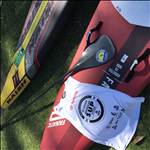
Board is 2014 Falcon 27.25, paddle is 8" Fanatic Carbon 40.
Interested to hear what you guys think.
Thanks,
Scott.
So if its 20 knts onshore are you battling your way out some distance and then downwinding back to shore?
Select to expand quoteScott79 said..
Guys,
I am looking for any pointers to improve my downwinding.
I haven't been doing it for long, and have read and watched alot of the stuff on SB, but the key difference is that the conditions I am in are largely based around unpredictable chop, generated in relatively shallow water and 20 knots onshore.
Are you paddling downwind or across the onshore chop Scott 
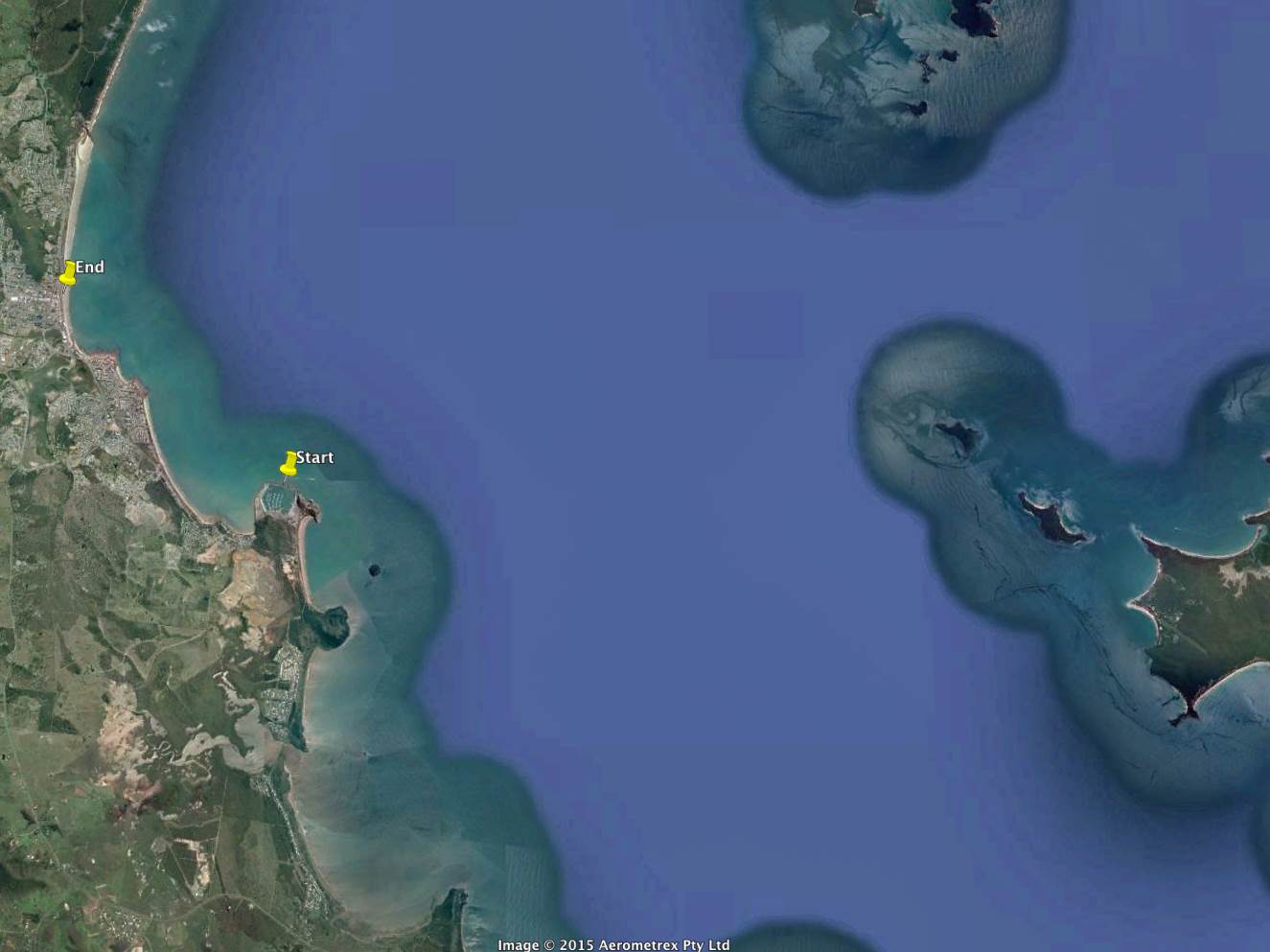
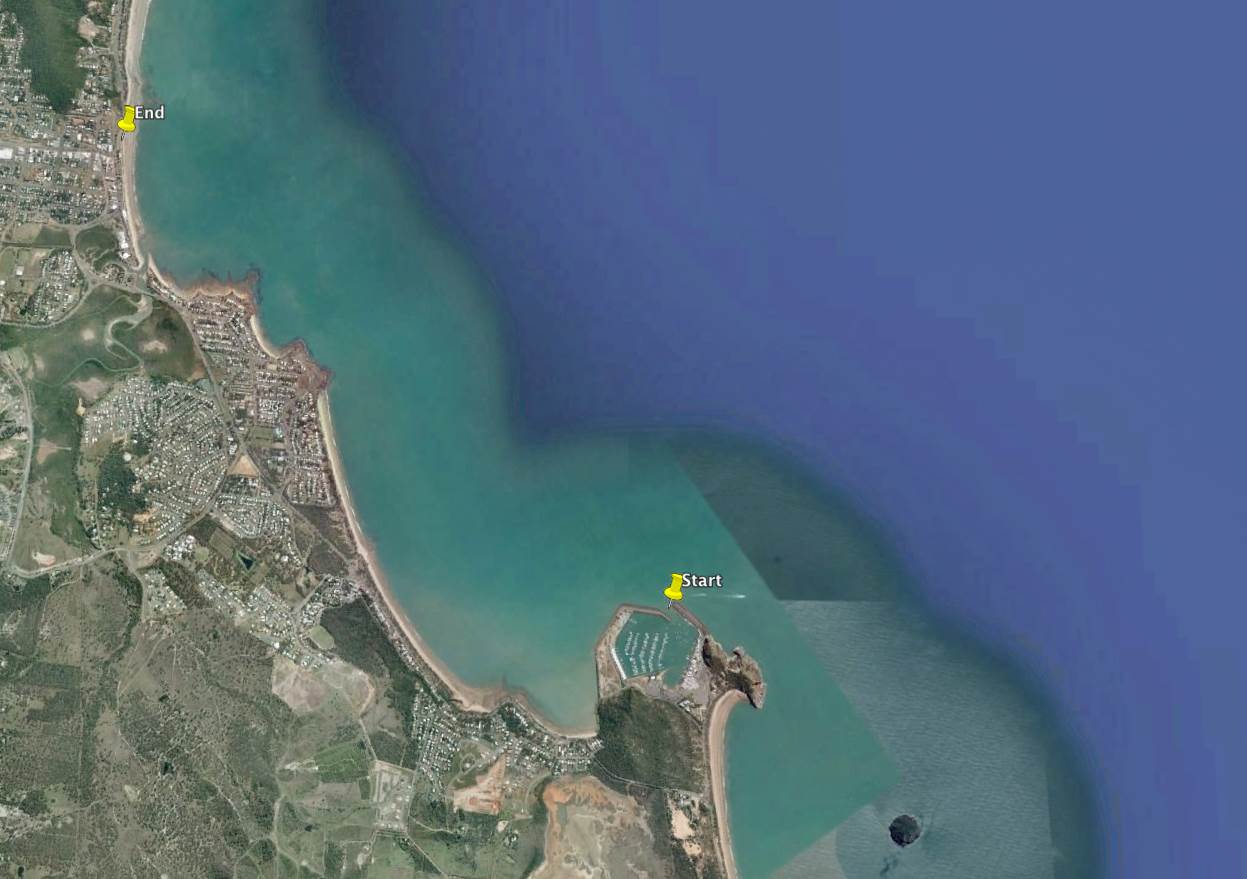
OK, to add some context, the top image is the bay, and the bottom image the typical run - a bit over 5km.
Both images are 'North up', so in a South Easterly the wind is more or less at your back. The first quarter or so of the run the swell/chop is pretty confused and typically angled behind/beside you at 30 degrees or so, no doubt due to the protection of the harbour, but the further into the run the more directly behind you it becomes.
Scott.
Whatever you do, don't get an Ace. It is horrible in confused shallow waters and side-chop.
Yes, a smaller blade can help. The stroke for DWing short period stuff if quite different from the best stroke for flat water. To get on a bump, use lots of very short strokes way out in front of you. Machine-gun it with light, short, strokes. It feels all wrong but works really well and is efficient in terms of endurance. The reason it works is largely I think because that kind of stroke doesn't compress the board in the water so much as a long hard one, freeing it up to plane easier and earlier.
Also, DWing is a substantially about timing your efforts and conserving energy. Don't paddle uphill, and bear in mind when considering pulling hard to try to make a bump that usually if you are having to make that much effort it is to going to work out, and you'll have blown about 3-minutes's worth of paddling energy in about 3 seconds. It is usually not worth it. An exception might be when you are already in a small bump and can use that speed plus extra paddle speed to get into a much bigger, faster-moving bump. But that doesn't happen very often in most runs for most people , and you really have to be moving pretty fast before it will work. Mostly, digging deep and trying to muscle yourself into bumps doesn't work terribly well except as exercise. Timing, steering and trim, with skilful rather than hard paddle-work and good reading of the water are mostly more effective. It's hard to teach that stuff though, mostly it's down to time on the water in a variety of conditions.
Oh, and btw, having the right board for the conditions can make a HUGE difference downwinding. More so than in flat water. Often in runs with friends we use runs where there might be two or three distinct sections with changes in depth of the water, how confused the water is etc. On different boards we will often see radically different speeds between different boards in different sections. These differences can dwarf the differences in skill and fitness between the paddlers, so you can see the person who was fastest in one section become the slowest in another and vice-versa. In fact this is a frequent occurrence. I was DWing yesterday with a friend who is a similar speed to me if we are on the same board. He was on a GS Naish Glide 14 V2 (27.5" wide). I was on a SCC SIC Bullet 14v2. Conditions were very shallow and short period chop in the 1-2ft range. The Bullet (unusually) did not like the conditions at all, and there was no way I could stay with my friend. The relatively flat rocker of the Bullet meant a huge amount of footwork was required, and it was extremely hard to avoid poking the nose. My friend however, with the much bigger nose rocker of the Glide, could remain relatively still in his board and the rocker took care of everything. He was MUCH faster, with less effort. However in the last section of the run the water becomes much more confused and it is almost like surfing rippy cross-chop. As soon as he hit this section the Naish slowed and started doing the hammock-swing thing that board tends to do occasionally, and threw him off a few times, and I was able to sail past him without any problem on the Bullet v2. I made a mental note however to take my Bullet V1 on that run next time - and let rocker be my friend.
So, the right board choice can be vital to enjoyment when DWing, and there's no such thing as a board that is perfect for all conditions, unfortunately (just as with surf SUPs). So if you can, try lots of different boards in your conditions and find out what works best for you. It is unlikely that anyone will be able to give you terribly accurate advice about that - there are too many variables at work. You just have to try for yourself.
Select to expand quoteArea10 said..
Whatever you do, don't get an Ace. It is horrible in confused shallow waters and side-chop.
Yes, a smaller blade can help. The stroke for DWing short period stuff if quite different from the best stroke for flat water. To get on a bump, use lots of very short strokes way out in front of you. Machine-gun it with light, short, strokes. It feels all wrong but works really well and is efficient in terms of endurance. The reason it works is largely I think because that kind of stroke doesn't compress the board in the water so much as a long hard one, freeing it up to plane easier and earlier.
Also, DWing is a substantially about timing your efforts and conserving energy. Don't paddle uphill, and bear in mind when considering pulling hard to try to make a bump that usually if you are having to make that much effort it is to going to work out, and you'll have blown about 3-minutes's worth of paddling energy in about 3 seconds. It is usually not worth it. An exception might be when you are already in a small bump and can use that speed plus extra paddle speed to get into a much bigger, faster-moving bump. But that doesn't happen very often in most runs for most people , and you really have to be moving pretty fast before it will work. Mostly, digging deep and trying to muscle yourself into bumps doesn't work terribly well except as exercise. Timing, steering and trim, with skilful rather than hard paddle-work and good reading of the water are mostly more effective. It's hard to teach that stuff though, mostly it's down to time on the water in a variety of conditions.
Oh, and btw, having the right board for the conditions can make a HUGE difference downwinding. More so than in flat water. Often in runs with friends we use runs where there might be two or three distinct sections with changes in depth of the water, how confused the water is etc. On different boards we will often see radically different speeds between different boards in different sections. These differences can dwarf the differences in skill and fitness between the paddlers, so you can see the person who was fastest in one section become the slowest in another and vice-versa. In fact this is a frequent occurrence. I was DWing yesterday with a friend who is a similar speed to me if we are on the same board. He was on a GS Naish Glide 14 V2 (27.5" wide). I was on a SCC SIC Bullet 14v2. Conditions were very shallow and short period chop in the 1-2ft range. The Bullet (unusually) did not like the conditions at all, and there was no way I could stay with my friend. The relatively flat rocker of the Bullet meant a huge amount of footwork was required, and it was extremely hard to avoid poking the nose. My friend however, with the much bigger nose rocker of the Glide, could remain relatively still in his board and the rocker took care of everything. He was MUCH faster, with less effort. However in the last section of the run the water becomes much more confused and it is almost like surfing rippy cross-chop. As soon as he hit this section the Naish slowed and started doing the hammock-swing thing that board tends to do occasionally, and threw him off a few times, and I was able to sail past him without any problem on the Bullet v2. I made a mental note however to take my Bullet V1 on that run next time - and let rocker be my friend.
So, the right board choice can be vital to enjoyment when DWing, and there's no such thing as a board that is perfect for all conditions, unfortunately (just as with surf SUPs). So if you can, try lots of different boards in your conditions and find out what works best for you. It is unlikely that anyone will be able to give you terribly accurate advice about that - there are too many variables at work. You just have to try for yourself.
get a ace. its the board they go to in chop 
if your good enough. 
look at that combined comp distance race in new zealand this year. every rider from every brand was on a ace for race in a choppy dw.
there was a thread in the breeze about it
The Ace is the last board I'd recommend to someone starting out in downwinding.
Learning to downwind means lots of falls. The Ace is very difficult to get back in (because you do get back "in" it rather than "on" it) when it is windy and there's significant chop. In fact this was the main reason why the previous owner sold his Ace to me: his wife had been watching him struggle on and off it at sea in wind and chop and told him that he didn't look safe and should sell it. He took no convincing.
So, with respect, recommending the Ace to a relative beginner just isn't very wise. In tricky conditions it's a board for very skilled people only. It is pretty awful in cross-chop and cross-winds relative to a proper downwind board and there are much more effective boards available in those conditions for the majority of paddlers. I own 16 SUP boards including the Ace, and the Ace is probably the last one I'd put someone starting out in downwinding on.
Select to expand quoteArea10 said..
The Ace is the last board I'd recommend to someone starting out in downwinding.
Learning to downwind means lots of falls. The Ace is very difficult to get back in (because you do get back "in" it rather than "on" it) when it is windy and there's significant chop. In fact this was the main reason why the previous owner sold his Ace to me: his wife had been watching him struggle on and off it at sea in wind and chop and told him that he didn't look safe and should sell it. He took no convincing.
So, with respect, recommending the Ace to a relative beginner just isn't very wise. In tricky conditions it's a board for very skilled people only. It is pretty awful in cross-chop and cross-winds relative to a proper downwind board and there are much more effective boards available in those conditions for the majority of paddlers. I own 16 SUP boards including the Ace, and the Ace is probably the last one I'd put someone starting out in downwinding on.
Select to expand quoteArea10 said...
I own 16 SUP boards including the Ace
16?! That has to be some kind of record I reckon. You own far to many haha.
Scott.
Don't paddle up hill. when starting out downwinding is about relaxing and picking the times to paddle. When the nose of the board lifts and points up don't paddle its wasted Energy. When The nose drops and points down hill paddle hard 2/3 hard sprint strokes should be enough to get onto a little bump.
When it's cross chop it's cross chop it always gets tough and messy. But you should be able to see the water movement and even when there's bumps going across you one will be going in the direction you want. Those are the ones you go hard for.
Hard to surf little bumps in bay type conditions unless it's really really blowing and they get big. I find it's more about getting on a bump a step back once on the glide then try paddle to link into another.
I've been dw about once a fortnight for 2 years now and still feel like I'm just starting and learning.. It's a long process to work it all out I think.
I like to think of down winding a 'surfing' the bumps and use my SUP surfing technique and timing to catch the bumps i.e read the water and spot a bump/rolling wind chop/wave to catch and go into a high cadence paddle and then stand up when I get the lift and start planing to catch my breath and enjoy the ride, and then paddle hard again to get the nose into the top of the chop/bump in front to 'link the bumps' as they say and catch another lift.
In between catching bumps I am just in a steady paddle cadence but nothing too hard as need/want to save energy to then shift into high 'surf' cadence when I spot the next bump to catch. All good fun!
Select to expand quoteAndyR said...Area10 said...
I own 16 SUP boards including the Ace
16?! That has to be some kind of record I reckon. You own far to many haha.
Scott.
Don't paddle up hill. when starting out downwinding is about relaxing and picking the times to paddle. When the nose of the board lifts and points up don't paddle its wasted Energy. When The nose drops and points down hill paddle hard 2/3 hard sprint strokes should be enough to get onto a little bump.
When it's cross chop it's cross chop it always gets tough and messy. But you should be able to see the water movement and even when there's bumps going across you one will be going in the direction you want. Those are the ones you go hard for.
Hard to surf little bumps in bay type conditions unless it's really really blowing and they get big. I find it's more about getting on a bump a step back once on the glide then try paddle to link into another.
I've been dw about once a fortnight for 2 years now and still feel like I'm just starting and learning.. It's a long process to work it all out I think.
Ive been doing for 6 to 7 years and there still stuff that tricks me up. Like coming of a massive set/link bumps only to stop dead. Gps graphs show it every time. Im not sure what to do. Go one less bump, Immediately cut across After running off ummm
But then guys like travis ,beau etc have doing it since they were kids
Yeah I'm with Lacey. The only board to get for these conditions is an Ace. Maybe it's different in the northern hemisphere.
Thanks to all.
I hadn't really thought too hard about the 'not paddling uphill' but it makes alot of sense. I am finding I still need to maintain a bit of momentum even when the going is tough in order to maintain balance.
Appreciate your detailed responses guys.
Scott.
That's how I was taught Scott.
When you feel the brakes come on and the board slows and nose points up you are either coming off the back of a bump or stuck on top of one at that point no point paddling you ant going to catch it. But a split second later that nose could drop a bit and that's when you go hard because that's you getting onto the bump behind the one you just didn't.
Paddling bay conditions like you are in tsv is much like brissy moreton bay And I assume Melbourne. Totally diferent to outside Gold Coast and Hawaiin stuff where the moving swell has a lot of volume.
Another tip is to try and stay on a runner - no matter how small and slow. The small ones can suddenly turn into big ones, particularly when the wind is diagonal.
First ever board was a 2012 ACE, learnt to paddle on it...flirted with nsp for a bit. Now back on a 2014 ACE. Loves the Port Phillip Bay chop no matter what direction I'm heading
So many of the top riders in Oz and NZ ride an ACE. I love mine and have recommended them to heaps of guys starting to paddle in the ocean. My recommendation would be to start with the wider one. The guys that have started with the wide ACE have progressed really well. Due to its stabillity they're able to concentrate on the learning side of down winding rather than concentrate on trying to stay upright.. Many of these guys have kept the wide ACE for bigger days and have now gone and got the 25.
I'd agree with Area 10 that the down side to the ACE is having to climb back in. But with the number of sharks here at the moment most of us are back in pretty quickly.
Like others have said, the don't paddle uphill is the secret, I believe, when downwinding. When you feel a wave under you that you are confident you can paddle onto, try to drop into the trough and keep the nose of the board in behind the wave in front (i.e. going 'downhill') and then just try to maintain that position for as long as you can. This will require some movement on the board and/or use of the paddle - some quick short strokes as recommended by others above. For choppy conditions, (for me, at least) I think it is best that you don't try to punch through the swell in front, just milk that wave for as long as it lasts....keeping the nose of the board nestled into the back of the wave in front - unless you have good wind behind you. 25+ knots and you can get up the speed to get over that wave in front.
Select to expand quotePTWoody said...
Yeah I'm with Lacey. The only board to get for these conditions is an Ace. Maybe it's different in the northern hemisphere.
If the Ace is such a great downwinder for everyone, then why don't I see everyone paddling one on DJ's videos. In fact in his latest one you are on an All Star. Why aren't you on the apparently far superior Ace?
The Ace is effective (if tricky) for sure in small stuff, but round here the waters are very confused and bumps are short period, and can get a decent size (head-high on occasion, waist-high commonly) considering we aren't in eg. Hawaii, and I don't know anyone skilled enough to use the Ace 14x25 in those conditions. Maybe you are all much more skilled in Oz. Or maybe you don't DW in open ocean.
It looks to me that the biggest growth in DW boards in your area recently is with SICs, not Aces. The SIC DW boards are much more useable than the Ace for most paddlers DWing IMO. But sure, if you downwind well-lined up little bumps in protected waters and your balance is good then the Ace could work for you.
I actually quite liked the Fanatic board that the OP has when I tried it in knee-high bumps. It's fast downwind in a good blow and a lot less technical than the Ace. You don't need much footwork at all. I very much doubt that the OP would find choppy conditions easier switching to an Ace. But maybe he can borrow one and give us his observations.
Select to expand quoteArea10 said..PTWoody said...
Yeah I'm with Lacey. The only board to get for these conditions is an Ace. Maybe it's different in the northern hemisphere.
. Maybe you are all much more skilled in Oz. Or maybe you don't DW in open ocean.
.
theres the answer... we are AUSSIE we are more skilled than any other nation in sport 
Select to expand quoteAndyR said..Area10 said..PTWoody said...
Yeah I'm with Lacey. The only board to get for these conditions is an Ace. Maybe it's different in the northern hemisphere.
. Maybe you are all much more skilled in Oz. Or maybe you don't DW in open ocean.
.
theres the answer... we are AUSSIE we are more skilled than any other nation in sport
I find it very hard to argue with you on that point although it's only fair to say the Kiwis also love their Aces, and their water is even more messed up than ours. Kind of like their anthropomorphic relations.
Select to expand quoteArea10 said..
It looks to me that the biggest growth in DW boards in your area recently is with SICs, not Aces. The SIC DW boards are much more useable than the Ace for most paddlers DWing IMO.
Yes SIC are having huge growth here in Oz but that's a combination of good boards and a new distribution network here with a new importer. Even if the boards had not changed we would have seen huge growth due to the importer change.
PT Woody doesn't use the ACE downwinding with DJ because he rips his tights when he climbs back on board after a fall. I'm sure Paul has heard it all before.
Select to expand quote2222222 said..
PT Woody doesn't use the ACE downwinding with DJ because he rips his tights when he climbs back on board after a fall. I'm sure Paul has heard it all before.
Love it!
Select to expand quotePTWoody said..
AndyR said..
Area10 said..
PTWoody said...
Yeah I'm with Lacey. The only board to get for these conditions is an Ace. Maybe it's different in the northern hemisphere.
. Maybe you are all much more skilled in Oz. Or maybe you don't DW in open ocean.
.
theres the answer... we are AUSSIE we are more skilled than any other nation in sport
I find it very hard to argue with you on that point although it's only fair to say the Kiwis also love their Aces, and their water is even more messed up than ours. Kind of like their anthropomorphic relations.
I was never going to say that. I wanted too, but these kind of statements have a habit of turning around and biting you on the bum