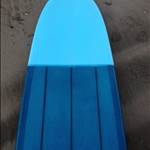
I've just noticed that both my naish and fanatic boards have a matt finish on the bottom, and the rails and top of the fanatic is nice and polished. Any idea why this is?
Cheers
Chris
Select to expand quoteChris1410 said..
I've just noticed that both my naish and fanatic boards have a matt finish on the bottom, and the rails and top of the fanatic is nice and polished. Any idea why this is?
Cheers
Chris
Two main reasons IMO..
The matt finish hides scuffs.. and scratches from sliding up the sand also helps hide those little dimple dents that you often get on the bottom of boards because of the light glass job on the bottom of board.. Gloss makes them really stand out...
Also... a matt finish is supposed to be faster through the water than gloss because the water tends to stick to gloss and release better with a matt or sanded finish.. Maybe a matt finish is cheaper to produce than gloss because of the polishing process...
DJ
What DJ said: two reasons, one cosmetic, one performance. Little scuffs aren't as visible, and water releases faster. Think of a shiny surface versus a Matt surface - water beads on a shiny surface, I.e. It sticks to it. In reality : it's all Cosmetic! Scratches aren't as obvious. That's all.
I used to give laminate offcuts to kids for the underside of their sandboards. The general consensus was that the stipple finish was faster. Aside from polishing the underside of a board, I'm pretty sure that a matt finish would provide better performance.
Call me cynical but I doubt SUPs made for the masses will matt finish them on the underside for performance....will be more economic or to hide scratches etc.
I've found that matt finished boards that come in contact with dark objects leave dark marks on the board,things like roof rack rubber.
none of my gloss boards do that.just saying
So if a matt finish makes a performance difference...and I've read and seen a lot of stuff about how that's supposed to work...how come no-one puts a matt finish on paddles?
Is the paddle supposed to stay pretty much in the one spot and you move your body and board forward of that... Didn't think you would want the paddle to be too slippery....
Cheers
Select to expand quoteAbdillam said..
Is the paddle supposed to stay pretty much in the one spot and you move your body and board forward of that... Didn't think you would want the paddle to be too slippery....
Cheers
...granted...although I can't see it making much difference during power phases when the blade is mostly upright and perpendicular to the direction of travel...but we also want a fast release and recovery at the end of a stroke..and a slipperier blade face (when it's not feathered and coming out of the water) would help with that? Would the same go for entry and catch? Just thinking out loud really, thought I'd put it out there.
Select to expand quoteHumanCartoon said..Abdillam said.. Is the paddle supposed to stay pretty much in the one spot and you move your body and board forward of that... Didn't think you would want the paddle to be too slippery.... Cheers...granted...although I can't see it making much difference during power phases when the blade is mostly upright and perpendicular to the direction of travel...but we also want a fast release and recovery at the end of a stroke..and a slipperier blade face (when it's not feathered and coming out of the water) would help with that? Would the same go for entry and catch? Just thinking out loud really, thought I'd put it out there.
In the spirit of thinking out loud, I wonder if they have ever tested blades with a dimpled surface given the inherent performance increases with dimpled golf balls. Yes I know golf balls are different to blades but they do manufacture fins with a dimpled surface for more qualitative water release so I see no reason why they would not at least test for this.
Cheers Ozzie
Select to expand quoteHumanCartoon said..
So if a matt finish makes a performance difference...and I've read and seen a lot of stuff about how that's supposed to work...how come no-one puts a matt finish on paddles?
Because you'll always go for the nice shiny new one that's hanging up in the shop...it would be a brave manufacturer to go with a dull, matt finish and hang their paddles up next to the shiny ones...
BTW Stu...did you pack some of that nice Qld sunshine for our downwinder tomorrow?
In fact they do!! QB make the Magic paddle which has dimples on the inside face for this purpose. "dimples on the inside face aerates and reduces friction in and out of the water during critical phases of stroke for adding speed and reducing seconds off of your time"
www.quickbladepaddles.com/store/Kanaha-Magic-All-Carbon
Select to expand quoteemw said..
In fact they do!! QB make the Magic paddle which has dimples on the inside face for this purpose. "dimples on the inside face aerates and reduces friction in and out of the water during critical phases of stroke for adding speed and reducing seconds off of your time"
www.quickbladepaddles.com/store/Kanaha-Magic-All-Carbon
Ahh well there you go. Thank you for that.
Cheers Ozzie
You know I had the opportunity to watch the video and the narrator makes reference to the purpose behind utilising dimples on a blade and why this is NOT encouraged on an actual board. The thinking here is that the technology works well under speed which is why it is used for a blade which does in fact generate appreciable velocity. However this does not seem to be the case for boards. But I wonder about this. Would a board not reach comparable speeds to a paddle whilst travelling on a wave if not greater ones? Just thinking out loud. I can accept that a race board is limited by the individual creating the speed for board movement, however surely the speed on a wave is such that it would warrant at least further investigation with this type of surface.
Cheers Ozzie
Basically all the reasons DJ listed.
The point with price isn't just the polishing it is an extra couple of processes and a lot more time to achieve a gloss finish.
Any dimples in a paddle blade would only be any benefit in the catch and the release phase of the stroke as during the rest of it the blade should be reasonably static in the water. I see no real benefit.
DJ is on the money.
If you watch Joel Parkinsons pre heat routine of rubbing the bottom of his board with sand for the same reasons.
There was also alot of disscusion years ago on directionally sanding the bottom for channeling the water.
maybe a little over the top but a theory.
Select to expand quoteBrisKites said..
Basically all the reasons DJ listed. The point with price isn't just the polishing it is an extra couple of processes and a lot more time to achieve a gloss finish. Any dimples in a paddle blade would only be any benefit in the catch and the release phase of the stroke as during the rest of it the blade should be reasonably static in the water. I see no real benefit.
How did you arrive at this conclusion? Water either flows around an object in a laminar or turbulent fashion and this will vary whether the object itself is stationary or in a dynamic state. In simple terms the type of flow will be defined by velocity. I am not aware of the QB water test results but I would not discount any potential benefits.
Cheers Ozzie
It's just my opinion. Yes it will flow around but why would you want to accelerate it.
Select to expand quoteHumanCartoon said..
So if a matt finish makes a performance difference...and I've read and seen a lot of stuff about how that's supposed to work...how come no-one puts a matt finish on paddles?
Excellent point!
Because a board moSelect to expand quoteLeroy13 said..HumanCartoon said.. So if a matt finish makes a performance difference...and I've read and seen a lot of stuff about how that's supposed to work...how come no-one puts a matt finish on paddles?Excellent point!
Because a board moves through the water and friction is bad. A paddle is hopefully reasonably static in the water and friction is GOOD!
Getting back to boards and a matte finish, I asked Jacko why they use matte finish like on my Fanatic Prowave and he reckons it's to prevent the water from beading which is what happens on a gloss finish creating drag.
Pickup up a Fanatic carbon pro 8" paddle today. It has a matte finish on the blade....
Basically, there are two factors that induce drag in the water:
- form drag: this is why a boards moves easier to the front than to the sides
- surface friction: studies show that too smooth surfaces "cling" to the water and induce more drag than matte finishes. You can find more info there: www.boardlady.com/fast.htm www.standupzone.com/forum/index.php?topic=7044.0
Note reducing the surface friction is important for the paddles, too, otherwise you will lose energy on entry/release. This is not at play for "anchoring" the paddle, as the form drag there is so high that the paddle doesnt move a lot and friction drag is thus negligible.
I personally sand the hull & rails of my sailboards and SUPs if I see water "beading" on them. The effect is quite noticeable on sailboards, and I found that it helped in SUP when trying to gather as much speed as possible, when pumping to race sections, or on the high line. Sanding fins should help too, for a better flow around the fin and delaying spinouts.