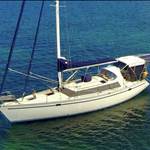
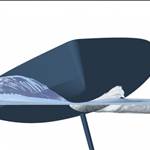
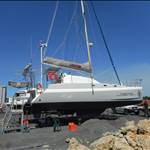
That's a scary cut out I'm wondering how well it's been strengthened before the furler was fitted?


Don't worry Southace, inmast furling has been around for a long time. Note the mast section is elliptical which adds to its resistance to buckling. The shrouds also add to the integrity of the whole system.
It's well engineered and a proven system. Lots of well known and respected brands have inmast furling models.
I've got inmast furling on a 34 footer - works well.
regards,
allan
True Allan I have not seen one cut away like that it's on a island packet 56 just looked a bit weak at first site.
It is a terrible idea, l resent and reject it in the strongest terms possible.
It nearly killed us when it got jammed on a new big Benny in storm conditions, 45-50knts gusting 60-65 in the notorious Bay of Biscay.
I would not live with it under any circumstances! 
The key to successful inmast furling management is to understand the mechanism and operate it accordingly.
Until I did, I had a few jambs - very frustrating.
Jambs are invariably caused by the sail initially being furled, or unfurled, with insufficient tension -so that some turns of the sail around the central rod can bunch up and jamb in the mast slot.
When retracting or deploying the main, it is important to maintain some tension on the sail to ensure the turns of the sail around the central rod are firm.
Viewed from the top of the mast, the sail is wound in a clockwise direction around the central rod. So, when viewed from the stern, the sail enters/exits the mast from the starboard side of the mast slot.
With the wind on the port side, the sail will tend to bind on the starboard side of the mast slot. Depending on wind strength and amount of exposed sail area, this added friction can make furling/unfurling very difficult or even impossible.
Conversely, with the wind on the starboard side, the sail will be clear of the sides of the mast slot and the wind will assist the unfurling of the sail. If you're not careful, this can lead to an uncontrolled, unwanted unfurling of the sail.
Exploiting these effects can make handling inmast furling safer and easier.
To furl with nice tight turns on the mast rod, get some starboard side wind on the sail and furl it whilst maintaining tension on the outhaul line.
Unfurl with some wind on starboard side and always maintain some tension on the furling line whilst operating the outhaul.
Inmast furling, when used correctly, is great for singlehanders like me. 
regards to all
allan
I am glad to learn that you are such an avid fan of a complicated to use and difficult to operate furling system which is hard to operate correctly even at normal wind conditions let alone in 15-20 foot seas and 60-70 knot gusts.
I this regard, l think you got no idea what you are talking about.
Select to expand quotesirgallivant said..
I am glad to learn that you are such an avid fan of a complicated to use and difficult to operate furling system which is hard to operate correctly even at normal wind conditions let alone in 15-20 foot seas and 60-70 knot gusts.
I this regard, l think you got no idea what you are talking about.
Hi Sirgillivant
I think you are being a bit harsh and judgemental of Datawiz
Regards Don
Hi all
My mate and his wife have a late model boat fitted with in mast furling and a head sail furler
They are both retired and only sail in the river and the channel and only go out on good days
The have both sailed in trying conditions on the boat they crew on in races but choose not to on their own boat
The in mast furling makes it easy for them to go for a sail and they love it
What suits them may not suit someone else but it is not up to us to judge or criticise others for their choice of boat or equipment because their usage may be completely different to ours
Regards Don
Personally, I think it's magnificent just to be able to drop your mainsail into a lazy jack stack pack.
Select to expand quoteDonk107 said..sirgallivant said..
I am glad to learn that you are such an avid fan of a complicated to use and difficult to operate furling system which is hard to operate correctly even at normal wind conditions let alone in 15-20 foot seas and 60-70 knot gusts.
I this regard, l think you got no idea what you are talking about.
Hi Sirgillivant
I think you are being a bit harsh and judgemental of Datawiz
Regards Don
I have to agree Donk.
I like SirG, he appears to have a lot of common sense and is foremostly focused on seamanship and safety, which is admirable.
I thought Datwiz' post to be quite erudite, it was clear and concise. I got straight away his description and suggestions on mitigating jams. And I enjoy Datawiz posts for that reason, they are always of interest and well written.
I wish SG you would contribute your point of view without the "my way or the highway" mantra.
We can respectfully disagree, can we not?
Cheers,
SB
The giant catermaran that was tourist operating out of Cairns had in mast furling.
They came back in one day with 100 odd punters on board and the furler jammed. It was about a 100 ft stick so they sent a guy up on a halyard with a sharp knife which he rode back down cutting the unfurled part of the sail off.
Them's ouch dollars.
Rather than inmast furling, I would go for behind mast furling which I think somebody on the forum has. That sort of stuff I believe is really only suitable for larger yachts because it puts a fair bit more weight aloft.
I have to agree with the forum etiquette quoted by others, we all have our likes/dislikes
I have never operated a in mast furler, but Alan's advice makes perfect sense to me. I jammed my Genoa furlers, my Ball's up, I left the haliard tension off, big mistake, but I'm not about condemning headsail furlers. And there are more and more new yachts with mainsail furling now. Me,I have a stack pack and that's fine, but I sometimes look enviously at the ease the mast furlers, allow cruiser to deploy the main, rather than motor a short bay hop!
I get a smug satisfaction hoisting the main and sailing back to the mooring from our local bay, when conditions are mild!
Richard
Hard and judgemental of a person l am not - if you read my words with care:
"...let alone in 15-20 foot seas and 60-70 knot gusts.
"In this regard, l think you got no idea what you are talking about." - whoever, of in-mast furling systems l am very critical.
Well, on my yacht or the one l am responsible for there is, yes, "my way or the highway" rules as democracy is not a platform on a sailing vessel. Not on the bay nor on the high seas, like it or not. Period.
Out there only prudence, perseverance and locking on to the fore-locks of Lady Luck are going to keep one alive.
It gives me grief to write this words, and l admit to a certain level of arrogance, but l do not take criticism likely from anyone who is obviously lacking similar experience to mine, where, because of a faulty in-mast furling system, we nearly lost a vessel and likely would have died on the iron bound coast of Normandy in '96.
Select to expand quotesirgallivant said..
Hard and judgemental of a person l am not - if you read my words with care:
"...let alone in 15-20 foot seas and 60-70 knot gusts.
"In this regard, l think you got no idea what you are talking about." - whoever, of in-mast furling systems l am very critical.
Well, on my yacht or the one l am responsible for there is, yes, "my way or the highway" rules as democracy is not a platform on a sailing vessel. Not on the bay nor on the high seas, like it or not. Period.
Out there only prudence, perseverance and locking on to the fore-locks of Lady Luck are going to keep one alive.
It gives me grief to write this words, and l admit to a certain level of arrogance, but l do not take criticism likely from anyone who is obviously lacking similar experience to mine, where, because of a faulty in-mast furling system, we nearly lost a vessel and likely would have died on the iron bound coast of Normandy in '96.
'96 to 2018 is a lot of time for improvements to the technology. Is it not??
Select to expand quotesirgallivant said..
Hard and judgemental of a person l am not - if you read my words with care:
"...let alone in 15-20 foot seas and 60-70 knot gusts.
"In this regard, l think you got no idea what you are talking about." - whoever, of in-mast furling systems l am very critical.
Well, on my yacht or the one l am responsible for there is, yes, "my way or the highway" rules as democracy is not a platform on a sailing vessel. Not on the bay nor on the high seas, like it or not. Period.
Out there only prudence, perseverance and locking on to the fore-locks of Lady Luck are going to keep one alive.
It gives me grief to write this words, and l admit to a certain level of arrogance, but l do not take criticism likely from anyone who is obviously lacking similar experience to mine, where, because of a faulty in-mast furling system, we nearly lost a vessel and likely would have died on the iron bound coast of Normandy in '96.
At the risk of a brow beating.
Why in storm conditions did you have so much sail out ?
or had it jammed some time before ?
My rig is rolling main .
i have been hit by a line scwall in Moreton bay and had the top fastener let go . Which resulted in the sail slipping half way down the track .
which made it not possible to furl properly.
had to climb mast strangle with rope before it shredded itself ,avoiding being hit by the flapping sail .
and yet I still like a rolling main.
for when it works it's just so easy.
i single hand.
the NZ in boom furling system looks ok to a outsider , never used one , but at least with that system some partial batons can be used.
the in mast set up does seem a bit "out of reach , hidden , complicated , difficult to fix and not efficient sailing wise .
heres a question without notice ....is there any other kind on here ? hahahah ... " Do charter fleets use in mast furling ? " if not, is is the extra build cost or is it the maintenance cost or punters inability to master the system ? or maybe they use it ?
Hi all
From what i have read, the boom needs to be at the correct angle to the mast to get a clean furl as well
Regards Don
Select to expand quoteDonk107 said..
Hi all
From what i have read, the boom needs to be at the correct angle to the mast to get a clean furl as well
Regards Don
Thanks Don - never knew that til now. Always open minded and ready to learn.
This forum sure is a treasure trove of information.
regards,
allan
Whoops! My oversight. It happened in '06 not in '96 as l wrote, so technology was not that much different from today's.
Of the question of reefing early - following the unwritten rules, "reef when you first think of it"! we started early and the near disaster started there.
Cut the story short, it was a rather terrifying but sobering hour and half, which l would not like to suffer again, hence my clinical aversion of any and all in - mast furling systems.
Once bitten, twice shy? !
Select to expand quoteDatawiz said..
The key to successful inmast furling management is to understand the mechanism and operate it accordingly.
Until I did, I had a few jambs - very frustrating.
Jambs are invariably caused by the sail initially being furled, or unfurled, with insufficient tension -so that some turns of the sail around the central rod can bunch up and jamb in the mast slot.
When retracting or deploying the main, it is important to maintain some tension on the sail to ensure the turns of the sail around the central rod are firm.
Viewed from the top of the mast, the sail is wound in a clockwise direction around the central rod. So, when viewed from the stern, the sail enters/exits the mast from the starboard side of the mast slot.
With the wind on the port side, the sail will tend to bind on the starboard side of the mast slot. Depending on wind strength and amount of exposed sail area, this added friction can make furling/unfurling very difficult or even impossible.
Conversely, with the wind on the starboard side, the sail will be clear of the sides of the mast slot and the wind will assist the unfurling of the sail. If you're not careful, this can lead to an uncontrolled, unwanted unfurling of the sail.
Exploiting these effects can make handling inmast furling safer and easier.
To furl with nice tight turns on the mast rod, get some starboard side wind on the sail and furl it whilst maintaining tension on the outhaul line.
Unfurl with some wind on starboard side and always maintain some tension on the furling line whilst operating the outhaul.
Inmast furling, when used correctly, is great for singlehanders like me.
regards to all
allan
I agree with everything Datawiz says. Initially I would have the wind in the wrong quarter when furling and get jams, loose furls and other issues. Once I understand the system better and became practised it was amazing how simply and quickly I could furl the main.
Select to expand quoteDonk107 said..
Hi all
From what i have read, the boom needs to be at the correct angle to the mast to get a clean furl as well
Regards Don
88 degrees if memory serves me correctly Just happens to be the same angle as the foot of the sail fully hoisted so one sets the topping lift to that and all is easy. Still need to head into the wind though.
Mine has full battens that help with the sail shape. The fact that it is infinitely reef-able I find good as well. 
UncleBob,
thanks for that - and also to Donk107.
Until he brought it up, I hadn't known about the boom angle. After googling around, I learned that this was quite an oversight on my part.
I think setting the right boom angle will make my furling operations much easier, especially in trying conditions.
I agree about the infinite reefing - having that fine control makes balancing the boat easier, so both the Raymarine autopilot or Monitor windvane don't have to struggle to maintain course.
regards,
allan
in the notorious Bay of Biscay. = on the iron bound coast of Normandy in '96.
Hmm, I don't have a chart of that area so I used Google maps,
I am aware that no competent navigator would refer to such unreliable sources, but such a navigator would not confuse such widely spaced locations.
I bit like placing Cairns in the Gulf of Carpentaria.
But to be fair in storm conditions, 45-50knts gusting 60-65 or wind conditions let alone in 15-20 foot seas and 60-70 knot gusts
it would be easy to miss your position by 600 kilometers.
Gary


Select to expand quotegarymalmgren said..
in the notorious Bay of Biscay. = on the iron bound coast of Normandy in '96.
Hmm, I don't have a chart of that area so I used Google maps,
I am aware that no competent navigator would refer to such unreliable sources, but such a navigator would not confuse such widely spaced locations.
I bit like placing Cairns in the Gulf of Carpentaria.
But to be fair in storm conditions, 45-50knts gusting 60-65 or wind conditions let alone in 15-20 foot seas and 60-70 knot gusts
it would be easy to miss your position by 600 kilometers.
Gary
Sounds like you have never been near there. Dont know exactly where the English channel ends exactly and becomes the Bay of Biscay, but we are only talking a couple of hundred miles at most. If you have been in heavy weather in the Bay of Biscay you will know exactly what the poster was getting at. And my experience was from the deck of a large ship!
Yes, me too Yara. I was aboard the passenger ship Celana going through the Bay in a storm. The only other vessel in the area
was a large fishing boat which our skipper told us later had sunk, no distress call, just vanished.
Although the stabelizers were out, trying to walk was hilarious, the companionways were constantly at 45 degrees and with
everyone ordered off deck, trying to get about through crowds of people all tilted at various angles in narrow passageways
was laughable. Dangerous place at times.