Can of worms here! Most of you will have read the reports of the Beneteau lost in the Atlantic when the keel snapped off a couple of weeks ago. My sympathies to the relatives of the crew. Always a tragedy to lose people at sea. (anywhere for that matter.)
But brings to my mind the seemingly ignored question of the safety of fin keels in the ocean. Used to be a discussion topic years ago, but seems to have dropped out of fashion recently.
Cisco has posted that he doesn't like cats because of their possible problems in a decent storm at sea. But what about fin keels?
I have seen a few yachts on the hard with cracks around the keels. (Don't ask me what and when! Just a few over the years.)
We all love the way fin keelers slice to windward, pointing like crazy. But a few seem to have come to grief in recent years.
I rented a Beneteau 39ft in New Caledonia a few years ago. Like a loungeroom inside.
But pounded fit to shake your fillings out when motoring to windward in about 15 knots. (Narrow channel and wind right on the nose and family aboard - my excuse for the donk.) And moved around at anchor enough to make you dizzy.
39 ft big dinghy really.
So for ocean cruising, I prefer the longer keels with more wine glass sections. I have delivered a Laurent Giles designed 30 footer (modified Vertue design) and found the lovely motion in a decent seaway a revelation.
And I do like the Walkers (along with HGO2!) We seem to have become speed obsessed, and want windward performance above all else.
I expect to be shouted down here, but any thoughts?
There are two issues here, one is fin keels that are fully encapsulated by fibreglass, meaning the entire weight of the keel is carried by the integrity of the encapsulation process. The other is the current and modern trend of bolting the keels on from the outside, generally these keels will be cast malleable iron and there have been several instances over the years where these keels just fell or dropped off the boat. While I didn't hear about the Bene that lost its keel in the Atlantic there are several cases of Bavarias having lost their keels due to either a design or a manufacturing problem.
Given the large number of yachts that sail these days with bolted on keels I would say the problems are minimal. It's an unfortunate fact of modern economics that manufactures have to find cheaper alternatives than lead in order to stay competitive.
It isn't bolted keels that is the problem, the S&S34 has a bolted on keel. It is having light construction hulls and very narrow keels with a single line of bolts.
However, in view of the number of yachts out there, keels falling off isn't your major worry. More yachts come to grief because of poor seamanship and navigation. Best in my view to focus on the issues that have a higher probability of causing problems.
This is the article. www.bbc.com/news/uk-27553902
I agree with you Morningbird, but this was not a seamanship problem, but probably faulty design/construction.
Looks like an extreme example of the fin keel philosophy by the look of the photo.
I guess at the end of the day, the integrity of the manufacturer is the most important factor.
And yes, Donk197, lovely boat!
Not intending to hijack this post, but, you did say "can of worms." As a cat owner, it would be remiss of me if I did not mention that the risk of a well-designed cruising cat capsizing is _highly_ overstated - esp. by monohull owners it seems  (Please don't confuse with racing cats.)
Of course the possibility DOES exist, as it does for a monohull. The difference is an inverted cat is perfectly survivable habitat, whereas an inverted monohull is not. People have survived in inverted cats at sea for months. Sadly, this is not true of monohulls.
Read this article to learn more:
www.shuttleworthdesign.com/Heavy-weather-article.html
As for going to windward, that is what the iron sail is for  .
.
Each to their own of course!
Yes scruzin, I think a well found boat and good seamanship over-rides the cat/monohull discussion. And ever since I saw that post a few months ago of the Outremer forty odd foot cat scorching along I have been buying lotto tickets :) . I was merely quoting Cisco from some post a couple of months ago about cats. BTW, I always love Cisco's posts. A bit of a loose cannon, but there is a lot of gold amongst the s**t.

Sorry, what I meant was that boats are getting into grief for a range of reasons with varying probabilities. Poor seamanship and navigation are right up there as probable causes but keels falling off, or cats inverting, aren't.
I will caveat that by noting that the broader issue of yachts not being suitable through design or maintenance including keels, rigging, sails and hull/deck strength is a significant issue. A lot of boats don't belong at sea where they can't run for shelter in inclement weather. Sometimes that is in sheltered water. I've now seen two yachts break masts at the spreaders inside Pittwater in 25kt gusts.
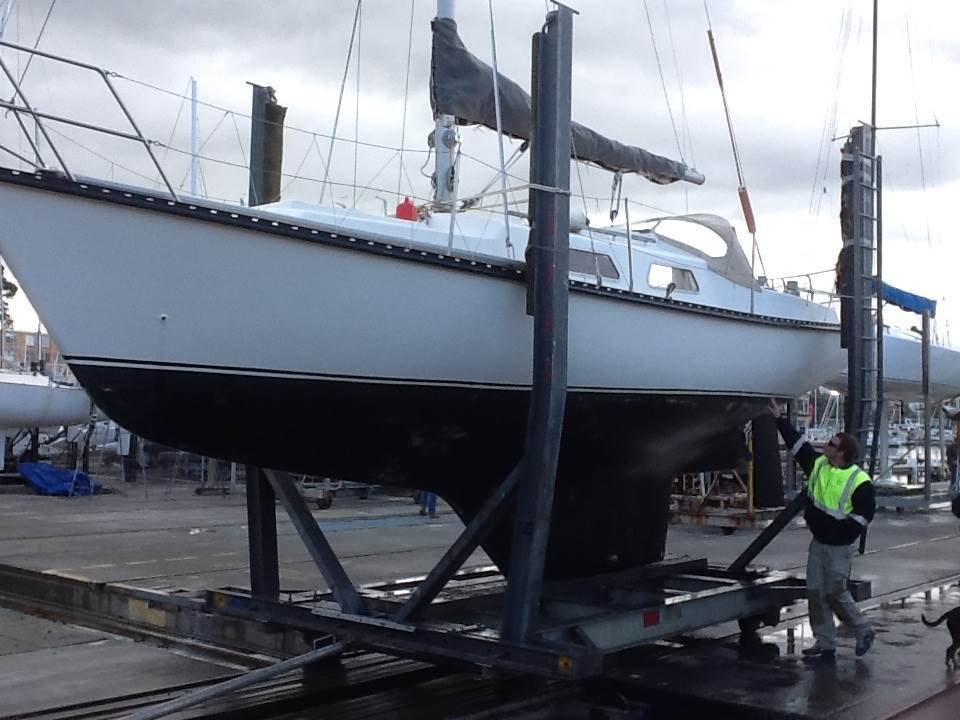
This is Morning Bird's keel taken pre soda blast and re epoxy of the bottom sides. It is bolted on with I think 7, or 9, bolts in offset pairs. It isn't falling off, in fact those that have removed them have had all sorts of trouble doing so. The keel
/hull join line is due to the 1/2" of antifoul put on by the previous owner who anitfouled every year with an 8" brush. Can hardly see it now.
By mentioning my name you have sucked me into this one Mikemeriki. 
I would just like to clear the air here as to me. Yes I have nearly 6,000 posts on this forum but many of them have been in the land sailing section which is where I joined about five years ago.
Check out land sailing, it is really exciting stuff. Imagine hooting along a beach at three to five times the speed of the wind, lying down, feet first and your bum just a couple of inches off the ground. Cheap thrills, especially for geriatrics like me and it is really SAFE.
Further, I am no legend, just old, though feeling less that way since I have been getting my weekly Chinese Massage. Damn, it is making me feel sexy and for a bloke who will be 64 in August, it is a good sign.
You must also understand I am a Navy trained MOBI. That stands for Most Objectionable Bastard Imaginable. Apart from my Navy sea time there will be guys half my age who have twice my sea time on yachts.
I am just powering up for as much sailing as I can get in before I walk the plank.
To your original question: Fin Keels.
I never have and probably never will own a yacht that is not a Fin Keeler and I am on my 7th yacht now. Why???
Fin keeled yachts are proven to the best windward performing hull design be the keel fixed, retractable or canting. End of story.
Re your concerns about fin keels falling off, that is whole different subject.
Forgetting about retractable and canting keels, lets just look at the three varieties of fin keels.
1. There is the encapsulated fin keel where the ballast is added to the inside after the hull is built. These keels do not fall off as long as the hull is built correctly.
2. The next type is the bolted on and faired in keel as exemplified in the S&S 34 with an hour glass hull form.
3. The directly bolted on keel with no fairing between the hull and keel which is the current format and probably the best for performance.
What it comes down to is the way in which the keel is attached to the hull, the scantlings in way of the keel attachment (strength of the hull) and the material used.
Assuming we are all sane people here, we know that the keel will be lead and the attachment of it will be using a dissimilar metal (think about electrolysis) because I have never seen lead bolts anywhere.
The two materials for attachment of lead keels to hulls are stainless steel or bronze. But it goes further than that. The mechanical method of attachment is of utmost importance.
If there is only a single row of bolts holding the keel on and they are stainless, be very wary. If they are alternately angled port and starboard as they were on my S&S 34, just make sure they are tight.
The best situation is sister bolting on the keel with bronze. That is what Second Wind has and I am smiling big time.
You can have the Bennys and Jennys with their fancy furniture and falling off keels. I am sticking with my Kiwi built Lotus 9.2 with bronze keel bolts.
Select to expand quoteMikemeriki said...
And moved around at anchor enough to make you dizzy.
39 ft big dinghy really.
So for ocean cruising, I prefer the longer keels with more wine glass sections. I have delivered a Laurent Giles designed 30 footer (modified Vertue design) and found the lovely motion in a decent seaway a revelation.
And I do like the Walkers (along with HGO2!) We seem to have become speed obsessed, and want windward performance above all else.
I expect to be shouted down here, but any thoughts?
My Currawong 30 has an encapsulated lead fin keel which in my opinion is the best compromise. The sections have to be wine glass so the engineering for a fin keel is easy compared to a full bolt on keel to a flat bottom hull. The result is a very seaworthy, comfortable motion but better windward performance than a long keeler.
The only downside is the fibreglass is a bit more vulnerable if your hitting a rocky bottom. Lead you will dent or gouge and is easy to repair. 'Glass you maybe lucky and only have to do some filling.
Full fin keels on flat bottoms will suffer from compression fractures to the hull immediately aft of the keel even after running aground on sand or mud. Encapsulated keels will never leak either nor have their keel bolts pulled on occasion.
The whole thing is a compromise and depends what your aim is. The difference in speed is not all that great, especially upwind. Though some well known local long keelers will not go to windward very well in fresh conditions. There are sites that show the different speeds of all the commercially available yachts so you can compare.
Select to expand quotecisco said...
By mentioning my name you have sucked me into this one Mikemeriki.
I would just like to clear the air here as to me. Yes I have nearly 6,000 posts on this forum but many of them have been in the land sailing section which is where I joined about five years ago.
Check out land sailing, it is really exciting stuff. Imagine hooting along a beach at three to five times the speed of the wind, lying down, feet first and your bum just a couple of inches off the ground. Cheap thrills, especially for geriatrics like me and it is really SAFE.
Further, I am no legend, just old, though feeling less that way since I have been getting my weekly Chinese Massage. Damn, it is making me feel sexy and for a bloke who will be 64 in August, it is a good sign.
You must also understand I am a Navy trained MOBI. That stands for Most Objectionable Bastard Imaginable. Apart from my Navy sea time there will be guys half my age who have twice my sea time on yachts.
I am just powering up for as much sailing as I can get in before I walk the plank.
To your original question: Fin Keels.
I never have and probably never will own a yacht that is not a Fin Keeler and I am on my 7th yacht now. Why???
Fin keeled yachts are proven to the best windward performing hull design be the keel fixed, retractable or canting. End of story.
Re your concerns about fin keels falling off, that is whole different subject.
Forgetting about retractable and canting keels, lets just look at the three varieties of fin keels.
1. There is the encapsulated fin keel where the ballast is added to the inside after the hull is built. These keels do not fall off as long as the hull is built correctly.
2. The next type is the bolted on and faired in keel as exemplified in the S&S 34 with an hour glass hull form.
3. The directly bolted on keel with no fairing between the hull and keel which is the current format and probably the best for performance.
What it comes down to is the way in which the keel is attached to the hull, the scantlings in way of the keel attachment (strength of the hull) and the material used.
Assuming we are all sane people here, we know that the keel will be lead and the attachment of it will be using a dissimilar metal (think about electrolysis) because I have never seen lead bolts anywhere.
The two materials for attachment of lead keels to hulls are stainless steel or bronze. But it goes further than that. The mechanical method of attachment is of utmost importance.
If there is only a single row of bolts holding the keel on and they are stainless, be very wary. If they are alternately angled port and starboard as they were on my S&S 34, just make sure they are tight.
The best situation is sister bolting on the keel with bronze. That is what Second Wind has and I am smiling big time.
You can have the Bennys and Jennys with their fancy furniture and falling off keels. I am sticking with my Kiwi built Lotus 9.2 with bronze keel bolts.
When has a Jeanueau keel fallen of CISCO? I have not read such report? Could you please confirm further reports?
its also my understanding that most lost keel reports confirm that the keel loss has been caused from hitting submerged objects rather than the keel boats with fancy furniture keels just falling off. I'm sure your little Lotus would tear her keel clean out if you hit the reef doing 7 knots under full sail.
tell me also CISCO can you take your hand of your #**k I mean tiller while sailing to windward? A full length keeler will sail nicely to windward with out any assistance but her only down fall is that she will tack slower than a fin and she does not like going backwards.
There was this one wavetrain.net/2010/12/24/charter-boat-loses-keel-and-no-one-noticed/ where it hit something, fell off and it took a while befoe anyone noticed
regards Don
Donk107 said... Nice one Donk
Ok that's one incident......and if you read into it the boat in question had hit Mother Earth on many occasions and apparently did a charter or two before anyone noticed the keel wasn't there! Also noted the keel boats sheared off and no breach to the hull......nothing to do with poor layups and flash furniture! It proves the layup is stronger than the keel bolts, that's outstanding!
Select to expand quotesouthace said...
Ok that's one incident......and if you read into it the boat in question had hit Mother Earth on many occasions and apparently did a charter or two before anyone noticed the keel wasn't there! Also noted the keel boats sheared off and no breach to the hull......nothing to do with poor layups and flash furniture! It proves the layup is stronger than the keel bolts, that's outstanding!
Hi all
just letting you know I don't mind Jenneau's
I crew on one in the local races and we do pretty well against some serious race boats
regards Don
Select to expand quotesouthace said...
When has a Jeanueau keel fallen of CISCO? I have not read such report? Could you please confirm further reports?
its also my understanding that most lost keel reports confirm that the keel loss has been caused from hitting submerged objects rather than the keel boats with fancy furniture keels just falling off. I'm sure your little Lotus would tear her keel clean out if you hit the reef doing 7 knots under full sail.
tell me also CISCO can you take your hand of your #**k I mean tiller while sailing to windward? A full length keeler will sail nicely to windward with out any assistance but her only down fall is that she will tack slower than a fin and she does not like going backwards.
The original owner of my Peterson 42 drove her onto a reef at 8 knots and she just bounced off. She had a bolt on keel and the hull was built immensely strong in alloy and to USL Code survey. The keel was sister bolted with stainless bolts. I doubt any sort of collision could tear the keel off that yacht.
With my Lotus, if she was driven hard enough onto a rock or reef I suspect it would rip the bottom out of the boat before the keel bolts let go.
I am not about to do the experiment to prove the point though but I think she would survive an encounter at 7 knots under full sail if only the keel hit the bottom. The rig would probably go or at least the top half of it. She has double lowers.
Re windward sailing ability and balance (taking my hand off my #**k, err tiller). It may be that she does not point as high as a full keeled yacht. It depends on which yacht we are comparing it to but most any well designed yacht should be able to self steer if the sails are correctly trimmed.
I haven't had the opportunity to sail her yet due to commitments and my priority task of getting her mooring laid. See my thread on that coming soon. Cheers.
Dont know if it has been posted before but this is a interesting video
on yacht testing
God now all I'm going to be thinking while sitting on my Jeanneua sipping a cold beverage is that I'm going to hear a crack and then a rip followed by a ttear as my keel slowelly rips from my hull with no doubt spoiling my night.....anyway on the good side at least I can sail home the following day without my keel attached! Hmmm must be that 4 Something meter beam that will keep her upright! Haha
Select to expand quotesouthace said...
God now all I'm going to be thinking while sitting on my Jeanneua sipping a cold beverage is that I'm going to hear a crack and then a rip followed by a ttear as my keel slowelly rips from my hull with no doubt spoiling my night.....anyway on the good side at least I can sail home the following day without my keel attached! Hmmm must be that 4 Something meter beam that will keep her upright! Haha
Not if its made in Germany! I'm considerably impressed by Donks video post on the Delher yacht. I wonder if they still make them like that?
Its horses for courses. My preference for a live aboard in Nth QLD etc would probably be a production type yacht. If I was heading into the Southern Tasman sea it would be something S&S or Joubert.
All yachts have benefits and limitations. Understand what you want from your boat and its limitations and be happy!
Have to agree with Southace on handling. My S&S will sail to windward for hours and hours without touching the tiller, if trimmed well. There is absolutely no steering in reverse or going backwards.
That Dehler handled the impacts very well.
I have just been going through a fin keel saga with my boat.
I bought the boat 12 months ago and whilst inspecting the hull with the seller I pointed out to him that there was a distinct keel/ hull joint smile that I was not happy about. I was assured by him that a trip to Bunning's for some silicone was all that was needed . The shipwrights said it was common to see a keel joint on yachts.
6 months later I removed the boat from the water for a closer look at the keel , I had no confidence to take the boat to sea with a niggling thought that the keel was loose, swinging underneath like "Hells Bells".. The boat was set down on the keel in a cradle and water started bleeding from the keel joint. I must point out that no water had been leaking into the bilge via the keel bolts. I put an 11/2" socket onto the bolts and once the nut was cracked off I was able to tighten the bolts a full turn and a half with no effort.
On the outside I stripped away silicone from the keel joint to assess the situation. I could see that in some places the bedding compound between the keel and hull had totally broken away.
I then decided to pull the keel bolts out so I shifted the motor out the way so I could access the bolts. When I say bolts,, well they are really studs with a nut at each end. I was able to access the nuts in the keel and pull the studs out in the bilge. The studs are 3/4 dia 316 stainless and there are 9 of them. All except one where in perfect condition. Some off the studs were wet and there was a strong styrene smell associated with them. 2 of the studs were wet with filthy black engine oil that must have penetrated the bolt hole some time ago in the past. Rather than just tighten the bolts back up I figured it would be best to drop the keel off so I built a frame around it to hold it upright and then lifted the boat off the keel with the slipway services travel lift. The travel lift didn't lift the whole weight of the boat before the keel let go from the bedding. For about 1/3 of the keel there was no cementing bond from the bedding there had also been engine oil in the joint at sometime.(the bedding was stained black and you could smell that dirty diesel oil )
I would say that the keel bedding was upset on this boat through striking a reef at sometime, there is a small strike mark on the very bottom of the keel that would suggest this, looks like nothing though.
I do believe that if you feel your not happy with something about the keel investigate it, don't just think yours will be ok because someone told you that there as never been a keel fall of your particular boat,,,, yours could always be the first.
To top off the saga I had the bottom soda blasted only to reveal thousands of gelcoat blisters. I have now shifted the boat home, It has been an expensive way to educate myself "How To Buy a Boat" , it would have been nice just to go sailing.
Wow Jolene, that sucks. I....being a slack ass would have taken the guys advice and some damage might have occured. Good on you. God knows what's going on in my encapsulated lead keel. I keep expecting it to drop out the bottom one day and the boat to fall on its side. Must slip that boat...it's been maybe seven years. Gulp!
Select to expand quoteJolene said...
I have just been going through a fin keel saga with my boat.
I bought the boat 12 months ago and whilst inspecting the hull with the seller I pointed out to him that there was a distinct keel/ hull joint smile that I was not happy about. I was assured by him that a trip to Bunning's for some silicone was all that was needed . The shipwrights said it was common to see a keel joint on yachts.
6 months later I removed the boat from the water for a closer look at the keel , I had no confidence to take the boat to sea with a niggling thought that the keel was loose, swinging underneath like "Hells Bells".. The boat was set down on the keel in a cradle and water started bleeding from the keel joint. I must point out that no water had been leaking into the bilge via the keel bolts. I put an 11/2" socket onto the bolts and once the nut was cracked off I was able to tighten the bolts a full turn and a half with no effort.
On the outside I stripped away silicone from the keel joint to assess the situation. I could see that in some places the bedding compound between the keel and hull had totally broken away.
I then decided to pull the keel bolts out so I shifted the motor out the way so I could access the bolts. When I say bolts,, well they are really studs with a nut at each end. I was able to access the nuts in the keel and pull the studs out in the bilge. The studs are 3/4 dia 316 stainless and there are 9 of them. All except one where in perfect condition. Some off the studs were wet and there was a strong styrene smell associated with them. 2 of the studs were wet with filthy black engine oil that must have penetrated the bolt hole some time ago in the past. Rather than just tighten the bolts back up I figured it would be best to drop the keel off so I built a frame around it to hold it upright and then lifted the boat off the keel with the slipway services travel lift. The travel lift didn't lift the whole weight of the boat before the keel let go from the bedding. For about 1/3 of the keel there was no cementing bond from the bedding there had also been engine oil in the joint at sometime.(the bedding was stained black and you could smell that dirty diesel oil )
I would say that the keel bedding was upset on this boat through striking a reef at sometime, there is a small strike mark on the very bottom of the keel that would suggest this, looks like nothing though.
I do believe that if you feel your not happy with something about the keel investigate it, don't just think yours will be ok because someone told you that there as never been a keel fall of your particular boat,,,, yours could always be the first.
To top off the saga I had the bottom soda blasted only to reveal thousands of gelcoat blisters. I have now shifted the boat home, It has been an expensive way to educate myself "How To Buy a Boat" , it would have been nice just to go sailing.
What sort of yacht?
Hopefully you mean Sikaflex and not silicon. The keel smile is normal on keel boats with this type of arrangement. Compression fractures to the hull aft of the trailing edge of the keel is more of a problem and an indication the vessel has hit the bottom at speed. Gouges in the lead are nothing to worry about. After the soda blasting was there a vinegar smell from all these blisters?
Just be careful your not finding faults where none really exist.
I thought the same as Ramona but don't know enough about keels to advise.
When I bought MB a few 'neighbours' said the keel was leaking into the boat, the cracking at the join was disastrous and the boat was a wreck. When I pulled the engine out to rebuild it I had the marina retension the keel nuts under the engine. They asked me why, it was a waste of my money. I said for peace of mind.
They retensioned the nuts and they were all correctly tensioned so it was waste of money if you ignore the peace of mind.
These boats aren't new and we tend to imagine problems where there isn't one, it just isn't as good as new. I do it pretty often because I pride myself on the boat being seaworthy and have to remind myself to be pragmatic, it needs to be seaworthy not new.
I recall an episode where a bloke had the yard inspect his keel bolts for all the same reasons, you know, the peace of mind thing. The yard did the requested work and replaced all the bolts with nice shiny new stainless steel ones, turns out they'd never seen monel bolts before and didn't like the look of them and threw them away, the cry of the boat owner could be heard several suburbs away.
I think that keels fit into that how long is a piece of string category. What's a keel smile?? An expansion that has cracked some paint or loose keel that deflects 5" under 20 deg heel. It is very hard to advise on. I know my digging found problems that did exist. In my case yes I do have an old boat but now I have the old bits back like new again, found a couple of problems that had been there since new so they will rectified and in my opinion it will then be better than new. Still having to do this work to a boat you have just bought can be a bit disheartening but you do gain ultimate peace of mind and a little more wisdom.