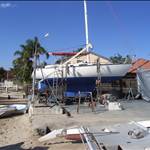
Took the new boat out on Sunday for the local offshore race. The first thing I realised was I really had no idea how to adjust the hydraulic backstay for maximum performance. My old boat had no backstay adjustment.
I thought I didn't have enough tension because the no 3 jib luff was didn't look tight enough but I was worried about putting too much tension on and breaking something.
So my questions are:
What indicators do you use on a masthead rig to know you have the right tension?
How do you know when you are getting close to too much tension?
What shouldn't I do when it comes to hydraulic backstays?
Sould I release the tension while the boat is berthed etc?
thanks for any advice
I get my rig retentioned each year and the rigger marks the hydraulic ram with tape at the maximum tension. I also have a pressure gauge on the hydraulics but I tend to use the mark.
We only use full tension while going to windward to try and stop forestay sage.
I always drop tension off when not required and when moored as I can see no reason to stress to boat unnecessary.
Some greater experts can correct me if Im off beam, this is my theroy from racing a lot at one time....
The sail itself where it slides in its track is not a straight edge but actually is cut so it bows out half way down the mast. You can see this is you lie it on the ground. If you pull on backstay tension it makes the mast bend in a way that matches that exact sail curve and the sail gets flattened. (The mast bows in its centre towards the bow like a gentle C shape). So do this when wind is strong but you want to keep main up. To get the most power out of the main you want a bit of depth so release the back stay. This applies for downwind too.
When no sail is up release the back stay so that mast doesnt get a permanent de-powering curve. ie. You want it to be able to straighten completely on demand if necessary.
Select to expand quoteandy59 said..
Took the new boat out on Sunday for the local offshore race. The first thing I realised was I really had no idea how to adjust the hydraulic backstay for maximum performance. My old boat had no backstay adjustment.
I thought I didn't have enough tension because the no 3 jib luff was didn't look tight enough but I was worried about putting too much tension on and breaking something.
So my questions are:
What indicators do you use on a masthead rig to know you have the right tension?
How do you know when you are getting close to too much tension?
What shouldn't I do when it comes to hydraulic backstays?
Sould I release the tension while the boat is berthed etc?
thanks for any advice
You're not really going to affect luff tension with backstay tension too much. Backstay tension is more about taking out luff sag. The only way backstay tension can affect luff tension is if it physically stretches the forestay, whereas normally it's more about taking out sag.
Indicators vary. In older wooden boats, max backstay sometimes occurred when the forestay stopped going straighter and the boat started getting bent. The rule was that if you can't see the forestay getting straighter as you increased tension then it was time to stop winding the backstay on.
In light winds, of course, you often want lower tension to increase luff sag because that puts more depth into the headsail. So you can get into a routine of winding on backstay as the wind increases to flatten the sail out, then easing tension off once more as you change down sails because you need to power up the new smaller sail. That is, if you've gone from the No 1 to a No 3 in a slowly building wind, you don't want to fully depower the No 3 because the move to a smaller sail has done the depowering, and you may need to be powering the No 3 up.
Hope this helps. Your manufacturer should probably be able to guide you, or a rigger. I'd release when the boat is berthed.
When I was a kid we had 3' hydraulic rams on the forestay as well, so you could pull the entire rig back and forth to control weather helm. THAT was complex!
Select to expand quoteJode5 said..
I get my rig retentioned each year and the rigger marks the hydraulic ram with tape at the maximum tension. I also have a pressure gauge on the hydraulics but I tend to use the mark.
That's a really good point Jode5. I just bought the boat I should have a rigger come and check/tune the rig. Its all rod rigging so its worth looking after.
I have a pressure gauge on the ram, but like you I didn't want to put any faith in it. Select to expand quoteTrek said..
The sail itself where it slides in its track is not a straight edge but actually is cut so it bows out half way down the mast. You can see this is you lie it on the ground. If you pull on backstay tension it makes the mast bend in a way that matches that exact sail curve and the sail gets flattened. (The mast bows in its centre towards the bow like a gentle C shape). So do this when wind is strong but you want to keep main up. To get the most power out of the main you want a bit of depth so release the back stay. This applies for downwind too.
When no sail is up release the back stay so that mast doesnt get a permanent de-powering curve. ie. You want it to be able to straighten completely on demand if necessary.
Thanks Trek, the other thing I have is an adjustable baby stay to pull the mast out to get that C shape.
All the above is pretty right. In summary (very simple here!)
Going upwind - backstay on
Stronger the wind, the more back stay tension you have (depower the main & straiten the jib luff)
Very important to know max backstay tension so you dont overload things, see above suggestions.
In softer airs only a little back stay, probably none in light air.
Reach & downwind - back stay off - You want sails full.
Definitely release all backstay tension when youre done!
Performance wise, you'll see when you have too much tension, the main will get creases running from the spreaders towards the clew.
ianshortsails.com.au/sail-trim/

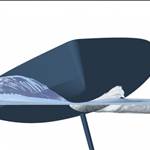
The other way to tell is when the rigging goes slack, like this


Thanks for all your replies I will definitely get a rigger to set the rig up and this weekend I'm going to have a play with the inner forestay/babystay and see what difference that makes.
I gotta say I love runners for the fine tuning, hate them for lazy days.
Sidenote and query; if you exaggerate the rake on a swept spreader rig it eventually ends up a backstayless design.
If you divide a circle by 3, you'll get 3 x 120 degree sectors, ie: triangulation.
My spreader rake is 117 (so not quite the perfect 120, dunno why), so no need for backstay/s to support the rig.
Some disadvantages I've found though.
The tension in the shrouds is pretty nuts, you need big chain-plates.
The mast will bend far enough when running sometimes that you can grab the forestay and flop it around. Ick.
Admittedly that might be running in 30+ with a full (wire-luffed) kite/staysail/main and the babystay torqued on hard, but it's an unnerving sight none the less.
The mainsail is hindered by the spreaders when running ddw. We don't spend much time sailing ddw anyway being an aso boat, so not much of an issue.

Dumb question number 632: Is there more load pulling forward on a mast from a symmetrical kite, or an assymetrical kite setup?
I'm trying to work out why the chain plates are so big, is it just because that's what you need for wire-luffed asymmetric spinnakers on bowsprits, or because of the lack of a backstay?
Methinks both, but that would mean an aso puts more load on the mast than a symmetrical kite, which I'm struggling to understand.
For that matter, I can't think of a no-backstay with a symmetrical kite boat, the backstayless cat's I can think of are all aso's . Does that say something obvious I'm missing?
Arrgh! All these questions!
SB
OD 35 was a backstayless symm boat. It was fairly big news for a while in the US in the late '90s, fitting between the Mumm 30 and Farr 40.
Backstayless dinghies of course ran syms for years, so there's probably not a huge issue. As you mention, swept spreaders can slow boats down when they are running dead square. Eons ago we used to race swept spreader JOG boats against boats with in-line spreaders who could ease the main out more, but to be honest I never saw it make a difference.
I'd have thought assys put more luff load on because the luff is straighter???????
Andy,
a good publication is on the SELDON site, worth looking at and advises stay tensions for both wire and rod. A cheap two foot rule and some tape will allow you to set up tensions yourself if you are a do it yourself type.
cheers Richard