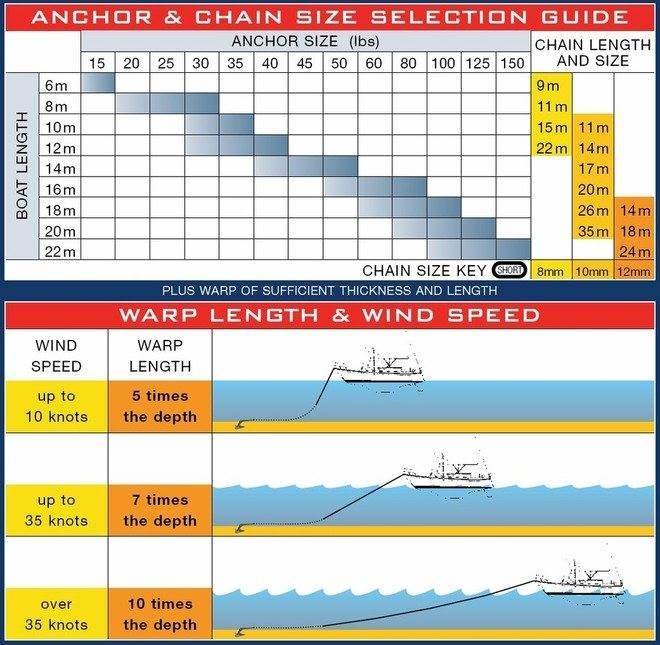
Looking for enlightenment as I'm sure I wouldn't be the first to go through this exercise. I normally put out anchor chain equivalent to about 5 times the depth (at high tide). I also run my motor in reverse when at anchor to top up the batteries when needed. If I'm in about 4m of water and have about 20m of 10mm chain out I will drag. If I'm in 10m of water and have 50m of water out I never drag while charging the batteries. My motor is only 30hp and I am only running it at about 1000rpm so I' don' believe I exerting a lot of extra force on the anchor. Well not more that it should be able to handle using the 5:1 formular for anchoring.
So it got me thinking (quite painful as some of you others are aware

) that if I was in shallow water like the pioneer bay at Airlie Beach (3-4m depth) and I was under the illusion that my safe anchoring practices of 5:1 would keep the second love of my life safe, then I'd probably be shortly ringing the insurance company if a strong N/E set in. So I did some calculations (with regard to wind force increase and required rode to obtain the same catenary sag in my 10mm chain) and came up with this. If my anchor rode, when set at 5:1, is the minimum requirement for 10 knts of breeze, then in 20 knts, I would need double the rode out, in 30 knts, I would need about 3 times as much and in 40 knts, I would need about 4 times the original rode calculation of 5:1.
Now I never did lots of calculations for different depths and I have anchored in over 30 knts and never dragged probably using about a ratio of 7:1 so I would say that my existing anchor set up at 5:1 has a higher wind rating then 10knts. But doing the calculations sure has he helped me get my head around the fact that 5:1 in a shallow anchorage means I'm more likely to drag than when using 5:1 in a deep anchorage.
Maybe this is why my mates in their cats who creep as close to the beach as they can and then deploy at 5:1, sometimes have problems with dragging.
Some facts. (If you start with an anchor rode length/setup that is only capable of holding the boat at 10 knts and not allowing for current or wave surge)
The extra wind force on the hull at 20 knts from 10 knts is 3.7 time more, but only requires twice the anchor rode to be let out
The extra force on the hull at 30 knts from 10 knts is 8.38 times more, but you only need 2.8 times the anchor rode let out
The extra wind force on the hull at 40 knts from 10 knts is 14.8 times more, but you only need about 3.8 times the anchor rode let out.
One thing is apparent is that the correlation between force applied to the anchor rode and the required rode length is not linear. The ratio reduces as the force increase and applying the 5:1 ratio works fine in deeper water but not necessarily accurate for shallow anchorages. Maybe each boat and it's associated anchoring equipment has a minimum rode length. I know I can get away with 20m when conditions are ideal and I'm not running the motor, but I wouldn't use the old 5:1 for shallow anchorages in $hit conditions.
It would be good if some one has done all this before or knows where this type of information can be found. For all I know, I could have it all wrong (again).


 .html]
  [/URL]