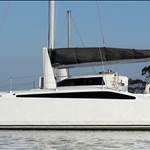
Here's 10 tips for cruising cat sailors that they don't usually teach you in sailing school:
1. Learn cat sense
2. Use your beam
3. Clean your hulls
4. Stay light
5. One engine is enough
6. Steer by sails alone
7. Park with engines alone
8. Three jacklines
9. Get a gennaker
10. Loosen up
Full write-up:
blog.arribasail.com/2014/11/ten-tips-for-catamaran-sailors.html
Alan,
Thanks for the AIS info on your blog. Very helpful. I have just ordered AIS650 and AIS100 from Arnold.
Regarding Tip #3
I have had my cat 6 months now. Green slime on hulls and rudders. I have my SCUBA gear on-board ready to start cleaning.
I know if I scrub excessively I will shorten the antifoul life so I will take care and use a soft sponge.
How many manual in water SCUBA cleans can I expect to be able to do before I need to re-paint the antifoul?
Seems to me I might do one clean at six months and re-paint annually
Or hopefully 2 x six monthly cleans and re-paint at 18 months.
Boat supplied with one coat blue and second coat black of Altex No 5 ablative antifoul.
Been in the water 6 months (In Sydney and Melbourne)
Select to expand quoteRob S said..
Alan,
Thanks for the AIS info on your blog. Very helpful. I have just ordered AIS650 and AIS100 from Arnold.
Regarding Tip #3
I have had my cat 6 months now. Green slime on hulls and rudders. I have my SCUBA gear on-board ready to start cleaning.
I know if I scrub excessively I will shorten the antifoul life so I will take care and use a soft sponge.
How many manual in water SCUBA cleans can I expect to be able to do before I need to re-paint the antifoul?
Seems to me I might do one clean at six months and re-paint annually
Or hopefully 2 x six monthly cleans and re-paint at 18 months.
Boat supplied with one coat blue and second coat black of Altex No 5 ablative antifoul.
Been in the water 6 months (In Sydney and Melbourne)
Hi Rob, nice to see another kiteboarding sailor - or is that sailing kiteboarder?
Anyway, here in SA where the water temperatures are cooler than up north, I manage to stretch out haul-outs and antifouling to every 2 years!
In between, for the first year after a fresh coat of antifoul, cleaning every six months with a softish scrubbie is about right. For the second year, slightly more frequent scrubs, say every few months, with a stiffer brush. Additionally, I go over the props pretty much every time I'm in the water, to keep them as smooth as possible.
Select to expand quoteRob S said..
Thanks Alan.
I'm very much the kiteboarder learning to sail.
I'm more the windsurfer/sailor learning to kite. Getting there though...
Frequency of scrubbing depends on what antifoul you have and water temp - My expierence, type of coating makes more of a difference to how long the coating lasts than what type of brush you use to scrub.
On our Seawind, I applied a harder antifoul suitable for planning power boats (can’t remember brand). In SE QLD, it lasts 4-6 months between scrubs, however in nth QLD I was scrubbing every 2-3weeks. The harder coating does allow growth to build up more than the soft stuff (doesn’t leach off), but with 2 coats it lasted 3 years with all that scrubbing and still looked good when lifted for a recoat. Use a stiff brush on a broom handle. Pull into the beach until the keels touch on the rising tide, drop anchor – walk around and scrub.
Oh – and I took up kiting long after sailing too. Both have their pros and cons….
I get around 8-10 months on our cat before it needs a scrub, using Jotun black ablative.
After one scrub though, it doesn't seem long though (another few weeks?) before the slimes back.
We are in Geelong, so reasonably cool water.
I'm doing the cleaning from a dingy with a soft bristle broom, and can normally get the slime off with gentle pressure and minimal scrubbing.
(ex windsurfer who found the SB windsurfing forum a few years ago and then realised there's a sailing forum as well...)
In the Swan River, once I scrapped the hull t was a monthly job. It didnt matter how new the antifoul was. Not sure what the brand was, but like harlie above, it was for planning powerboats. Apparently where I was was one of the two worst spots on the river for growth build up.
Cant make claim of ever kite -boarding, and only tried windsurfing a few times......
Select to expand quoteharlie said..
Pull into the beach until the keels touch on the rising tide, drop anchor – walk around and scrub.
Interesting info from everyone. The harlie technique sounds attractive. I would rather do it walking around than swimming if I can find the right beach.
My Seawind is on a swing mooring and it was a bit windy yesterday. It was more difficult than I expected diving (SCUBA) to clean the hulls. If I do it that way again I am going to have to find a way to hold my self into the side of the boat. And pick a calm day. Every time I gave it a wipe I pushed myself away from the hull. Dead easy and fast when I could hold a rudder or a keel. In a few places the entire black layer was removed showing the underlying first (blue) coat of antifoul.
cleaning the hull by swimming can have it's drawbacks.
Like getting the little shrimp/sea lice whatever they are that live in the growth down the front of your budgie smugglers.
not a good look.
Select to expand quoteRob S said..harlie said..
Pull into the beach until the keels touch on the rising tide, drop anchor – walk around and scrub.
Interesting info from everyone. The harlie technique sounds attractive. I would rather do it walking around than swimming if I can find the right beach.
My Seawind is on a swing mooring and it was a bit windy yesterday. It was more difficult than I expected diving (SCUBA) to clean the hulls. If I do it that way again I am going to have to find a way to hold my self into the side of the boat. And pick a calm day. Every time I gave it a wipe I pushed myself away from the hull. Dead easy and fast when I could hold a rudder or a keel. In a few places the entire black layer was removed showing the underlying first (blue) coat of antifoul.
I use these things when diving to scrub the hull - they stick on well enough to do the job. Available from a well known chain of chandlers. 
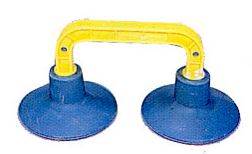
A couple of things to note - firstly they don't float, so get a couple or plan to tie them on to something for when the inevitable happens. Secondly, the rubber cups just screw on to the plastic handles and pop out easily, so I unscrew them and dab some epoxy in then retighten before use; that way you have a chance of the thing remaining as one piece.
Select to expand quotecrustysailor said..
cleaning the hull by swimming can have it's drawbacks.
Like getting the little shrimp/sea lice whatever they are that live in the growth down the front of your budgie smugglers.
not a good look.Select to expand quoteRob S said..harlie said..
Pull into the beach until the keels touch on the rising tide, drop anchor – walk around and scrub.
Interesting info from everyone. The harlie technique sounds attractive. I would rather do it walking around than swimming if I can find the right beach.
My Seawind is on a swing mooring and it was a bit windy yesterday. It was more difficult than I expected diving (SCUBA) to clean the hulls. If I do it that way again I am going to have to find a way to hold my self into the side of the boat. And pick a calm day. Every time I gave it a wipe I pushed myself away from the hull. Dead easy and fast when I could hold a rudder or a keel. In a few places the entire black layer was removed showing the underlying first (blue) coat of antifoul.
I drape a line in the water from hull to stern that I can hold onto. Also, I recommend using more lead weights than you usually dive with.
Well I am a catamaran sailor also, though point 5 has me bemused, where does the engine go?
boat looks a lot like this...
read the blurb
"Cats typically have fully battened mainsails with lots of roach, which lowers the Center of Effort (CoE) and reduces heeling"
huh?? raises
i've tried the scrubbing thing and not a fan, only for those with hard af
my tip is do the anti fouling yourself, i do one thick coat and don't roll back over it, and mix it often with a power mixer, also park near a storm water drain whenever possible
me cat and kite too
Select to expand quoteJedibrad said..
...also park near a storm water drain whenever possible
Agreed - people in the bay I'm in guard their mooring spots near stormwater drains, it's the best place to be.
For those still confused - the fresher water near the drains and creeks slows down the fouling process. Or seems to, anyway. 
Then I apologise to Jedibrad. The single, long statement implied that wet chemicals were being applied when out of the water - above a stormwater inlet.
haha, sorry my fault, i didn't explain it properly
sydchris is spot on, the freshwater run off kills off the foul
Select to expand quoteJedibrad said..
haha, sorry my fault, i didn't explain it properly
sydchris is spot on, the freshwater run off kills off the foul
In the city it might. Country area estuaries and rivers the run off contains all sorts of nutrients and the effect maybe the opposite. In my experience it is the area with the strongest current flow that has the greatest problem with shell growth. More feed for the critters flowing past them.
Just a bit of a thread wander here. Have not heard much about ultrasonic doodads for awhile. Apparently the latest PBO magazine does a test on them. It seems they were not impressed. Read the thread here. forums.ybw.com/index.php?threads/reports-suggest-seems-to-make-a-difference-antifouling-article.415715/
Select to expand quoteRob S said..harlie said..
Pull into the beach until the keels touch on the rising tide, drop anchor – walk around and scrub.
Interesting info from everyone. The harlie technique sounds attractive. I would rather do it walking around than swimming if I can find the right beach.
My Seawind is on a swing mooring and it was a bit windy yesterday. It was more difficult than I expected diving (SCUBA) to clean the hulls. If I do it that way again I am going to have to find a way to hold my self into the side of the boat. And pick a calm day. Every time I gave it a wipe I pushed myself away from the hull. Dead easy and fast when I could hold a rudder or a keel. In a few places the entire black layer was removed showing the underlying first (blue) coat of antifoul.
Get one of those suction handles that glaziers use to handle glass. Then you can attach it to the hull and use it to keep you steady - move and repeat. Although I would add that the divers I see on the boats in Rushcutters bay don't have handholds but you do need to be wearing fins to give some pressure.
I will drape a line and also buy a double suction cup handle from Whitworths next time she is due for a wipe.
I just had a light bulb moment.
Tell me if this will work adequately well or not. Run a big fat rope from one side of the boat to the other, fastened to the toe rail and every eighteen inches have a big chunky knot tied in the rope that where it contacts the hull it leaves a hand hold gap that won't pinch your fingers. You would be able to hang on as you work your way from port to stbd. reaching in both directions away from the rope. Then just reposition the rope and start again.
Select to expand quoteJedibrad said..
read the blurb
"Cats typically have fully battened mainsails with lots of roach, which lowers the Center of Effort (CoE) and reduces heeling"
huh?? raises
Sorry, I just noticed this comment about CoE and I realize I was unclear.
So for a given sail height, then yes, the roachy sail has the higher CoE since there is more sail area higher than a less roachy sail with the same height. But for a given sail area, i.e., if the sail area is the same, then the roachy (short & fat) sail has the lower CoE.
For example, the following rectangles all have the same area (4), and you can see that the CoE gets progressively higher as the rectangle gets taller