Hi, another long time reader, first time poster. No doubt a common scenario in one's development, some days i go upwind no problem, other days it feels like i'm all over the shop. Someone on the beach suggested thinking about pointing the rear foot slightly backwards to help with the edge control on a TT (along with the usual recommendations about looking, turning hips, weight predominantly on rear leg etc). I interpret this as keeping the toes pointing outwards in either direction of travel - i haven't had a chance to try on the water but i think i tend to point both sets of toes in the direction of travel. I looked through the various forums and only found reference to this once. Just curious as to other peoples thoughts please?
Hi TBB and welcome to Seabreeze,
Edge control for me is more about weight distribution and body position more so than the position of your feet. How you position ur feet is more about comfort.
The twin tip is ur rudder........
Laying back further (heelside), creating more of a knife edge effect, putting more weight on ur back leg and turning ur head and body towards the wind will give u the upwind ability u are looking for. I also find that having my straps a bit looser than normal allows more freedom to make myself comfortable when edging hard. Even learning to fly the kite with one hand helps u turn your body more towards the wind.
From what u have described, it sounds like u have got it dialled. Don't over think it, just keep practicing what u already know.
Cheers
Select to expand quoteTBB said..
Hi, another long time reader, first time poster. No doubt a common scenario in one's development, some days i go upwind no problem, other days it feels like i'm all over the shop. Someone on the beach suggested thinking about pointing the rear foot slightly backwards to help with the edge control on a TT (along with the usual recommendations about looking, turning hips, weight predominantly on rear leg etc). I interpret this as keeping the toes pointing outwards in either direction of travel - i haven't had a chance to try on the water but i think i tend to point both sets of toes in the direction of travel. I looked through the various forums and only found reference to this once. Just curious as to other peoples thoughts please?
TBB
this is a very common thing with students etc they all seem to have this crazy notion that they can do things better one way then they can the other. one thing that is often overlooked is very important and has nothing to do with your ducking or body position.
due to having low hours on the water its tuff to see straight away but as im hoping you were taught in your lessons / wind and water going in same direction reduces your speed and wind and water going in opposing directions increases your speed. its very obvious in a river and when tides at its peak (well leading upto and away from) but often what is overlooked is just how this works when you are kiting along back and forth bwhen the wind is at an angle to the current/tide
this angle of lets say 30 degrees means you will be sailing more powered on one tack or direction then 30 degrees less powered on the other direction.
so when the wind is straight onshore an tide is straight onshore you wont notice as much of a difference its when the wind is crosses and tides straight on or the swell or current is crossed and wind is straight on
hard to explain without markers but hope you understand
good news is your probably not as **** at going one side as you think you are the invisible conditions are probably just a bit more askew :D
Select to expand quoteTBB said..
Someone on the beach suggested thinking about pointing the rear foot slightly backwards to help with the edge control on a TT (along with the usual recommendations about looking, turning hips, weight predominantly on rear leg etc). I interpret this as keeping the toes pointing outwards in either direction of travel - i haven't had a chance to try on the water but i think i tend to point both sets of toes in the direction of travel.
Usually you set your bindings in a toe-out stance to help with comfort on your front foot. When you straighten out your front leg and lean back over your back leg, it's easier to point your front foot toward the direction of travel. You don't have to but it makes the stance easier to hold. Going both ways makes toe-out on both feet the most common setup.
That said, if you are pointing your back foot toward the direction of travel you may be shortchanging the torque applied when twisting your hips forward.
Here's an experiment. Stand up and hold a wide, toe-out stance like you would on a twin tip. Now try to rotate your hips left while leaving your feet in the same position (aim for 45 degrees but stop when it starts getting uncomfortable). What you should notice is that both feet want to rotate left as well, but the right foot is more uncomfortable due to the toe-out stance. You can check this by keeping your hips and left foot in the same position, but pivot on your right heel to point your toes over to the left. There should be an immediate drop in turning pressure on your right foot and most likely throughout your whole body. The problem is we WANT turning pressure (torque).
Consider a twintip running along flat on the water pointing in the direction of travel. If you rotate the board to the left, the fins will engage providing resistance to the original direction and make it easier for the board to now follow the new direction the board is pointing. When attempting to head upwind, you can engage the fins in this way by applying a rotation on the board to make it easier for the board to convert as much forward momentum into upwind direction. You can overdo it of course; rotating the board too far will give less edge to cut into the water, greater resistance to the change in direction and more skatey control. You're effectively putting the board into a power slide.
Due to board and fin configurations giving different effects the end result is more of a feel thing, but rotating up to 15 degrees from the direction of travel can still provide a more efficient upwind direction.
Thanks for your feedback guys much appreciated. Was hoping to put into action this evening but common sense prevailed - everyone was out on kites at least 2 sizes smaller than my smallest kite. Will have to resort to thinking about expanding the quiver instead.
Step 1/ buy dynabar V8 with rope slider
Step 2/ rear foot always 90° to board direction
Step 3/dont look back.
Holding the rearfoot at 45° pointing outwards rather than 90° to the board just helps you putting more weight on the rear of the board while at the same time lifting the front of the board out of the water. If you combine that with having the kite high in the air to reduce your body weight and keeping your back and legs perpendicular to the board for maximum efficiency you can suddenly go upwind with very little wind.
If you live in a wavy area this is almost useless because in this stance you become very prone to being knocked over by kickers....
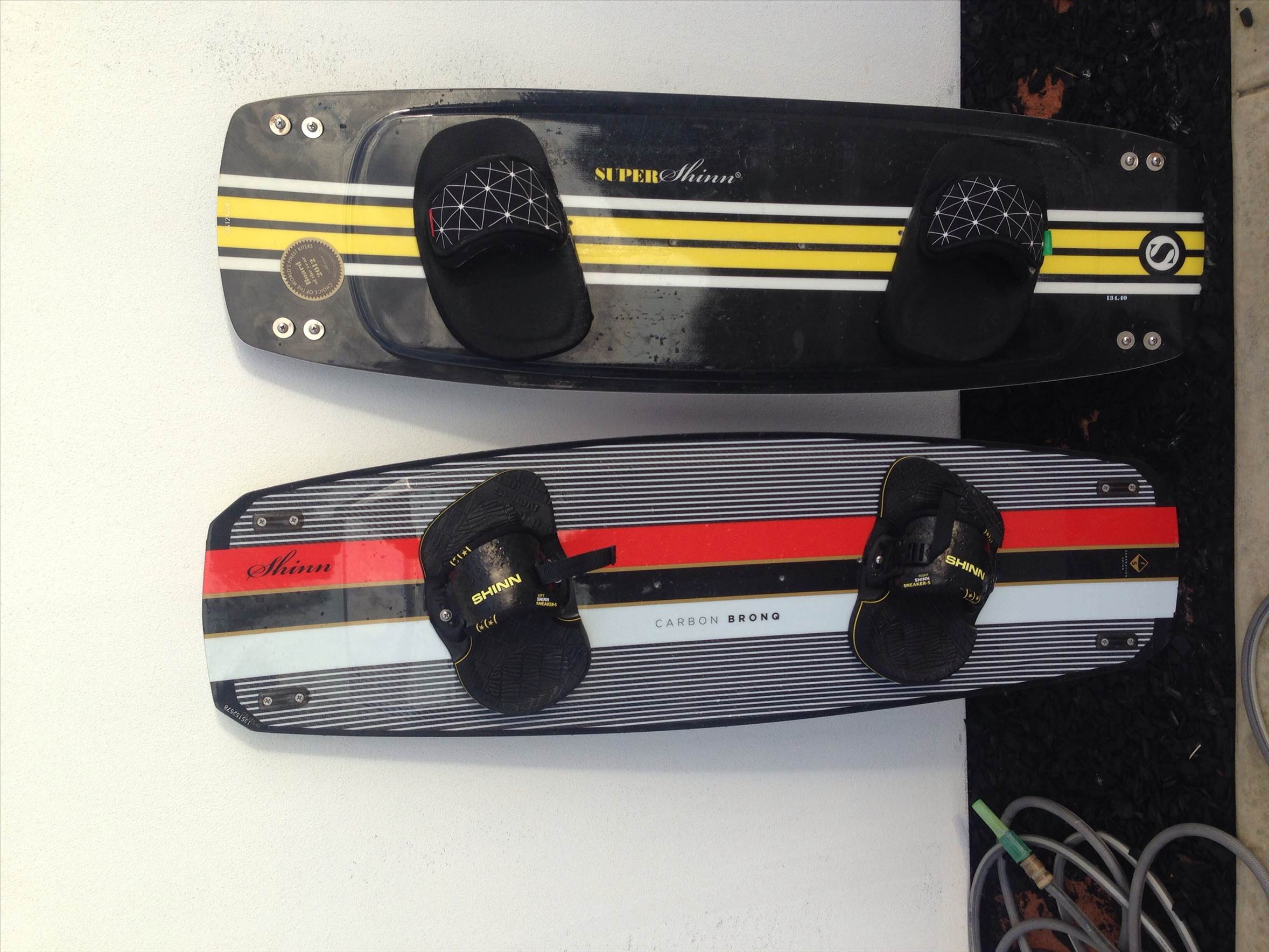
Here's my stance, personally there's no way I'd get upwind with a more closed stance,
However there is a fair bit of technique , some guys naturally get upwind better than others no matter what you do with foot positions,
Certain kites ,boards also hip, body, harness positions all contribute