People tease my kid and its not fair
Poor young fella has red hair and he cops a bit
Sometimes even from the missus and me.
But you know what ,the kids got red hair
God forbid he becomes a afl footy star and someone dresses up as him
If they but on a red wig to look like him ,its racism thru his Scottish heritage
REALLY
Grow up call a spade a spade . Nic nat ,I hope you get traded to the dockers
AS I have told him Your a ranger and your going to cop a bit .
least your not a pom
There is every chance he could live a normal life, if only
- schools would introduce an anti Ranga hate lesson
- we could make an acronym like Non Majority Hair Coloured Person. NMHCP encompasses not just rangas but also those with the funny light grey / ashy colour or those with strawberry blonde that is not one or the other. Don't pigeonhole, call them all NMHCP's
- the Government would just put a question on the census about hair colour
Let them thrive you bigots.
I've plenty of ranga's in my extended family, thanks to it being a dominant gene...
Couldn't wish it to be otherwise, as they're all awesome people.
I've often thought about buying some "Ranga Pride" T shirts, just to express my thoughts publicly, although none of them feel the least bit of shame or embarrassment for being who they are.
I've too many good ranga friends to think otherwise.
Select to expand quoteCrusoe said..
Why are some red heads nicknamed 'Blue'?
Because most would prefer a fight than a good feed. 'had a blue with me mate' slang for a dust up, and red-haired are renowned for short fuses. 
I have friends who have red hair and I pretty much treat them like a real person
So I am so much a better person than you racists bigots
A couple down the road have 3 boys around 5 to 9 years old. All 3 are fire engines. The couple aren't rangas.
When the 3rd was born you'd be feeling cursed.
No redheads in my family, but all of my siblings and I who have partners have redhead partners.
When these alleles persist in a population you'd be fair to say that the human species does not have strong enough selection pressures acting against it in order to improve the fitness of the species by Darwinian evolution.
But ranga alleles are right down the list when you consider some of the deleterious mutations that have been kept in circulation thanks to equal opportunity, human rights, globalization etc etc
With the looming global population crisis I think the s*** will hit the fan and the honeymoon period will end when it's every man for himself
Eat the weak
Rant over
Select to expand quotemineral1 said..Crusoe said..
Why are some red heads nicknamed 'Blue'?
Because most would prefer a fight than a good feed. 'had a blue with me mate' slang for a dust up, and red-haired are renowned for short fuses.
Yeah, probably only got a short fuses cause everyone picks on them  . I had to go to school to learn racism. Never learnt it at home. The first kiwi I met was a nice guy and helped me out of a jam when all the other f$&kwits where I was working wouldn't. I could never work out why some people put **** on them. As for the word "Ranga", never heard it before reading it on this forum and it will never be used by me. I'm of Scotish/English decent and most of my cousins have fair skin/with different shade of red hair, but me, the mother in-law though I was aboriginal when she first laid eye on me. Welcome to the family.
Select to expand quoteChris_M said..
When these alleles persist in a population you'd be fair to say that the human species does not have strong enough selection pressures acting against it in order to improve the fitness of the species by Darwinian evolution.
But ranga alleles are right down the list when you consider some of the deleterious mutations that have been kept in circulation thanks to equal opportunity, human rights, globalization etc etc
With the looming global population crisis I think the s*** will hit the fan and the honeymoon period will end when it's every man for himself
Eat the weak
Rant over
Your understanding of genetics is probably a bit flawed. If its a recessive gene, how would you select it for removal? After all, if you and everyone you knew had a recessive gene that created purple eyes, how would you know it?
As can be shown throughout history there are times when a random mutation has lead to a gene that can survive some event or attack, yet two copies of the same gene are fatal or less effective. Indeed, if the population were more homogenous, a single attack might take out everyone, but luckily for us, there are enough variations that there is probably someone that would survive. For things like small-pox, who would survive if we all had the same limited pool of genes?
You would have to wonder why red-head genes are not only existent, but pretty common in cold areas. Is it because they have a better survivability in cold areas? Is it because of some random effect that makes them thrive in an area where 'other skinned' people can't? Or did the dark skin people just admire the fair skin and blue eyes and get in for a bit of baby making? Or is it just random?
Bring on a nuclear winter and see who survives?
Anyway, as you said there are plenty of genes that you wonder why they exist.
Looming global population crisis? Please tell me what you have heard, because my understanding is that the number of people being born is going down, not up. Believe it or not.
Formula, I probably have a better grasp on the concepts of Biology than your average keyboard warrior don't you worry about that.
A few flaws in your reply actually.
A) It's not exclusively us that does the selection for removal, but the environment. By the "environment" I mean any selective pressure eg competitors, predators, abiotic factors.
Recessive alleles that provide a disadvantage are slowly weeded out by either 1): Inheritors of homozygous copies of that allele not surviving long enough/ not being successfull enough at mating to pass on many copies of that allele to offspring. Yes, some do, but really should only be fancy rangas like Ed Sheeran, or Prince Harry. You know, guys with money and, going against all feminine urges, some kind of inexplicable pu$$y magnet that other rangas don't have (therefore do not get to pass on there genes to the next generation = loss of ranga alleles in gene pool).
Or 2: Fatal if inherited in a recessive pairing, which ranga is not, but definitely is a more at risk phenotype due to the propensity of short fuse brawling and other risky behaviours/ lack of tolerance to anything containing red food colouring, which puts them at risk of running infront of a bus/ out of a building/ off a cliff etc when exposed to red jelly beans/ raspberry soda/ fanta/ ribena etc.
Both of the above scenarios likely to reduce the % frequency of alleles over time.
My hypothesis is that these alleles do not display complete dominance, but rather, co dominance, which would explain the common phenotype "mousey freckler" or "ginger balls" on an otherwise brown haired individual.
B) The evolutionary advantage to fair skin is for greater Vitamin A absorption from the sun in cooler, shorter day latitudes such as Norther Europe.
Second point, there is no arguement that human population is growing at a rate that is unsustainable. Even if people in developed nations are having fewer babies than 40 years ago, that still leads to population growth. Especially as people live longer thanks to modern medicine, increased quality of life etc.
Heres a couple of graphs to consider. Link provided.
The second is of a typical population growth curve of a K selected species. Onces it gets to carrying capacity (K) the "wavy bit" at the top of the graph, that's when competition is so high that basically we are all at war with one another trying desperately to survive thanks to intraspecific competition.
Happy days :)

phys.org/news/2010-06-humans-extinct-years-eminent-scientist.html

ChrisM I think your "looming global population crisis" is a bit over stated. I guess time will tell, but I think the reality is that populations in developed countries will fall due to increased living standards. Populations in developing countries can either stay the same or fall as well due to better health. There was a very interesting documentary on this done by some statistician. Like you, most of the audience thought the population was still increasing.
I am too lazy to search for any data to back me up, but people do not keep breeding just for the sake of it. Its good to have kids, but if they are going to be a drain on you and don't contribute to your own well-being, why would you have more than you need?
I think the argument is that we now have the biggest population that we will ever have and that it is reversing, but the easy thing to think is that its still growing. Saying it is a non-argument does not make it so.
What's your stand on impulsive risky behaviour versus passive safe behaviour in a group? I think you probably agree that both types of personality are required for long term survival of a group. Too 'safe' is not good, and too risky is not good.
Your comment on red food colouring is strange, and sort of offsets your knowledge on genetics. I had a friend's mother that thought her daughter (with brown hair even!) would react to anything with red colour in it. Is that science nowdays? She also believed in star signs, and other voodoo stuff, so maybe she was right.
Your graphic on a K selected species seems to miss out on the influence of flat-screen TVs, obesity, new cars, and reality TV. We are not at war with one-another, we are just too lazy and/or selfish to breed. It is the modern way.
Currently we have 7.4 billion people
The develop world has pretty much stopped growing.
The developed world is still going gang busters, Africa alone will quadruple its population in the next 100 years.
It is estimated by the UN that the population will reach about 11 or 12 billion in the next 100 years.
Is that its peak or will it keep rising is still a guess at this stage. I think about 11.5 is about the peak because Thomas Malthus will finally be proven correct, just 10billion people off.
Anyway, the global population has not stopped growing, although the rate of increase has been slowing down a little in the last few decades.
An great question in population debates is what is the human carrying capacity of the planet? There is no correct answer but interesting rationales
Select to expand quoteChris_M said..
Formula, I probably have a better grasp on the concepts of Biology than your average keyboard warrior don't you worry about that.
A few flaws in your reply actually.
B) The evolutionary advantage to fair skin is for greater Vitamin A absorption from the sun in cooler, shorter day latitudes such as Norther Europe.
Nah. You get vitamin A from eating carrots, not resembling them.
Cholecalciferol is the one that you get from time at the beach.
Oops,
Amendment:
Everythings rosy
Gingas not sensitive to red food colouring
World population actually shrinking
Global warming not real
Earth is only 5000 years old just like Jeebus said
Select to expand quoteChris_M said..
Oops,
Amendment:
Everythings rosy
Gingas not sensitive to red food colouring
World population actually shrinking
Global warming not real
Earth is only 5000 years old just like Jeebus said
I thought that was the case. I knew your words were just them book learnin words and you really didn't understand.
You forgot 'NZ is not a state of Australia' 
Select to expand quoteFormulaNova said..Chris_M said..
Oops,
Amendment:
Everythings rosy
Gingas not sensitive to red food colouring
World population actually shrinking
Global warming not real
Earth is only 5000 years old just like Jeebus said
I thought that was the case. I knew your words were just them book learnin words and you really didn't understand.
You forgot 'NZ is not a state of Australia'
And Australia founded by well meaning whitey holiday makers who want to go and experience new and diverse cultures
Select to expand quotebigtom said..
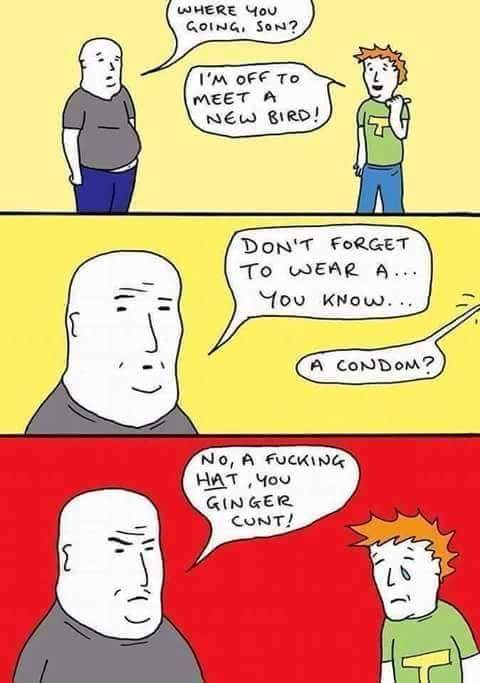
People tease my kid and its not fair
Poor young fella has red hair and he cops a bit
Sometimes even from the missus and me.
But you know what ,the kids got red hair
that reminded me of this.
Select to expand quoteChris_M said..
The second is of a typical population growth curve of a K selected species. Onces it gets to carrying capacity (K) the "wavy bit" at the top of the graph, that's when competition is so high that basically we are all at war with one another trying desperately to survive thanks to intraspecific competition.
Oh, you mean Sydney?
3 options
1.- Suck it up, go with whatever the world throws
2.- Toughen the f**k, and take on any bastard that opens his mouth
3.- Disguise... hair dye is cheap
I have a pseudonym because i have a red beard and have
to shave twice a day. (The shame)
I have also been known to ride a Mctavish, sit down to pee and and whine at the guy that nearly ran over me as i GOT IN HIS WAY.